
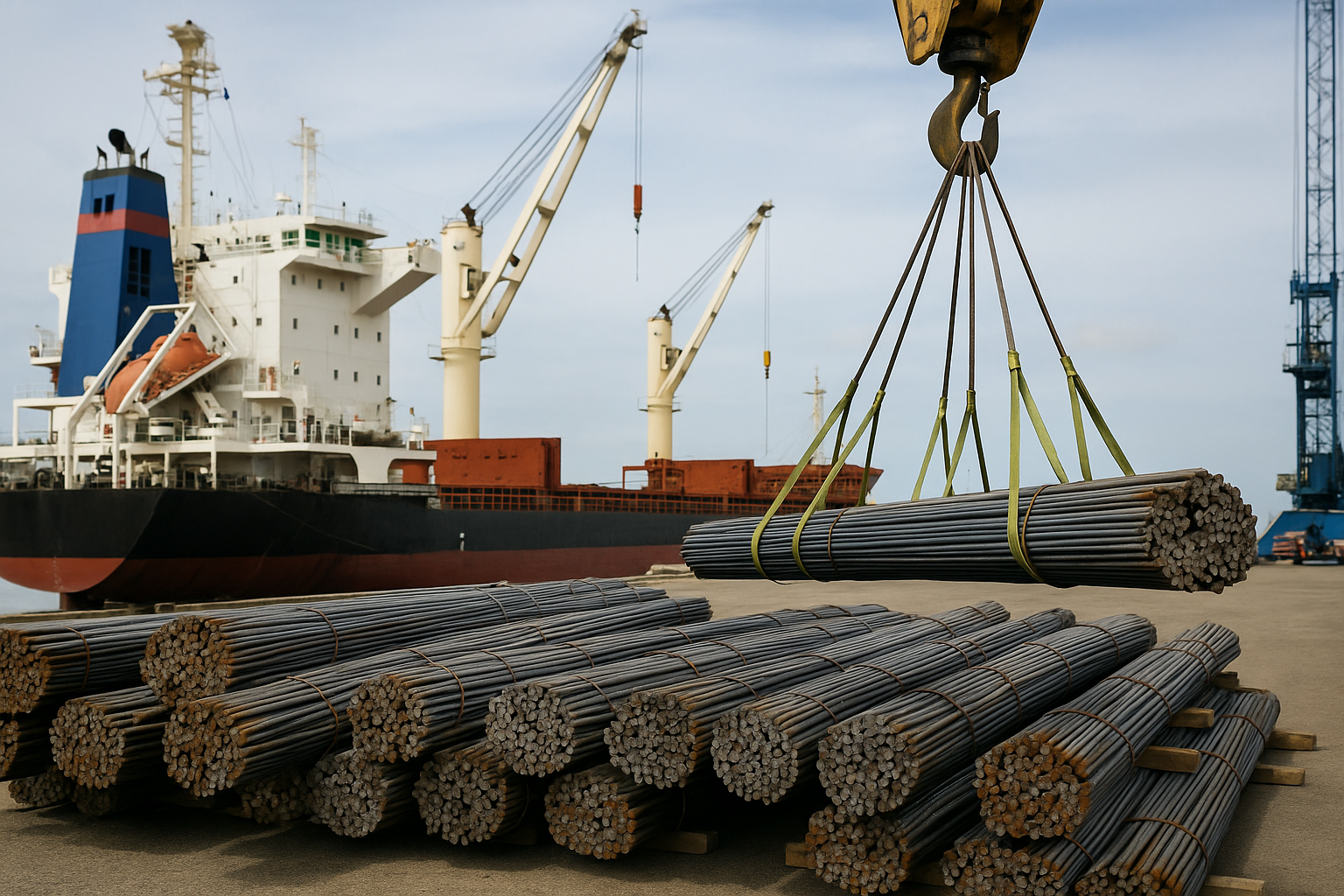
The main challenges in exporting steel to emerging markets are confirming buyer credit, meeting product and import requirements, obtaining payment, coordinating heavy-cargo logistics, and controlling the costs of delays or disputes.
These risks should be assessed for the actual country, buyer, product, and transaction. “Emerging market” is a broad economic description, not a finding that every port is unreliable, every buyer is risky, or every technical standard is outdated.
For steel exporters, a promising quotation becomes a viable order only when the commercial, technical, financial, and logistical conditions can be executed together. This guide focuses on that transition, from buyer qualification to shipment release and claims management.
1. Assess the Transaction Rather Than the Regional Label
A country with strong construction demand may still be unsuitable for a particular export order. The buyer may lack the financing, import authorization, storage, or technical approvals needed to complete it.
Conversely, a qualified buyer with established banking arrangements and reliable handling facilities may support a workable transaction in a market that otherwise appears difficult.
Build the assessment around the product, buyer, production source, destination, transit route, and payment arrangement. Record assumptions and their evidence before accepting a firm order.
Do not infer rapid growth or limited competition from the market label. Establish whether the proposed steel meets a specific demand and whether the expected margin survives the transaction’s actual costs.
2. Identify the Buyer and the Importing Party
The company negotiating the order may differ from the importer, payer, consignee, or end user. Resolve those roles before issuing final contractual documents.
Recommended checks include legal identity, registration, authorized signatories, trading history, financial information, and relevant ownership information. Confirm who can import the product and who will perform clearance.
Use independent verification where possible. A website, business card, or introduction from an intermediary is not sufficient proof of creditworthiness or import capability.
Review applicable sanctions, export restrictions, and other transaction controls for the parties, destination, end use, and transit arrangements. The necessary checks depend on jurisdiction and product; they should not be reduced to a country-name filter.
For the broader qualification method, see How to Choose a Reliable Overseas Steel Supplier: A Practical Guide for Importers. Exporters can adapt the same emphasis on evidence, approved sources, and change control to their buyer assessment.
3. Approve the Technical Specification Before Production
“Structural steel,” “galvanized coil,” and “industrial sheet” are not complete specifications. Define the standard and edition, grade, dimensions, tolerances, delivery condition, surface or coating requirements, and required tests.
Identify the intended application and any requirements imposed by the end customer or project. Different national specifications can be valid without being interchangeable.
JIS or GOST designations should not be dismissed as outdated merely because of their origin. BIS is an organization, while individual Indian Standards identify particular requirements. Verify the actual document and applicable certification arrangements.
If the buyer requests an alternative grade, compare the relevant requirements and obtain written technical acceptance. Similar chemical composition or nominal strength does not establish complete equivalence.
For distinctions between the products commonly offered, see What Are the Most Commonly Traded Steel Products Globally?.
4. Separate Standards From Mandatory Market Requirements
A material may meet a recognized product standard but still require destination-specific approval, testing, labeling, registration, or conformity assessment.
The WTO Agreement on Technical Barriers to Trade distinguishes standards, technical regulations, and conformity assessment. Buyers and exporters should make the same distinction when reviewing a transaction.
Create a dated requirements register for the exact product. Record the source, responsible party, evidence required, approval stage, and any expiry date.
Ask the importer and competent local specialists to confirm what must be completed before manufacture, shipment, or clearance. Treat their confirmation as evidence to review, not a substitute for checking the governing requirement.
An inspection certificate or sample approval does not automatically establish authorization to import a commercial shipment.
5. Confirm Classification and Import-Cost Assumptions
Define the product description and proposed classification using its actual characteristics. International tariff classifications share a framework, but national subdivisions and measures can differ.
Confirm ordinary duties, applicable trade-remedy measures, taxes, licenses, quotas, and origin requirements before fixing the commercial assumptions. Product scope, origin, producer, and shipment timing may affect the result.
Do not promise preferential treatment solely because a trade agreement exists. Qualification and documentary requirements must be satisfied for the actual product.
Keep a distinction between customs origin, shipment country, seller location, and manufacturing site. A change in routing or invoicing does not by itself change origin.
Where a charge remains uncertain, show it as an unresolved assumption rather than burying it in a fixed delivered price.
6. Select Payment Terms Before Committing Production
Payment method determines when the exporter receives funds and what exposure remains. Agree it before producing customer-specific grades, dimensions, or coatings.
| Method | Practical consideration | Exposure to review |
|---|---|---|
| Advance payment | Confirm cleared funds and the agreed production obligations | Refund obligations, amendments, and buyer acceptance |
| Letter of credit | Review issuing bank, wording, documents, dates, and any confirmation | Document discrepancies, bank exposure, and country or transfer risk |
| Documentary collection | Banks facilitate document release under collection instructions | No bank payment undertaking equivalent to a credit |
| Open account | Goods are supplied before the agreed payment date | Buyer default and the effectiveness of any credit protection |
This is a decision framework, not a ranking that makes one method suitable for every order. The exporter, buyer, and banks must agree an arrangement that is both acceptable and executable.
7. Review the Letter of Credit as an Operational Document
A letter of credit creates a bank undertaking subject to its terms and applicable rules. It does not remove every risk in a steel transaction.
Before shipment, review bank acceptability, amount and quantity tolerances, latest shipment date, expiry, presentation requirements, transport documents, inspection documents, and any restrictions on partial shipments or transshipment.
A requirement for a document that the exporter cannot obtain can make an apparently secure payment method unworkable. Resolve problematic wording through the agreed banking process before dispatch.
International Trade Administration guidance on letters of credit emphasizes bank assessment and documentary discrepancies. Discuss the need and feasibility of confirmation with the bank; it should not be assumed merely because a credit has been advised.
8. Understand Collections and Credit Insurance Limits
With a documentary collection, banks handle documents under instructions but do not provide the payment guarantee associated with a letter of credit. The International Trade Administration explanation makes this distinction explicit.
Documents against payment and documents against acceptance create different release conditions. Acceptance of a draft payable later is not the same as receiving the money.
Export credit insurance can help manage covered commercial and political non-payment risks. Review buyer approval, insured limits, exclusions, deductibles, reporting duties, waiting periods, and claim procedures under the actual policy.
Credit insurance is distinct from cargo insurance. Coverage for unpaid receivables does not automatically cover corrosion, handling damage, storage costs, or every contractual dispute.
The cited Trade.gov resources explain financing mechanisms from a U.S. exporter perspective. Availability of support, policy terms, and eligibility must be checked with the exporter’s own banks and insurers.
9. Address Currency and Transfer Risk Separately
A buyer can agree to pay in a stable currency yet face difficulty obtaining or transferring it. Contract denomination alone does not eliminate access-to-currency risk.
Identify invoice currency, payment account, conversion responsibilities, banking charges, due dates, and required approvals. Review any restrictions relevant to the proposed payment path.
If the exporter’s costs and receipts use different currencies, evaluate the exposure over the actual production and payment period. Hedging availability and cost should be assessed with the financial institution.
Do not confuse a favorable sales margin at quotation with the cash that will ultimately be received after financing and conversion costs.
10. Use Incoterms With Separate Contract Clauses
State the selected Incoterms rule, the precise named place or port, and the edition. Then address payment, specifications, acceptance, title, remedies, and dispute resolution separately.
ICC guidance on common Incoterms misunderstandings explains why the rules do not replace a sales contract or determine ownership transfer.
For sea terms such as CFR or CIF, paying carriage to the destination does not mean that risk necessarily transfers there. Understand the selected rule rather than inferring responsibility from the freight invoice.
Before offering DDP, verify that the seller can lawfully and practically perform the required import arrangements and price the associated obligations. A delivered-price commitment should not rest on unresolved destination requirements.
Force majeure, termination, and arbitration clauses need transaction-specific drafting. Neither a port closure nor an unexpected tariff automatically produces the same contractual consequence in every agreement.
11. Check Handling Capacity for the Actual Steel Cargo
Confirm maximum piece weight, lifting equipment, coil-handling tools, unloading arrangements, storage conditions, and inland transport restrictions.
A port capable of handling general cargo may still be unsuitable for a particular coil size, plate bundle, or delivery schedule. The assessment should be shipment-specific.
Review packaging, blocking, securing, moisture protection, and handling instructions with the relevant operators. Avoid assuming that a refrigerated or temperature-controlled service is the standard solution for steel corrosion risk.
Document responsibilities for unloading and the equipment needed at the final destination. A technically acceptable shipment can still become unusable or costly if it cannot be discharged safely.
12. Plan Delays and Storage Costs Before Booking
Identify freight scope, destination charges, applicable free time, storage arrangements, equipment return requirements, and who pays additional charges under the contract.
Definitions and charging practices for demurrage, detention, and terminal storage vary by carrier and operating arrangement. Confirm the relevant tariff and terms instead of assuming the labels have identical meanings everywhere.
Build realistic clearance and inland-delivery assumptions. A vessel’s estimated arrival is not a guaranteed delivery date at the customer’s factory.
For route and freight context, see Maritime Logistics and Steel Trade in 2026: Freight Costs, Route Disruptions and Supply Chain Risk.
13. Reconcile Documents Before Shipment
Prepare the documentary requirements from the sales agreement, import rules, transport arrangements, and payment instrument. Keep their descriptions and identifiers consistent.
| Record | Recommended consistency check |
|---|---|
| Invoice and packing list | Parties, descriptions, quantities, weights, marks, and contractual references |
| Transport document | Consignee instructions, ports or places, cargo details, and payment requirements |
| Inspection or mill documents | Grade, heat or batch identity, tests, and connection to supplied material |
| Origin documentation | Actual origin basis and applicable documentary rules |
| Permits or conformity evidence | Relevant product, parties, validity, and shipment scope |
Not every order requires the same set of documents. Establish which records are necessary and who must issue them before manufacture or booking.
Review translated descriptions and units. Written clarification of a discrepancy is preferable to an assumption that customs, banks, and the customer will interpret it identically.
14. Define Local Support Without Giving Up Control
A local distributor, agent, warehouse, or service provider can support execution. Evaluate its actual competence, handling facilities, financial reliability, and authorized role.
Define who may make commitments, grant discounts, receive claims, approve substitutions, and communicate technical requirements. Local representation should not create conflicting versions of the order.
Agree the governing document language and process for confirming amendments. Address the needs of the buyer’s organization rather than relying on continent-wide assumptions about negotiation style.
Technical and commercial contacts should know when to escalate a problem. A disputed certificate should reach the responsible technical reviewer, not be resolved through an informal sales promise.
15. Test the Margin Against Additional Costs
The following hypothetical example shows how delays can reduce an order’s expected contribution. All costs are assumed to be payable by the exporter; actual allocation depends on the agreement.
| Assumption or result | Amount |
|---|---|
| Quantity | 200 tonnes |
| Sales price | US$800/t |
| Revenue | US$160,000 |
| Included base cost | US$740/t |
| Total base cost | US$148,000 |
| Initial contribution | US$12,000 |
| Assumed delay charges: 10 days × US$450/day | US$4,500 |
| Additional handling | US$1,500 |
| Additional financing | US$800 |
| Remaining contribution | US$5,200 |
Initial contribution: 200 × (US$800 − US$740) = US$12,000. Additional costs: US$4,500 + US$1,500 + US$800 = US$6,800. Remaining contribution: US$12,000 − US$6,800 = US$5,200.
The additional costs consume approximately 56.7% of the initial contribution. Contribution as a share of revenue falls from 7.5% to 3.25%.
These are illustrative assumptions, not freight quotations or forecasts. Contribution here is revenue less the included costs; it is not a complete net-profit calculation. Add omitted costs, taxes, overhead, commissions, and contingencies consistently before making a final decision.
16. Apply a Documented Shipment Release Check
The following checklist is a recommended operating control. Adapt it to the transaction rather than treating it as a universal regulatory requirement.
- Buyer, importer, consignee, and payer roles are verified.
- Technical specification and deviations are approved.
- Applicable import and conformity requirements are addressed.
- Payment conditions are operational and any required protection is in place.
- Documents can satisfy the contractual and banking requirements.
- Cargo condition, packaging, identification, and handling arrangements are checked.
- Destination costs and delay responsibilities are understood.
- Responsible personnel have approved shipment release.
If a critical item remains unresolved, record the issue and obtain the appropriate decision before dispatch. Pressure to meet a booking date should not turn an undocumented assumption into approval.
17. Prepare a Claims Process Before Problems Occur
Agree inspection points, notification periods, evidence requirements, and responsible contacts. Preserve material identifiers, photographs, handling records, documents, and relevant samples when investigating a problem.
Distinguish manufacturing nonconformity, transport damage, storage damage, and application-related issues. A claim requires evidence connecting the observed problem to the relevant shipment and responsibility.
Coordinate communications with insurers, banks, carriers, and legal advisers where required. An informal settlement or admission may affect contractual or coverage positions, so follow the agreed process.
After delivery, compare the actual costs and events with the assumptions used to approve the order. Use the findings to revise future quotations and controls.
18. Frequently Asked Questions
What is the biggest risk when exporting steel to emerging markets?
There is no universal answer. Payment, import eligibility, technical acceptance, and logistics should be assessed for the transaction. Any one of them can prevent successful completion.
Are local steel standards necessarily outdated?
No. Check the actual standard, edition, application, and legal requirements. A different national designation does not establish inferior quality.
Does a letter of credit eliminate payment risk?
No. Bank acceptability, credit terms, document compliance, and any confirmation matter. The arrangement must be reviewed before shipment.
Is documentary collection the same as a letter of credit?
No. Collection banks facilitate the document process without the equivalent bank payment undertaking. Release against acceptance can leave a later-payment exposure.
Does credit insurance cover damaged steel?
Not automatically. Credit insurance and cargo insurance address different risks. Review the actual policies and exclusions.
Does CIF mean that the seller carries risk until destination?
No. The rule’s delivery and risk provisions must be distinguished from the seller’s carriage and insurance obligations.
Can an exporter offer DDP in any country?
Do not assume so. Verify whether the seller can perform the necessary import arrangements and associated obligations before committing to the term.
Does a mill test certificate guarantee customs clearance?
No. Technical records do not automatically satisfy licenses, conformity assessment, origin, or other destination requirements.
Should the first order be smaller?
A controlled pilot can help test execution, but size alone does not make an order safe. Payment, technical acceptance, and import requirements still need approval.
When is an export order ready to ship?
When the relevant commercial, technical, financial, documentary, and logistical conditions have been checked and the responsible team has approved release.
19. Turn Market Interest Into an Executable Order
Successful steel export execution requires a verified buyer, an accepted product, a workable payment arrangement, consistent documents, and a logistics plan suited to the cargo.
Assess those conditions before committing production and review them again before dispatch. This makes the decision depend on the transaction’s evidence and economics rather than optimistic assumptions about the destination.
20. Sources and Technical References
- International Trade Administration — Letters of Credit.
- International Trade Administration — Documentary Collections.
- International Trade Administration — Export Credit Insurance.
- International Trade Administration — Trade Finance Guide, 2022 edition.
- ICC Academy — Incoterms 2020 misunderstandings and title transfer.
- International Chamber of Commerce — Incoterms rules.
- WTO — Agreement on Technical Barriers to Trade.
References reviewed during the October 2026 editorial revision. Transaction checklists and the numerical example are recommended controls and hypothetical assumptions. Destination-specific duties, restrictions, approvals, financing eligibility, and legal terms require current verification for the actual order.