
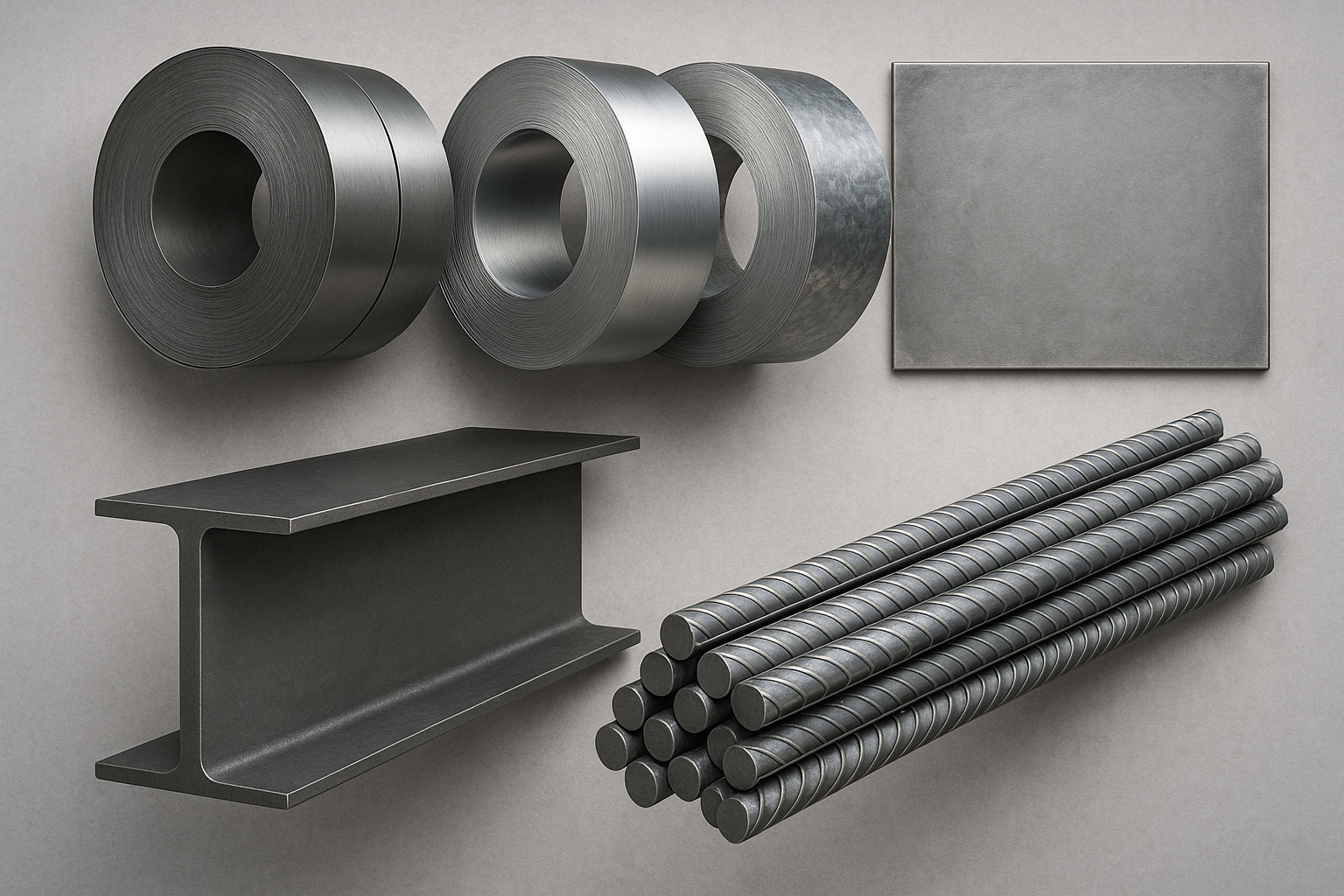
The most commonly traded steel products include hot-rolled sheets and coils, semi-finished steel, galvanized sheet, tubes and fittings, plate, cold-rolled sheets and coils, wire rod, and structural sections. Their importance depends on whether trade is measured by tonnage, value, or a particular country’s imports.
For buyers, these categories are only the starting point. A coil, bar, or pipe must also meet the required grade, dimensions, delivery condition, surface quality, and testing requirements. Two offers with the same commercial product name may represent materials that behave differently in manufacturing or service.
This guide combines a volume-based trade overview with practical distinctions between product families and the purchasing details that matter.
1. Which Steel Products Lead Global Trade by Volume?
The following table ranks the ten largest product categories in worldsteel’s World Steel in Figures 2026, using reported exports for 2025. Values are in million tonnes; the category names follow the source.
| Rank | Product category | 2025 exports, million tonnes |
|---|---|---|
| 1 | Hot-rolled sheets and coils | 78.0 |
| 2 | Ingots and semi-finished material | 71.2 |
| 3 | Galvanised sheet | 45.8 |
| 4 | Steel tubes and fittings | 39.9 |
| 5 | Plates | 35.5 |
| 6 | Cold-rolled sheets and coils | 31.4 |
| 7 | Wire rod | 27.7 |
| 8 | Other coated sheet | 24.1 |
| 9 | Angles, shapes and sections | 24.0 |
| 10 | Concrete reinforcing bars | 21.0 |
Source: World Steel Association, World Steel in Figures 2026, “World steel exports by product,” 2025 column. The table covers 118 countries, approximately 99% of world trade in that year. Country-reported exports include intra-EU trade and trade between USMCA countries.
These are statistical categories, not a ranking of individual grades. “Hot-rolled sheets and coils” is broader than HRC alone, while “steel tubes and fittings” includes fittings. The ranking measures shipment weight rather than sales value.
For interpreting trade alongside production and demand, see Key Indicators for Understanding the Global Steel Market.
2. Understand Product Form Before Comparing Steel Grades
Steel terminology describes several different attributes. Product form identifies a coil, plate, bar, section, or tube. Processing describes hot rolling, cold rolling, drawing, or coating. Metallurgical family identifies carbon, alloy, or stainless steel. Delivery condition describes the material’s state when supplied.
These attributes overlap. A stainless coil can be cold-rolled; an alloy steel plate can be heat-treated; a hot-rolled coil can become feedstock for welded pipe.
| Product group | Examples | Typical purchasing purpose |
|---|---|---|
| Semi-finished | Slabs, billets, blooms | Further rolling or forging |
| Flat | Coil, sheet, strip, plate | Stamping, cutting, forming, fabrication |
| Long | Rebar, wire rod, bars, structural sections | Reinforcement, drawing, machining, construction |
| Tubular | Seamless and welded tubes and pipes | Fluid transport, structural or mechanical service |
The Brazil Steel Institute’s product classification distinguishes semi-finished, flat, and long products. Classification conventions can differ between industry publications and customs systems, so buyers should identify the actual product rather than rely on a broad family label.
3. Semi-Finished Steel: Slabs, Billets and Blooms
Semi-finished steel connects steelmaking capacity with downstream rolling and forging capacity. A mill may buy these products instead of producing all its own feedstock.
Slabs generally feed flat-product rolling. Billets commonly feed bar, rebar, and wire-rod mills. Blooms are used for larger sections and other downstream products, depending on their dimensions and the receiving mill’s capabilities.
The purchasing specification should identify dimensions, chemistry, surface condition, internal quality requirements, and the intended processing route. A suitable composition does not compensate for a cross-section that the buyer’s equipment cannot accept.
Unlike a finished component, semi-finished material normally requires substantial further processing before reaching its final application.
4. Hot-Rolled Coil and Sheet
Hot-rolled coil is produced by rolling steel at elevated temperatures and winding the strip into coils. It can be sold for direct processing or used as feedstock for cold rolling, coating, or welded tube production.
Applications include formed components, welded fabrications, pipe and tube manufacture, and cut-to-length sheet. Suitability depends on the grade, thickness, manufacturing process, and required performance.
For an HRC inquiry, specify thickness and width tolerances, grade, surface condition, coil weight, internal diameter, and any processing restrictions. Pickled and oiled material differs from material supplied with mill scale.
HRC is also distinct from a rolled structural beam. A beam may be produced in a section mill or fabricated from flat steel, but the buyer must specify the required product and manufacturing route.
5. Cold-Rolled Coil and Sheet
Cold rolling reduces thickness and changes the material’s surface and mechanical condition. Commercial supply may include additional processing to achieve the specified properties.
CRC is used for formed parts, appliances, cabinets, and other applications that require appropriate surface quality and dimensional control. Cold-rolled grades range from highly formable steels to higher-strength products.
It is therefore inaccurate to assume that every CRC grade is stronger than every HRC grade. For example, SSAB Form 200 Cold-Rolled is a mild steel intended for forming.
Buyers should state the grade, required delivery condition, surface finish, dimensional tolerances, and forming requirements. A quotation that says only “CRC” leaves these decisions unresolved.
6. Metallic-Coated and Prepainted Steel
Coated sheet combines the properties of a steel substrate with a specified surface system. The coating is part of the purchase specification, not a substitute for specifying the substrate grade.
Galvanized steel
Galvanized sheet carries a zinc coating. Hot-dip and electrolytic coating routes should be identified explicitly when they matter to the application. Buyers must also specify coating designation, surface treatment, and substrate properties.
Galvannealed steel
Galvannealed sheet undergoes an additional thermal step after hot-dip coating, producing a zinc-iron alloy coating. Its forming and surface behavior differ from conventional galvanized sheet. The GalvInfo technical note on galvanneal explains these distinctions.
Aluminum-zinc alloy-coated steel
Products commonly called GL or Galvalume use an aluminum-zinc alloy coating and should not be treated as interchangeable with zinc-coated sheet. The GalvInfo note on 55% aluminum-zinc alloy-coated sheet describes this coating family.
Prepainted steel
Prepainted material adds an organic coating system. Purchasing should identify the metallic-coated substrate, paint system, color requirements, coating thickness requirements, and intended exposure.
For every coated product, clarify whether a quoted thickness refers to the base metal or the finished coated material. Coating-mass designations must also be interpreted under the applicable specification; do not assume that every designation refers to one surface only.
7. Steel Plate
Plate serves structural fabrication, machinery, shipbuilding, pressure equipment, and other demanding applications. Commercial definitions separating plate from sheet are not universally identical across standards and producers.
Specify the actual thickness, width, length, grade, delivery condition, and tolerances. Do not treat “over 6 mm” as a complete universal definition or purchasing specification.
Structural plate, pressure-vessel plate, abrasion-resistant plate, and protection steel are different purchasing categories. A higher hardness or strength value does not establish suitability for every application.
Depending on service requirements, the order may need impact testing, ultrasonic examination, particular heat-treatment conditions, or other documented acceptance criteria. These requirements should be agreed before production and pricing.
8. Rebar
Reinforcing bar is used in reinforced concrete. Ribbed products are designed to provide the required interaction with concrete, while their mechanical characteristics must meet the applicable specification.
Orders should identify the standard, grade, nominal diameter, length or coil form, and required test results. Weldability, ductility, and other project requirements must be considered where relevant.
A common nominal diameter does not establish equivalence between different national specifications. Engineering acceptance and any required local certification should be resolved before an import order is placed.
9. Wire Rod and Drawn Wire
Wire rod is a hot-rolled long product normally supplied in coils. It is often processed into wire, fasteners, springs, or other products.
Its role as feedstock for another manufacturer does not make it equivalent to a billet or slab in the usual product-form classification. Wire rod and drawn wire are also separate trade categories.
ArcelorMittal’s wire-rod product information illustrates applications in cold heading, welding, and construction manufacturing.
The buyer should specify diameter, grade, downstream process, surface-quality requirements, and the required coil condition. Wire intended for a demanding forming operation cannot be selected solely on the basis of a low price per tonne.
10. Structural Sections and Other Long Products
Angles, channels, beams, and other sections support buildings, industrial facilities, and infrastructure. Bars and rails serve additional markets and may be reported separately in trade statistics.
Sections can cross international borders even when local supply offers a freight advantage. Availability, section range, project schedules, and material requirements influence sourcing decisions.
For sections, verify the exact dimensional series, grade, length, straightness, tolerances, and any processing requirements. Similar section names from different markets may conceal different dimensions or mass per unit length.
11. Seamless and Welded Pipes and Tubes
Seamless products are manufactured without a longitudinal weld seam. Welded products are formed from flat material and joined through a specified welding process.
Both routes serve important industrial markets. Tenaris’s onshore line-pipe portfolio includes seamless and welded products, demonstrating why route selection requires more than a general price comparison.
The purchase specification should identify intended service, standard, grade, outside diameter, wall thickness, manufacturing route, end preparation, and required tests.
Do not infer pressure suitability from the presence or absence of a seam alone. Design requirements, material properties, dimensions, service environment, and qualification requirements must be evaluated together.
Structural tubing, line pipe, boiler tubes, and mechanical tubing should not be treated as interchangeable merely because they are hollow steel products.
12. Stainless Steel Is a Material Family, Not a Single Product Form
Stainless steel is traded as coil, sheet, plate, bar, wire, and tubular products. It overlaps with several of the geometric forms discussed above.
Worldstainless describes stainless steels as corrosion-resistant steels containing at least 10.5% chromium. Its guide to categories, grades, and product forms explains the principal families.
The required grade depends on the service environment, fabrication, and performance requirements. “Stainless” does not mean immune to corrosion in every environment.
Buyers should specify grade, product form, dimensions, finish, delivery condition, and documentation. Nickel-related pricing considerations apply differently across stainless families, so not every stainless quotation has the same alloy-cost exposure.
For a broader explanation of how chemistry interacts with processing and properties, see How Chemical Elements Influence Steel Properties and Industrial Applications.
13. Electrical Steel
Electrical steels are selected for magnetic performance in equipment such as transformers, motors, and generators. Their purchasing specifications extend beyond ordinary structural strength.
Grain-oriented electrical steel is particularly important in transformer cores, where directional magnetic behavior matters. Non-grain-oriented electrical steel is used in motors and other rotating electrical machines.
Thyssenkrupp’s electrical-steel portfolio distinguishes these products and their applications.
Identify thickness, grade, magnetic-loss requirements under specified test conditions, coating, and processing requirements. A material described simply as “silicon steel” is not a complete technical offer.
14. Packaging Steel and Other Specialized Products
The largest-volume categories do not capture every important market. Tinmill products, specialty bars, drawn wire, rails, and other products supply industries with their own technical requirements.
Tinplate is an example of steel packaging material. Worldsteel’s tinplate product profile identifies uses in food cans and industrial packaging.
A smaller trade category can still be commercially important to a particular buyer. Product selection should follow the application rather than the position of a category in a global tonnage table.
15. Why Steel Trade Flows Differ Between Products
As a purchasing framework, consider where the required grade can be produced, whether it is available in the required dimensions, and how much processing the buyer can perform locally.
A rolling mill purchasing slabs faces a different supply question from a manufacturer buying finished coated sheet. A project requiring a particular pipe qualification may have fewer acceptable suppliers than a buyer sourcing standard sheet.
Freight, handling, lead time, financing, and inventory also change the comparison between local and imported supply. Trade measures add another layer and must be checked for the actual product, origin, producer where relevant, destination, and shipment timing.
Do not assume that an exporting country’s total steel production establishes its capability to supply every product. For industry context, see our overview of major steel producers and market structure.
16. A Practical Steel Purchasing Checklist
Use the following checklist to make competing offers comparable. Adapt it to the product and the applicable engineering and contractual requirements.
- Identify the product: form, manufacturing route, standard, grade, and intended application.
- Define dimensions: nominal values, tolerances, length, coil or bundle limits, and processing constraints.
- Specify delivery condition: required mechanical condition, surface, finish, coating, or heat treatment.
- Agree on verification: test results, inspection-document requirements, traceability, markings, and any third-party inspection.
- Confirm origin and producer: distinguish the steelmaking or manufacturing location from the seller’s address and shipment port.
- Clarify commercial terms: quantity tolerances, delivery term and named place, payment, lead time, packaging, and claims procedure.
- Check import requirements: classification, applicable trade measures, permits, and product-specific conformity requirements.
- Compare accepted output: include processing losses, quality risk, inventory, and the usable material delivered to production.
An inspection certificate should connect the supplied material with the required specification and test results. Its presence alone does not prove that the material meets every requirement of the buyer’s application.
17. Compare Cost per Usable Tonne
The following example is hypothetical and illustrates a purchasing calculation. It does not represent current market prices, freight rates, or duty rates.
| Assumption | Offer A | Offer B |
|---|---|---|
| Purchased quantity | 100 tonnes | 100 tonnes |
| Cost per purchased tonne at the same defined stage | US$700 | US$720 |
| Total included cost | US$70,000 | US$72,000 |
| Assumed usable yield | 94% | 98% |
| Usable output | 94 tonnes | 98 tonnes |
| Included cost per usable tonne | US$744.68 | US$734.69 |
Included cost per usable tonne = total included cost ÷ usable tonnes.
Offer A: US$70,000 ÷ 94 = US$744.68. Offer B: US$72,000 ÷ 98 = US$734.69.
Under these assumptions, Offer B costs more per purchased tonne but less per usable tonne. This is not evidence that a higher-priced material always delivers better yield. Yield must be measured or supported by production trials. Scrap credits, conversion costs, financing, and any other excluded costs must be added consistently before making a final commercial decision.
18. Frequently Asked Questions
What is the most traded steel product by volume?
In the 2025 worldsteel categories used in this article, hot-rolled sheets and coils rank first. This is an aggregated category, not a ranking of individual grades or HRC contracts.
Are billets and slabs traded internationally?
Yes. They are semi-finished products purchased for further processing. Their specifications must match the receiving mill’s equipment and intended output.
Is wire rod a semi-finished product?
In the usual geometric classification used here, wire rod is a rolled long product. It can be feedstock for wire drawing or other manufacturing without being grouped with billets and slabs.
Is cold-rolled steel always stronger than hot-rolled steel?
No. The comparison depends on the grades and delivery conditions. Cold-rolled products include steels selected for formability as well as higher-strength grades.
Are GI, GA and GL interchangeable?
No. These commercial labels commonly refer to different coating systems. Confirm the actual coating, substrate, designation, and applicable specification.
Is seamless pipe always the correct choice for pressure service?
No. Selection must follow the applicable design and product requirements. The manufacturing route alone does not establish suitability.
Why is stainless steel not a separate row in the main ranking?
The ranking uses worldsteel’s published product categories. Stainless steel is a material family supplied in multiple forms, so adding a separate stainless total could overlap with a form-based classification.
Which steel products have the highest value per tonne?
There is no universal ranking. Grade, alloy content, processing, dimensions, qualification, and market conditions affect price. Trade volume does not establish unit value.
Can different national grades be treated as equivalent?
Only after checking the relevant requirements. Compare chemistry, mechanical properties, delivery condition, dimensions, tests, and the needs of the application.
What should a buyer request before placing an order?
Request an offer tied to a complete specification, identified producer and origin, required inspection documents, packaging, delivery terms, and agreed acceptance criteria.
19. Choosing the Right Product for the Purchase
A global trade ranking helps identify the scale of product markets. A successful purchase requires a narrower decision: which product, grade, delivery condition, and supplier can meet the application at an acceptable total cost?
Start with the technical requirement, make offers comparable, and verify the supply and import conditions. That process makes the trade data useful to procurement rather than leaving it as a list of large markets.
20. Sources and Technical References
- World Steel Association — World Steel in Figures 2026: 2025 export volumes and statistical scope.
- Brazil Steel Institute — Products: product-form classification.
- SSAB — Form 200 Cold-Rolled: an example of a cold-rolled forming grade.
- GalvInfoNote 1.3 — Galvanneal: Differences from Galvanize.
- GalvInfoNote 1.4 — 55% Aluminum-Zinc Alloy-Coated Steel Sheet.
- ArcelorMittal — Wire Rod.
- Tenaris — Onshore Line Pipe.
- Worldstainless — Introduction to Stainless Steels.
- Worldstainless — Categories, Grades and Product Forms.
- Thyssenkrupp Steel — Electrical Steel Overview.
- World Steel Association — Tinplate Product Profile.
Trade data refer to 2025 and were checked against the 2026 publication during the October 2026 editorial review. Supplier product pages illustrate technical distinctions; they are not a ranking or endorsement of suppliers.