
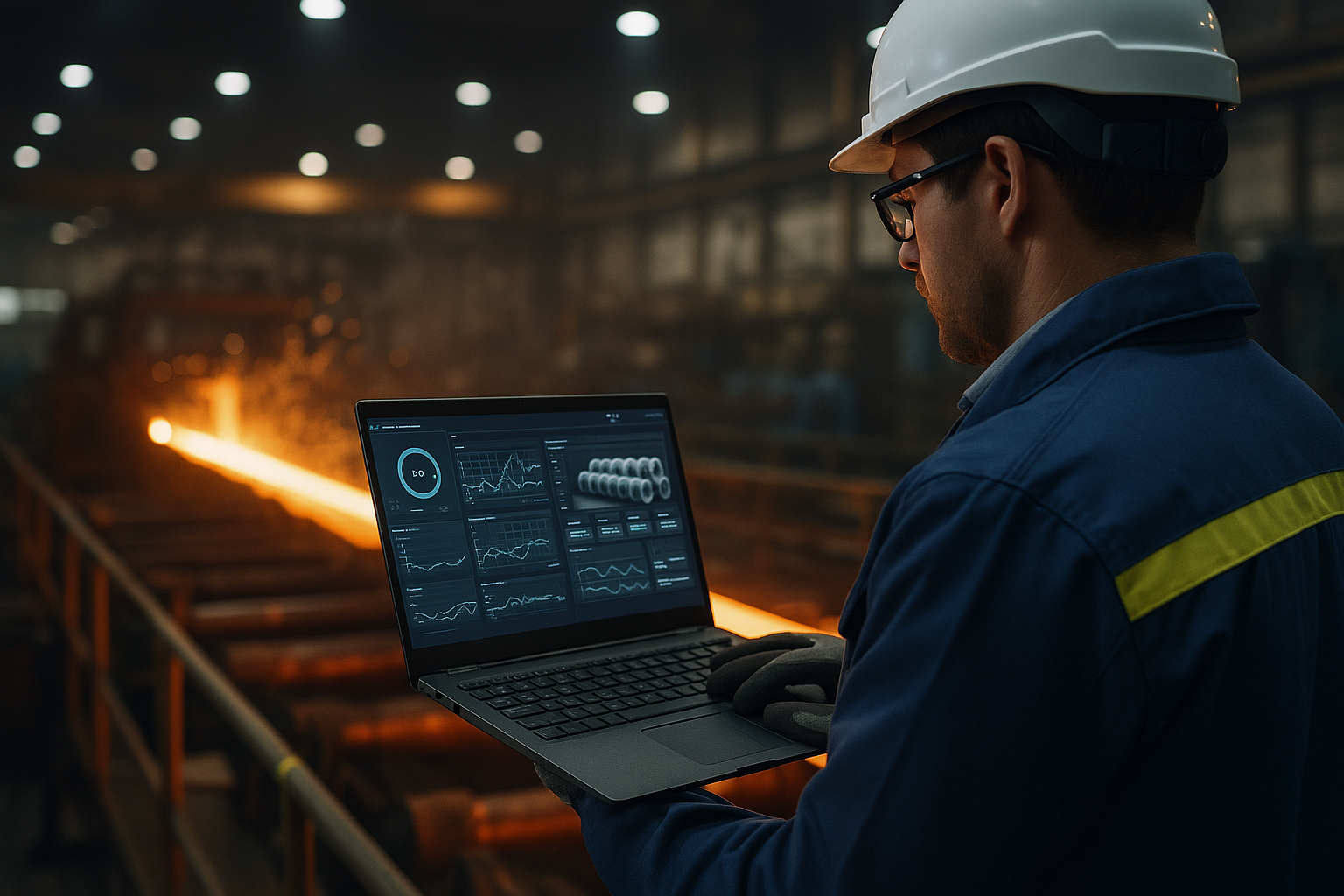
Steel decarbonization is often discussed in terms of breakthrough technologies: hydrogen-based direct reduced iron, electric arc furnaces, renewable electricity, carbon capture, increased scrap use and new production routes.
All of these technologies matter.
But another transformation is taking place inside steel plants, and it receives considerably less attention: the conversion of industrial operations into increasingly connected, measurable and data-driven systems.
Digital innovation does not replace the physical technologies required to decarbonize steelmaking. Artificial intelligence cannot eliminate the chemical reactions of an integrated steel plant, and a digital twin cannot substitute hydrogen for metallurgical coal.
What digitalization can do is help steelmakers operate existing and emerging technologies more efficiently, understand process variability, reduce waste, improve energy management, increase equipment reliability and generate better environmental data.
That distinction is fundamental.
Digital technology is not the decarbonization pathway itself. It is an enabling layer that can make multiple decarbonization pathways more efficient, controllable and scalable.
For an industry characterized by high capital intensity, continuous processes, complex metallurgical interactions and significant energy consumption, that enabling role can become strategically important.
Why Digital Innovation Matters in Steelmaking
Steelmaking involves thousands of interconnected process variables.
Temperature, pressure, gas flow, chemical composition, raw-material quality, equipment condition, energy availability, cooling conditions, rolling parameters and product tolerances can all influence productivity, quality and environmental performance.
Historically, steel plants have already relied heavily on automation and process control. The current digital transformation therefore does not begin from zero.
The difference is the increasing ability to connect operational data from different systems and use advanced analytics to convert that information into better decisions.
Digital technologies can support steelmakers in areas such as:
- energy efficiency;
- process stability;
- material yield;
- predictive maintenance;
- product quality;
- emissions monitoring;
- scrap optimization;
- asset utilization;
- production planning;
- environmental reporting.
This is where digitalization and sustainability begin to intersect.
A more stable furnace can consume resources more efficiently.
A better-controlled rolling process can reduce downgraded material.
Earlier detection of equipment deterioration can prevent unplanned shutdowns.
Improved quality prediction can reduce scrap and reprocessing.
Better energy forecasting can help plants coordinate electricity-intensive operations with energy availability and cost.
Individually, these improvements may appear operational. Collectively, they affect the environmental and economic performance of steel production.
1. Artificial Intelligence and Machine Learning Move from Data Analysis to Decision Support
Artificial intelligence is becoming increasingly relevant to industrial operations because steel plants generate enormous quantities of data.
Sensors, laboratory systems, process-control equipment, quality inspection systems, maintenance records and production databases continuously generate information.
The challenge is no longer simply collecting data.
It is determining which data matter and how they should influence an operational decision.
Machine-learning models can analyze relationships that are difficult to identify through conventional statistical monitoring alone.
Potential applications include:
- predicting equipment failure;
- identifying abnormal operating conditions;
- forecasting energy demand;
- predicting product quality;
- optimizing process parameters;
- detecting surface defects;
- analyzing production bottlenecks;
- supporting raw-material optimization.
However, the strongest industrial use of AI is not necessarily autonomous decision-making.
In many steelmaking applications, AI works best as a decision-support layer combined with metallurgical knowledge, process engineering and conventional automation.
This is particularly important because industrial models operate in environments where process conditions change.
Raw-material characteristics vary. Equipment deteriorates. Product mixes change. Sensors drift. Operating practices evolve.
An AI model that performed well under one set of conditions may require validation or retraining when those conditions change.
For this reason, successful industrial AI requires more than algorithms.
It requires data governance, process knowledge, model validation and human oversight.
2. Digital Twins Can Reduce the Cost of Experimentation
A digital twin is more than a graphical representation of a machine.
In industrial applications, it can combine physical models, operating data and analytics to create a dynamic representation of equipment, processes or even an entire production system.
For steelmakers, this creates an important possibility: testing operational scenarios before applying them to physical production.
Consider a reheating furnace.
Engineers may want to evaluate changes in:
- furnace temperature profiles;
- residence time;
- fuel consumption;
- production rate;
- slab temperature;
- heat losses.
Testing every alternative directly in production can be expensive and disruptive.
A sufficiently accurate digital model allows engineers to evaluate scenarios virtually and identify promising operating windows before conducting controlled industrial trials.
Similar concepts can be applied to blast furnaces, electric arc furnaces, continuous casting, rolling mills, energy systems and material flows.
Digital twins therefore have a broader strategic function.
They can shorten the cycle between hypothesis → simulation → industrial validation → implementation.
That can accelerate both productivity improvements and sustainability initiatives.
3. Industrial IoT Turns Equipment into Continuous Sources of Information
Industrial Internet of Things technologies connect sensors, machines and systems so that operating conditions can be monitored continuously.
In steel plants, useful measurements can include:
- vibration;
- temperature;
- pressure;
- electrical current;
- gas flow;
- water consumption;
- equipment position;
- energy consumption;
- emissions-related parameters.
The value, however, does not come from installing the largest possible number of sensors.
It comes from connecting measurement to action.
A vibration sensor that generates millions of data points but does not improve maintenance decisions creates little value.
A sensor system that identifies a developing bearing problem before failure can create substantial value.
The same principle applies to sustainability.
Real-time monitoring can help identify compressed-air losses, abnormal energy consumption, water inefficiencies, process deviations and equipment deterioration.
Smart factories are not defined by how much data they collect. They are defined by how effectively they convert data into operational improvement.
4. Predictive Maintenance Has a Direct Sustainability Dimension
Maintenance is frequently treated as a reliability issue.
It is also a sustainability issue.
Equipment operating outside its optimal condition may consume more energy, generate unstable process conditions, reduce yield or create quality defects.
Traditional maintenance strategies generally fall between two extremes:
Reactive maintenance: repair equipment after failure.
Preventive maintenance: service equipment according to predefined intervals.
Predictive maintenance adds another approach.
By analyzing operating condition and historical behavior, maintenance teams can estimate when intervention is actually required.
This can reduce:
- catastrophic failures;
- unnecessary maintenance;
- unplanned shutdowns;
- spare-parts consumption;
- production losses;
- secondary process disturbances.
The sustainability benefit is indirect but important.
A reliable plant is generally easier to operate efficiently than an unstable one.
5. Digital Quality Control Can Reduce Material Waste
Sustainability in steelmaking is not only about reducing energy consumption per tonne.
It is also about producing the required product correctly.
Every tonne that must be reprocessed, downgraded or scrapped represents resources that were consumed without generating the intended product value.
Advanced vision systems and machine-learning algorithms can increasingly support detection of:
- surface defects;
- dimensional deviations;
- coating irregularities;
- shape problems;
- process anomalies.
The greater opportunity is moving from defect detection to defect prediction.
If historical data show that certain combinations of process variables increase the probability of a defect, analytics can potentially identify the risk before the product reaches final inspection.
That changes quality management from:
produce → inspect → reject
toward:
measure → predict → adjust → prevent.
For steel production, that is a significant conceptual shift.
6. Energy Management Is Becoming More Data-Driven
Energy represents one of the central technical and economic challenges of steel decarbonization.
Digital systems can improve visibility into where, when and how energy is consumed.
Instead of analyzing only monthly plant-level consumption, companies can increasingly monitor energy at the level of individual production areas, equipment or process stages.
This enables more sophisticated questions:
Which process consumes more energy than expected?
Is consumption increasing because of product mix or equipment condition?
Can production scheduling reduce peak electricity demand?
Can energy-intensive operations be better coordinated with electricity availability?
Are process deviations increasing specific energy consumption?
The International Energy Agency has emphasized the importance of process optimization, better controls, monitoring, energy-management systems and artificial intelligence as tools for improving industrial efficiency.
But an important caution is necessary.
Digital optimization should not be confused with deep decarbonization.
The IEA’s 2025 assessment shows that global steel emissions remain broadly unchanged and that much greater deployment of near-zero-emission production technologies is still required.
Efficiency reduces the burden.
It does not eliminate the need for technological transformation.
7. Digitalization Can Support New Low-Carbon Steelmaking Routes
The importance of digital control may actually increase as steelmaking adopts new production routes.
Hydrogen-based DRI, expanded EAF production, renewable electricity, energy storage and other low-carbon systems introduce new operational and economic variables.
For example, renewable electricity availability can vary.
Hydrogen production costs can depend strongly on electricity prices.
Scrap composition affects EAF operation and final steel chemistry.
DRI characteristics influence furnace performance.
Advanced digital systems can help coordinate these variables.
This creates a connection between the physical decarbonization infrastructure and the digital optimization infrastructure.
The first changes how steel is produced.
The second helps determine how efficiently that new system operates.
8. Carbon Accounting Is Moving Toward Better Primary Data
One of the most important changes in sustainable manufacturing is the increasing demand for credible environmental data.
Customers, regulators and investors increasingly want to understand the emissions associated with products and production routes.
This creates a measurement challenge.
A steel product’s environmental footprint depends on many variables, including:
- production route;
- energy sources;
- raw materials;
- scrap content;
- alloying elements;
- processing stages;
- yield;
- transportation boundaries;
- methodology used.
Digital systems can help connect production records, energy data, material flows and environmental information.
But technology alone does not guarantee credible carbon accounting.
The methodology and system boundaries remain essential.
This is where Life Cycle Assessment becomes important.
In 2026, the World Steel Association released an updated global Life Cycle Inventory database based on 2024 production data. The database provides cradle-to-gate environmental information for major steel products and incorporates data reported by more than 160 production sites worldwide.
This development illustrates an important trend:
environmental claims are increasingly expected to be supported by structured, comparable and methodologically robust data.
Digitalization can make collecting and managing that data significantly more practical.
9. Traceability Is Becoming More Important Than Blockchain Itself
A few years ago, blockchain was frequently presented as the inevitable solution for industrial traceability.
The underlying business requirement remains valid.
The technology choice is more nuanced.
Steel buyers may increasingly need reliable information about:
- production origin;
- production route;
- recycled content;
- carbon intensity;
- certifications;
- chain of custody.
These requirements can be addressed through different combinations of databases, digital product records, ERP integration, certification systems and, in some cases, distributed-ledger technologies.
Therefore, the strategic question should not be:
“Should our company use blockchain?”
It should be:
“How can the required product and environmental information be made reliable, traceable and auditable?”
Technology should follow the business requirement—not the other way around.
10. Digital Sustainability Requires Cybersecurity
Greater connectivity also creates greater exposure.
A steel plant increasingly dependent on connected sensors, remote access, cloud services, industrial networks and integrated control systems must treat cybersecurity as an operational requirement.
A cyber incident affecting industrial systems can disrupt:
- production;
- safety systems;
- logistics;
- quality records;
- energy management;
- environmental monitoring.
This means digital sustainability programs must include cybersecurity from the beginning.
Adding connectivity without appropriate industrial cybersecurity can exchange one operational risk for another.
11. Legacy Equipment Is Not Automatically a Barrier
Many steel plants contain equipment installed decades ago.
Replacing every legacy asset simply to enable digitalization would be economically unrealistic.
Fortunately, digital transformation does not necessarily require complete equipment replacement.
Companies can progressively add:
- external sensors;
- data acquisition systems;
- industrial gateways;
- condition-monitoring systems;
- analytics platforms;
- integration layers.
This creates a practical migration strategy.
Rather than asking:
“How do we build a completely digital plant?”
companies can ask:
“Where is the largest information gap affecting cost, quality, reliability or emissions?”
Solving the highest-value gaps first can produce a much stronger investment case.
12. The ROI of Digital Sustainability Must Be Measured Carefully
Digital projects are sometimes justified using broad claims about energy savings, emission reductions or productivity gains.
That approach should be avoided.
Actual results depend heavily on:
- baseline performance;
- process route;
- equipment condition;
- plant configuration;
- product mix;
- data quality;
- implementation maturity.
A better business case connects each digital initiative to measurable operational indicators.
For example:
Predictive maintenance
→ fewer unplanned failures
→ higher availability
→ lower production losses.
Advanced process control
→ lower process variability
→ better yield
→ less rework and scrap.
Energy analytics
→ identification of abnormal consumption
→ corrective action
→ lower specific energy consumption.
Quality prediction
→ earlier process intervention
→ fewer defects
→ lower material loss.
This makes the relationship between technology, financial performance and sustainability visible.
A Practical Digital Sustainability Maturity Model for Steel Plants
Steel companies can evaluate digital sustainability in five stages.
Level 1 — Fragmented
Data exist in isolated systems, spreadsheets and local equipment.
Level 2 — Connected
Critical production and environmental data are collected automatically.
Level 3 — Integrated
Production, quality, maintenance, energy and environmental systems begin sharing information.
Level 4 — Predictive
Analytics identify trends, predict failures and support process optimization.
Level 5 — Adaptive
AI, digital twins and advanced control systems increasingly support real-time operational decisions while engineers maintain governance and validation.
The objective is not necessarily to move every process to Level 5.
The objective is to determine where greater digital maturity creates measurable industrial value.
Frequently Asked Questions
Can digitalization significantly reduce steel industry emissions?
Digitalization can reduce emissions indirectly by improving energy efficiency, yield, reliability, process control and resource utilization. However, it cannot replace fundamental decarbonization technologies such as low-carbon electricity, hydrogen-based DRI, greater scrap utilization and other near-zero-emission production routes.
How can AI improve steel production?
AI can analyze large volumes of process data to support quality prediction, maintenance, energy management, process optimization, anomaly detection and production planning.
What is a digital twin in steelmaking?
A digital twin is a dynamic digital representation of equipment or processes that can combine physical models and operational data to monitor performance and evaluate scenarios.
How does predictive maintenance contribute to sustainability?
By identifying equipment deterioration before failure, predictive maintenance can reduce downtime, production losses, unnecessary maintenance and inefficient operation.
Can older steel plants adopt digital technologies?
Yes. Legacy equipment can often be supplemented with sensors, data-acquisition systems, industrial gateways and analytics without replacing the entire production asset.
Is blockchain necessary for green steel traceability?
Not necessarily. The objective is reliable, auditable product and environmental information. Blockchain is one possible architecture, but conventional databases, certification systems and integrated digital records may also meet traceability requirements.
Does AI replace metallurgical and process engineers?
No. Industrial AI depends on process knowledge, data quality and validation. Its most valuable role is supporting engineers and operators with faster and more sophisticated analysis.
Conclusion: Digitalization Is an Enabler, Not the Decarbonization Solution
The transformation toward sustainable steel will ultimately depend on physical changes in how iron and steel are produced.
Renewable electricity, increased recycling, low-carbon hydrogen, DRI-EAF routes, carbon capture where applicable, material efficiency and other technologies will determine the industry’s long-term emissions trajectory.
Digitalization plays a different but highly complementary role.
It can make those systems more measurable, predictable, efficient and controllable.
AI can identify patterns.
Sensors can expose losses.
Digital twins can accelerate experimentation.
Predictive maintenance can increase reliability.
Advanced analytics can improve energy and material efficiency.
Digital environmental systems can strengthen emissions measurement and traceability.
But none of these technologies creates value merely because it is digital.
The relevant question for a steel producer is therefore not:
“How much digital technology can we install?”
It is:
“Which information, process or decision should we improve to reduce cost, waste, energy consumption or environmental impact?”
That is where digital transformation becomes industrial strategy.
And as steelmaking moves toward increasingly complex low-carbon production systems, the companies capable of combining metallurgical expertise + process engineering + reliable data + digital technology + disciplined sustainability measurement will be better positioned to turn decarbonization from an environmental objective into an operational capability.