
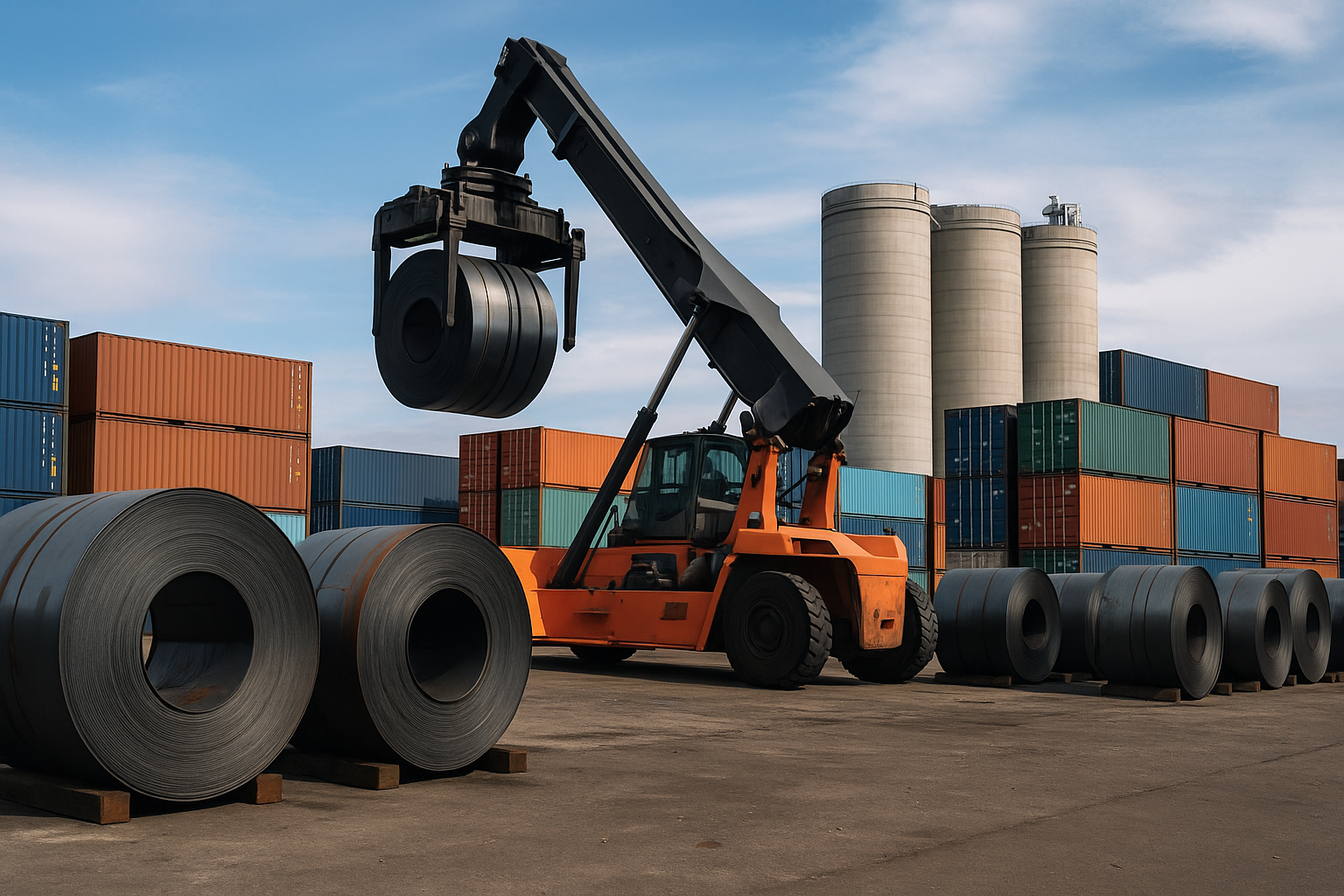
Steel supply chains are expensive because they combine high material volumes, capital-intensive production, long transportation routes, volatile input markets and demanding customer delivery requirements.
A steel producer may purchase raw materials from another continent, move them through ports and terminals, hold weeks of inventory, transform them through multiple production stages and then ship finished products hundreds or thousands of kilometers to customers.
Every step consumes money, capacity and time.
But supply chain optimization is not simply about reducing each cost individually.
A cheaper supplier can require more inventory.
Lower inventory can increase stockout risk.
A lower freight rate can come with longer transit time.
A highly efficient single-source arrangement can become vulnerable when that supplier or route is disrupted.
The correct objective is therefore not:
Minimize Supply Chain Cost
It is:
Optimize Total Cost + Service + Working Capital + Risk
This distinction is especially important in steel, where disruptions in raw materials, logistics or trade conditions can quickly affect production continuity.
A well-designed steel supply chain connects sourcing, inventory, logistics, production and customer delivery as one economic system.
1. What Supply Chain Optimization Means in the Steel Industry
Steel supply chain optimization is the coordinated management of material, information and financial flows from suppliers through production to customers.
Depending on the business model, the chain may include:
- iron ore;
- coal and coke;
- scrap;
- ferroalloys;
- fluxes;
- slabs;
- billets;
- hot-rolled coil;
- cold-rolled coil;
- coated steel;
- service centers;
- ports;
- warehouses;
- transport providers;
- distributors;
- final customers.
Optimization means making these elements work together rather than improving one function at the expense of another.
A procurement department may negotiate a lower purchase price while increasing logistics and inventory costs.
A logistics department may consolidate shipments to reduce freight cost while increasing delivery lead time.
Production may maximize campaign efficiency while creating excessive finished-goods inventory.
Each department can appear efficient while the total supply chain becomes more expensive.
The management unit should therefore be the end-to-end flow.
2. Why Steel Supply Chains Are Different
Steel supply chains have characteristics that make optimization particularly challenging.
Steel is:
- heavy;
- expensive to transport;
- produced through capital-intensive processes;
- often manufactured in campaigns;
- available in thousands of specifications;
- exposed to commodity and energy prices;
- affected by international trade policy;
- dependent on raw-material availability;
- frequently transported over long distances.
A steel order is also not defined only by tonnage.
Customers may require specific:
- grade;
- thickness;
- width;
- coating;
- surface condition;
- mechanical properties;
- dimensional tolerances;
- packaging;
- certification.
Inventory that exists physically may therefore be unavailable commercially because it does not match the required specification.
This is why supply chain optimization in steel requires more than simply balancing total tonnes.
3. Supply Chain Optimization Is Not Cost Minimization
Cost minimization asks:
What is the cheapest option?
Optimization asks:
What combination of cost, service, inventory and risk produces the best economic result?
Consider two suppliers.
Supplier A offers the lowest unit price but requires:
- long ocean transit;
- large minimum orders;
- high safety stock;
- greater working capital;
- greater exposure to port disruption.
Supplier B charges more per tonne but provides:
- shorter lead time;
- smaller lots;
- more reliable delivery;
- lower inventory requirements.
Purchase price alone cannot determine which supplier is economically preferable.
The correct comparison must extend beyond price.
4. Purchase Price, Landed Cost and Total Cost Are Different
Three concepts should be distinguished.
Purchase Price
The commercial price paid for the material under the applicable sales terms.
Landed Cost
The cost required to bring the material to the required destination.
Depending on the transaction, it can include:
- purchase price;
- international freight;
- insurance;
- import duties;
- port charges;
- customs-related costs;
- inland transportation;
- handling.
Total Supply Chain Cost
The broader economic impact of acquiring, transporting, storing and managing the material.
It may also include:
- inventory carrying cost;
- working capital;
- quality losses;
- administrative cost;
- emergency freight;
- supply disruption;
- production interruption;
- delivery impact.
Therefore:
Purchase Price ≠ Landed Cost ≠ Total Supply Chain Cost
This distinction is fundamental for steel sourcing decisions.
International sourcing decisions also benefit from systematic analysis of trade flows, origin and market conditions, as explained in Steel Import and Export Data Analysis: A Practical Guide for Market Intelligence.
5. Build a Total-Cost Architecture Before Optimizing
A supply chain cannot be optimized if major costs remain invisible.
A useful cost architecture may include:
| Cost Dimension | Typical Components |
|---|---|
| Material | Purchase price, alloy surcharge, commercial adjustments |
| International Logistics | Ocean freight, rail, insurance, terminals |
| Trade | Duties, trade remedies, customs-related charges |
| Domestic Logistics | Truck, rail, handling, transfer |
| Inventory | Carrying cost, storage, financing |
| Quality | Inspection, rejection, claims, rework |
| Administrative | Procurement, planning, documentation |
| Disruption | Premium freight, emergency sourcing, lost production |
| Service | Late delivery, penalties, customer impact |
Not every company needs every component.
The important point is to establish a consistent boundary before comparing alternatives.
6. Raw-Material Strategy Starts With Criticality
Not all inputs deserve the same supply strategy.
A useful starting point is to classify materials according to:
Economic Importance × Supply Risk
A high-value material available from many reliable suppliers may require a different strategy from a lower-value alloying element available from only a few sources.
Questions include:
- How many qualified suppliers exist?
- Where are they located?
- How long is replenishment?
- Is substitution technically possible?
- How much inventory is available?
- What happens if supply stops?
- How quickly can another supplier be qualified?
This converts procurement from transactional buying into supply-risk management.
7. Supplier Selection Must Be Multicriteria
Price is important, but supplier evaluation should normally include additional dimensions.
Typical criteria include:
- price;
- quality;
- technical capability;
- capacity;
- lead time;
- delivery reliability;
- lead-time variability;
- minimum order quantity;
- flexibility;
- geographic location;
- logistics route;
- trade exposure;
- financial stability;
- responsiveness;
- traceability.
The relative importance of each criterion depends on the material.
A commodity input and a highly specialized steel grade should not automatically use identical supplier-selection logic.
8. Supplier Reliability Has Economic Value
Two suppliers can quote the same material at similar prices but create very different downstream costs.
A supplier with unstable delivery performance may force the buyer to hold additional safety stock.
That inventory consumes:
- cash;
- warehouse capacity;
- handling;
- management attention.
Reliability therefore has economic value even when it does not appear on the purchase order.
Supplier performance should be measured rather than described informally as “good” or “bad.”
9. Average Lead Time Is Not Enough
Consider two hypothetical suppliers:
Supplier A: approximately 30 days with limited variation.
Supplier B: approximately 27 days but with substantial variation.
Supplier B has the shorter average lead time.
But planning around Supplier A may be easier because arrival dates are more predictable.
The relevant management question is therefore not only:
What is the average lead time?
It is also:
How variable is the lead time?
Lead-time variability influences:
- safety stock;
- production planning;
- delivery confidence;
- emergency purchasing.
A shorter but highly unstable supply route may be economically inferior to a slightly longer but predictable route.
10. Demand Forecasting Is a Planning Input — Not a Prediction of Certainty
Forecasting helps align:
- procurement;
- production;
- inventory;
- logistics;
- capacity.
But every forecast contains uncertainty.
The objective is not to create a forecast that is always correct.
It is to understand forecast error sufficiently to make better decisions.
Useful analysis may include:
- historical demand;
- seasonality;
- customer orders;
- market changes;
- promotions;
- project demand;
- product families.
Forecast accuracy should be monitored over time.
11. Forecast Bias Can Be More Dangerous Than Random Error
Forecast error measures how far actual demand differs from forecast demand.
Bias asks whether the errors systematically occur in one direction.
Persistent overforecasting can create:
- excessive purchasing;
- excessive production;
- inventory accumulation.
Persistent underforecasting can create:
- shortages;
- rush production;
- premium freight;
- missed deliveries.
Therefore, supply chain planning should monitor not only forecast accuracy but also whether forecasting is systematically optimistic or conservative.
12. Artificial Intelligence Does Not Fix Poor Planning Data
Advanced forecasting tools can support complex demand patterns.
But technology does not eliminate basic data requirements.
Before implementing sophisticated analytics, verify:
- item master data;
- customer data;
- units of measure;
- historical demand;
- abnormal events;
- product substitutions;
- discontinued products.
A sophisticated forecasting model built on unreliable data can simply automate unreliable decisions.
The correct sequence is:
Reliable Data → Appropriate Model → Error Measurement → Planning Response
13. Inventory Is Both a Cost and a Buffer
Inventory is frequently described only as waste or tied-up capital.
That is incomplete.
Inventory can protect operations from:
- demand variability;
- supplier delays;
- transportation disruption;
- production instability.
Therefore:
Inventory = Cost + Protection
The management problem is determining whether the protection provided is economically justified.
Too much inventory increases cost.
Too little inventory increases disruption risk.
Optimization lies between these extremes.
Inventory policies and their cost implications are examined in greater depth in How Steel Inventory Management Reduces Costs in Manufacturing Companies.
14. Different Inventory Types Serve Different Purposes
Not all inventory should be managed identically.
Cycle Stock
Inventory associated with normal replenishment quantities and consumption.
Safety Stock
Inventory maintained to protect against uncertainty in demand or replenishment.
Pipeline Inventory
Material already committed to the supply chain but still moving between locations.
Strategic or Buffer Stock
Inventory deliberately held against identified supply risks or exceptional events.
Finished-Goods Inventory
Saleable products awaiting customer demand, allocation or shipment.
A plant cannot meaningfully “reduce inventory” without understanding which inventory is being reduced and why it exists.
15. Safety Stock Should Reflect Uncertainty
Safety stock should not be based only on habit.
Its requirement is influenced by factors such as:
- demand variability;
- lead time;
- lead-time variability;
- required service level;
- replenishment frequency;
- supply criticality.
Reducing safety stock without reducing the underlying uncertainty simply transfers risk from inventory to operations.
A better sequence is:
Reduce Variability → Improve Reliability → Recalculate Required Buffer
This produces sustainable inventory reduction.
16. Pipeline Inventory Matters in International Steel Sourcing
Long-distance sourcing creates inventory even when material is not physically inside the buyer’s warehouse.
Material may be:
- at the supplier;
- at an export terminal;
- aboard a vessel;
- at the destination port;
- undergoing customs procedures;
- moving inland.
Economically, capital may already be committed.
Therefore, a sourcing strategy with long transit times can create substantial pipeline inventory.
This is one reason why purchase-price comparisons alone can be misleading.
17. Inventory Creates Working-Capital Requirements
Steel inventory can represent substantial monetary value.
Cash can remain committed throughout:
Purchase → Production → Shipment → Transit → Customs → Storage → Consumption or Sale
Longer supply chains generally increase the time between cash commitment and economic recovery.
This makes working capital an important supply-chain variable.
A lower-cost material may not be financially superior if it requires significantly more inventory and longer cash exposure.
18. Inventory Carrying Cost Is More Than Warehouse Rent
Inventory cost can include:
- cost of capital;
- storage;
- insurance;
- handling;
- damage;
- corrosion;
- obsolescence;
- inventory administration.
The relevant components depend on the product and business.
For steel, specification proliferation also matters.
Material may remain physically usable but lose commercial flexibility because customer demand moves toward another grade, thickness, width or coating.
19. Just-in-Time Is Not a Universal Steel-Supply Strategy
Just-in-time principles can reduce inventory when supply and production conditions are sufficiently reliable.
But aggressive inventory reduction becomes dangerous when the supply chain contains:
- long international routes;
- unreliable transport;
- concentrated suppliers;
- high demand variability;
- geopolitical exposure;
- critical raw materials.
JIT should therefore be treated as an operating strategy under appropriate conditions, not as a universal rule.
A resilient system may intentionally maintain buffers for critical materials while using much leaner policies elsewhere.
20. Inbound Logistics Should Be Optimized by Total Effect
Inbound logistics includes movement from suppliers to production facilities.
Depending on location and material, modes can include:
- ocean shipping;
- barge;
- rail;
- truck;
- multimodal transport.
The cheapest freight rate does not automatically produce the lowest total cost.
Mode decisions can affect:
- transit time;
- lot size;
- reliability;
- inventory;
- handling;
- damage exposure.
Transport should therefore be evaluated as part of the supply system rather than as an isolated purchasing category.
21. Ocean Freight Introduces Specific Risks
International steel sourcing can depend heavily on maritime transport.
Relevant variables include:
- vessel availability;
- port congestion;
- route disruption;
- weather;
- freight rates;
- transshipment;
- terminal capacity;
- documentation.
Long ocean routes also increase the amount of inventory in transit.
The logistics strategy should therefore consider both:
Transportation Cost
and:
Transportation Reliability
22. Ports Can Become Supply Chain Bottlenecks
A low-cost ocean movement can lose its advantage if cargo becomes trapped at the port.
Potential causes include:
- congestion;
- customs delays;
- incomplete documentation;
- terminal restrictions;
- transport unavailability;
- inspection requirements.
Port performance should therefore be monitored as part of end-to-end lead time.
The relevant metric is not simply:
Days at Sea
but:
Supplier Release → Material Available for Use
23. Demurrage, Detention and Storage Are Preventable Cost Signals
Unexpected terminal and equipment charges often indicate coordination problems.
Potential causes include:
- documentation delays;
- poor arrival planning;
- customs issues;
- unavailable inland transport;
- insufficient unloading capacity;
- poor communication.
These costs should be coded separately.
If they are absorbed into a generic logistics account, management may not recognize recurring process failures.
24. Production Planning and Supply Planning Must Be Connected
Procurement can deliver all required material and the plant can still perform poorly if production and logistics plans are misaligned.
Examples include:
- material arrives before storage is available;
- production occurs before shipment capacity exists;
- one grade is overproduced while another becomes critical;
- campaigns are optimized locally but customer orders are delayed.
Supply planning should therefore connect:
Demand → Material Availability → Capacity → Production Sequence → Shipment
The objective is flow, not departmental optimization.
This end-to-end coordination also connects with the principles of flow and WIP control discussed in Lean Manufacturing in Steel Plants: A Practical Guide to Flow, Waste and Operational Excellence.
25. Production Campaigns Create Economic Trade-Offs
Steel production frequently benefits from campaigns that reduce:
- setup changes;
- grade transitions;
- cleaning;
- process instability.
Longer campaigns can improve manufacturing efficiency.
But they can also increase:
- finished-goods inventory;
- working capital;
- storage;
- mismatch with actual demand.
Therefore, campaign size should be evaluated against total system economics.
Production Efficiency ≠ Supply Chain Efficiency
when output accumulates without corresponding demand.
26. Finished-Goods Inventory Should Reflect Service Strategy
Finished steel can be produced:
- to stock;
- to order;
- through hybrid strategies.
The appropriate model depends on:
- product standardization;
- demand stability;
- customer lead-time requirements;
- production flexibility;
- product value.
Common products with stable demand may justify stock.
Specialized grades with uncertain demand may be better produced against confirmed requirements.
Segmentation is more useful than applying one inventory policy to every product.
27. Outbound Logistics Is Part of Customer Service
Supply chain performance does not end when production is complete.
Finished material must still reach the customer:
- in the correct quantity;
- with correct identification;
- without damage;
- with required documents;
- at the agreed time.
Outbound logistics therefore connects directly to commercial performance.
A plant can achieve excellent manufacturing KPIs and still disappoint customers through poor dispatch and transportation execution.
28. OTIF Is a Powerful Service KPI
On Time In Full (OTIF) measures whether orders are delivered at the required time and in the required quantity.
But OTIF definitions must be explicit.
Questions include:
- Which date is used?
- Customer-requested or confirmed date?
- What tolerance is allowed?
- Is partial delivery considered failure?
- Is performance measured at shipment or receipt?
Without a standard definition, OTIF comparisons become unreliable.
29. Supplier OTIF Can Reveal Upstream Instability
The same concept can be applied to suppliers.
Supplier delivery performance should evaluate whether the required material arrives:
- when expected;
- in the required quantity;
- with required quality and documentation.
A supplier with a slightly higher price but consistently strong delivery performance may reduce downstream inventory and disruption costs.
This is another reason supplier evaluation should extend beyond unit price.
30. Trade Policy Is Now a Supply Chain Variable
International steel supply chains are strongly affected by trade policy.
The OECD Steel Outlook 2026 reports a high level of antidumping and countervailing-duty activity and growing restrictions affecting steelmaking inputs. It also notes increasing restrictions on scrap exports and on some chromium and nickel raw materials.
This means sourcing decisions should consider:
- product classification;
- origin;
- trade remedies;
- import restrictions;
- raw-material policies;
- potential trade diversion.
A commercially attractive source can become economically unattractive if the regulatory environment changes.
31. Origin Matters Beyond Geography
Country of shipment and origin are not necessarily the same thing.
Steel may pass through:
- traders;
- service centers;
- processors;
- distribution hubs.
Supply-chain due diligence should therefore establish, where relevant:
- actual producer;
- production location;
- material origin;
- processing history;
- applicable certificates.
This is especially important when trade measures depend on origin or product characteristics.
32. Raw-Material Restrictions Can Affect Production Continuity
Steelmaking depends on global flows of:
- iron ore;
- scrap;
- coal;
- nickel;
- chromium;
- ferroalloys.
The OECD identifies increasing restrictions on several steelmaking inputs and notes that such measures can disrupt global value chains and contribute to production bottlenecks and higher costs.
Supply risk analysis should therefore extend beyond direct steel suppliers.
A supplier can be operationally healthy while remaining exposed to critical upstream materials.
33. Single Sourcing Creates Concentration Risk
Single sourcing can provide benefits:
- purchasing leverage;
- simpler qualification;
- closer technical cooperation;
- lower administrative complexity.
But it also creates dependency.
If the supplier experiences:
- equipment failure;
- financial problems;
- logistics disruption;
- trade restrictions;
- force majeure,
the buyer may have limited alternatives.
The correct decision depends on material criticality and alternative availability.
34. Multi-Sourcing Is Not Automatically Better
Adding suppliers can reduce concentration risk, but it can also create:
- smaller purchasing volumes;
- more qualifications;
- more supplier management;
- greater material variability;
- additional administrative cost.
Therefore:
More Suppliers ≠ More Resilience
automatically.
The question is whether additional sources materially reduce risk at an acceptable total cost.
35. Geographic Diversification Can Reduce Common-Mode Risk
Two suppliers are not truly diversified if they depend on the same:
- country;
- port;
- raw-material source;
- transportation corridor;
- energy system.
A supply network should therefore be analyzed for common-mode exposure.
The key question is:
If one disruption occurs, how many nominally independent suppliers fail at the same time?
This is a stronger measure of resilience than simply counting supplier names.
36. Scenario Planning Makes Risk More Concrete
Risk discussions often remain abstract until scenarios are tested.
Useful scenarios can include:
- primary supplier unavailable;
- port closed;
- freight cost sharply higher;
- lead time doubled;
- demand unexpectedly increases;
- raw-material export restriction introduced;
- trade remedy imposed;
- major logistics corridor disrupted.
For each scenario, ask:
What happens first?
How long before production is affected?
What alternative exists?
How much does the alternative cost?
This converts resilience into operational planning.
37. Resilience Has a Cost — and a Value
Resilience can require:
- safety stock;
- alternative suppliers;
- redundant logistics routes;
- reserved capacity;
- contingency contracts.
These measures cost money.
The goal is not maximum redundancy.
It is economically justified protection against material risks.
A supply chain that is optimized only for normal conditions may appear extremely efficient until the first significant disruption occurs.
38. Digital Systems Should Support Decisions, Not Become the Objective
Common supply-chain technologies include:
- ERP;
- planning and scheduling systems;
- procurement platforms;
- TMS;
- WMS;
- tracking systems;
- analytics platforms.
Each system serves a different purpose.
Technology should solve a defined planning or execution problem.
Installing additional software without process ownership can simply create another disconnected source of data.
39. ERP Provides the Transactional Backbone
Enterprise Resource Planning systems typically connect:
- purchasing;
- inventory;
- orders;
- finance;
- production;
- master data.
ERP is essential for transactional integration but does not automatically optimize decisions.
Its value depends heavily on:
- accurate master data;
- disciplined transactions;
- process integration;
- appropriate planning rules.
Poor data entered into an integrated system remains poor data.
40. TMS and WMS Address Different Logistics Problems
A Transportation Management System (TMS) can support:
- route planning;
- carrier management;
- freight execution;
- shipment visibility;
- freight-cost analysis.
A Warehouse Management System (WMS) focuses on:
- location control;
- receiving;
- storage;
- picking;
- movement;
- loading.
These systems can improve execution, but their economic value should be measured against actual operational problems.
41. Real-Time Tracking Is Valuable When It Changes Decisions
GPS, RFID and other tracking technologies can improve visibility.
But visibility alone does not create value.
The management question is:
What action becomes possible because we know this information earlier?
Examples include:
- rescheduling production;
- changing transport;
- notifying customers;
- reallocating stock;
- accelerating another shipment.
Tracking should therefore be connected to exception-management rules.
42. A Control Tower Needs More Than a Dashboard
Supply-chain control towers are often presented as centralized visibility platforms.
But visibility without response capability has limited value.
An effective control-tower concept requires:
Reliable Data → Defined Events → Alerts → Decision Rules → Ownership → Action
If no one knows who should act when an alert appears, the system becomes another dashboard rather than a management mechanism.
43. Data Quality Is Supply Chain Infrastructure
Supply-chain optimization depends on data such as:
- material codes;
- units;
- supplier lead times;
- inventory balances;
- order dates;
- transportation status;
- customer requirements.
Poor master data can produce:
- wrong replenishment;
- duplicate inventory;
- incorrect forecasts;
- scheduling errors.
Data governance should therefore be treated as operational infrastructure, not merely an IT responsibility.
44. A Practical Steel Supply Chain KPI Framework
| KPI | Management Question | Definition Requirement |
|---|---|---|
| Supplier OTIF | Are suppliers delivering reliably? | Define date, quantity and acceptance rules |
| Lead Time | How long does replenishment take? | Define start and end points |
| Lead-Time Variability | How predictable is replenishment? | Use consistent route/process boundary |
| Forecast Error | How far is demand from forecast? | Define method and aggregation level |
| Forecast Bias | Are forecasts systematically high or low? | Define sign convention |
| Inventory Turns | How efficiently is inventory used? | Define inventory valuation and period |
| Days of Inventory | How much coverage exists? | Define demand/consumption basis |
| Freight Cost/t | What does transportation cost? | Define included logistics charges |
| Premium Freight | How much emergency logistics occurs? | Define qualifying transactions |
| Demurrage/Detention | Where are logistics delays costing money? | Separate charge categories |
| Stockout Events | How often does material availability fail? | Define criticality and event |
| OTIF | Are customers receiving complete orders on time? | Define required date and tolerance |
| Total Supply Chain Cost/t | What does the complete flow cost? | Define all included cost layers |
The objective is not to maximize the number of KPIs.
It is to create enough visibility to support decisions.
Supply chain indicators should ultimately connect with manufacturing performance, using the same disciplined KPI logic described in Steel Production Performance: A Practical Guide to KPIs, Yield, Quality and Efficiency.
45. Common Supply Chain Optimization Mistakes
Choosing Suppliers Mainly by Purchase Price
Low purchase price can be offset by freight, inventory, quality and disruption costs.
Reducing Inventory Without Reducing Variability
This removes the buffer while leaving the cause of the buffer unchanged.
Treating JIT as a Universal Rule
Lean inventory policies require reliable supply conditions.
Measuring Average Lead Time but Ignoring Variability
Predictability can matter as much as speed.
Optimizing Freight Separately
The cheapest transport decision can increase inventory or service costs.
Maximizing Production Campaigns
Manufacturing efficiency can create excessive finished-goods inventory.
Counting Suppliers Instead of Assessing Concentration
Multiple suppliers can still share the same geographic or logistics risk.
Buying Technology Before Defining the Process
Software cannot repair unclear decision rules.
Building Dashboards Without Ownership
Visibility has little value without defined action.
Ignoring Trade Policy
International sourcing economics can change when trade measures or origin requirements change.
46. A Practical Supply Chain Optimization Roadmap
Step 1 — Map the End-to-End Flow
Identify suppliers, materials, production stages, warehouses, transport routes and customers.
Step 2 — Establish the Cost Boundary
Define which costs belong to the supply-chain decision.
Step 3 — Segment Materials
Classify inputs by economic importance, criticality and supply risk.
Step 4 — Measure Supplier Performance
Establish reliable quality, delivery and lead-time data.
Step 5 — Measure Lead-Time Variability
Do not rely only on averages.
Step 6 — Analyze Demand
Understand volume, variability, seasonality and forecast error.
Step 7 — Classify Inventory
Separate cycle, safety, pipeline, strategic and finished-goods inventory.
Step 8 — Identify Why Buffers Exist
Do not reduce inventory until its function is understood.
Step 9 — Analyze Logistics
Measure freight, transit time, reliability, port costs and emergency transport.
Step 10 — Connect Production and Logistics
Evaluate campaign sizes and schedules against actual demand and shipping capacity.
Step 11 — Map Supply Risks
Identify concentration, route, origin, raw-material and trade exposures.
Step 12 — Develop Scenarios
Test how the chain responds to realistic disruptions.
Step 13 — Define KPIs
Use explicit calculation boundaries.
Step 14 — Assign Decision Ownership
Every major exception should have an accountable response process.
Step 15 — Improve and Verify
Confirm whether changes actually reduce total cost without degrading service or increasing unacceptable risk.
47. Supply Chain Optimization Requires Cross-Functional Governance
No single department owns the entire steel supply chain.
Procurement controls supplier relationships.
Planning controls material and production requirements.
Production controls manufacturing execution.
Logistics controls movement.
Finance measures working capital and cost.
Sales understands customer requirements.
Optimization therefore requires cross-functional decisions.
Otherwise, each function can optimize its own KPI while degrading total performance.
A mature governance process asks:
What is best for the total flow?
not:
Which department has the best individual result?
48. Frequently Asked Questions
What is the main objective of steel supply chain optimization?
To balance total cost, customer service, working capital and supply risk rather than minimizing one cost category independently.
Is the cheapest steel supplier usually the best option?
Not necessarily. Purchase price should be evaluated together with logistics, duties, inventory, quality, lead time, reliability and supply risk.
Should steel companies minimize inventory?
No. Inventory should be economically sized according to demand, lead time, variability, criticality and service requirements. Some inventory performs a necessary risk-buffer function.
Is just-in-time appropriate for steel?
It can be appropriate for sufficiently stable and reliable flows. It should not be applied universally to critical materials or highly uncertain long-distance supply chains.
What is the difference between landed cost and total supply chain cost?
Landed cost generally captures the costs required to bring material to a destination. Total supply chain cost extends further to effects such as inventory, working capital, quality, administration and disruption.
Why is lead-time variability important?
Because unpredictable replenishment often requires additional safety stock and creates greater planning risk even when average lead time is relatively short.
Can multi-sourcing eliminate supply risk?
No. It can reduce some concentration risks, but suppliers may share the same country, raw-material source, port or logistics corridor.
Which technologies are most useful for supply chain optimization?
The appropriate stack depends on the problem, but ERP, planning systems, TMS, WMS, procurement systems, tracking and analytics are common tools. Technology should support defined decisions and processes.
How should supply chain performance be measured?
Using a small set of clearly defined KPIs covering supplier reliability, lead time, inventory, logistics cost, service and total economic performance.
Why are trade measures relevant to supply chain optimization?
Because duties, trade remedies, origin rules, export restrictions and other policy measures can change material availability and the economics of international sourcing.
49. Conclusion
Steel supply chain optimization is not a search for the lowest purchase price, the lowest freight rate or the smallest inventory.
It is the management of an interconnected economic system.
The strongest supply chains understand the relationships among:
Supplier → Lead Time → Variability → Inventory → Working Capital → Production → Logistics → Customer Service → Risk
A sourcing decision that looks inexpensive at the purchase-order level can become costly after freight, inventory and disruption are considered.
An inventory reduction that improves working capital can become expensive if it creates production shortages.
A logistics decision that reduces freight cost can damage service if transit becomes unreliable.
A single-source strategy can improve purchasing efficiency while increasing concentration risk.
For this reason, supply chain excellence requires an end-to-end view.
The practical sequence is:
Map the Flow → Measure Total Cost → Understand Variability → Size Inventory → Evaluate Risk → Coordinate Decisions → Monitor Performance
Technology can support this process.
Forecasting can improve planning.
Tracking can improve visibility.
Control towers can accelerate exception management.
But none of these tools replaces sound economic logic, reliable data and clearly assigned decision responsibility.
In a steel industry increasingly exposed to volatile markets, trade measures and raw-material restrictions, supply chain resilience is no longer separate from cost optimization. The OECD Steel Outlook 2026 documents both continued high trade-remedy activity and growing restrictions affecting important steelmaking inputs.
The best steel supply chain is therefore not necessarily the leanest, the cheapest or the most technologically complex.
It is the one that consistently delivers the required material and product at an economically justified total cost while maintaining an acceptable level of service and risk.
Technical References
- OECD — OECD Steel Outlook 2026
- OECD — Trade Actions Increase as the Steel Crisis Worsens
- NIST — How Small Manufacturers Can Develop Risk Management Strategies for Their Supply Chains
- World Steel Association — Sustainability Indicators 2025 Report
- World Steel Association — Sustainability Indicators: Definitions and Calculation
- World Steel Association — World Steel in Figures 2026