
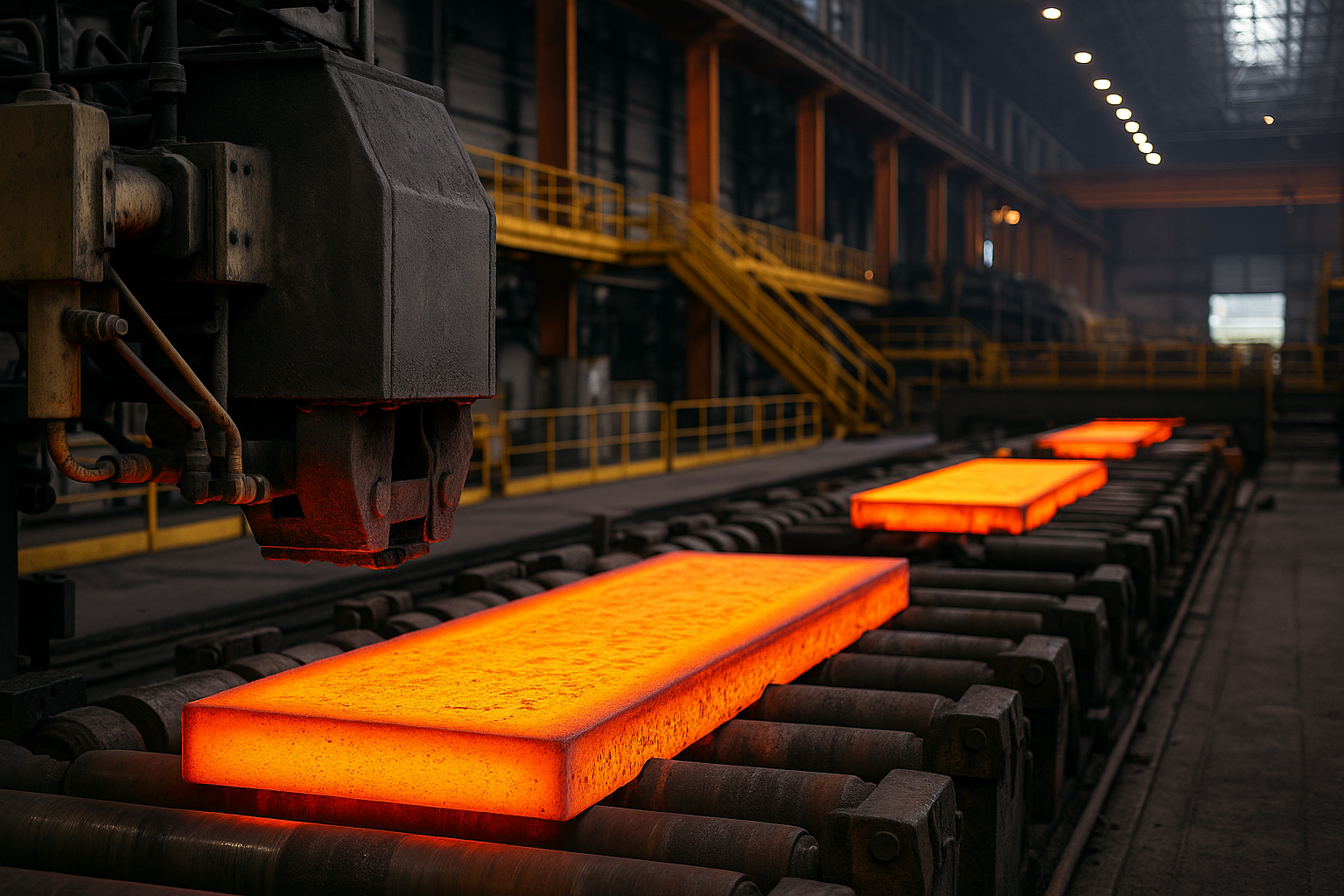
Steel manufacturing is one of the most complex industrial environments in the world.
Temperature, chemistry, pressure, electrical power, mechanical loads, cooling rates, material flow and equipment condition interact continuously across interconnected production stages.
A change made in one part of the process may affect product quality, energy consumption, equipment life and production several stages later.
Traditional automation systems are excellent at controlling equipment. Historical databases are excellent at recording what happened. Process models are excellent at simulating specific conditions.
A digital twin attempts to connect these capabilities into a continuously updated representation of a physical asset, process or manufacturing system.
For steelmakers, this creates an important opportunity: instead of simply observing what is happening inside a blast furnace, electric arc furnace, continuous caster or rolling mill, engineers can increasingly use models to understand why it is happening, what may happen next and which operating decision may produce a better result.
That changes the role of digitalization.
The objective is no longer simply collecting more production data.
The objective is converting data into better operational decisions.
What Is a Digital Twin — and What Is Not?
The term digital twin is frequently used too broadly.
A dashboard showing furnace temperature is not necessarily a digital twin.
A 3D model of a rolling mill is not necessarily a digital twin.
A conventional process simulation is not automatically a digital twin either.
A useful manufacturing digital twin combines a digital representation of an observable manufacturing element with operational data and models capable of supporting analysis or decisions related to the physical system.
The ISO 23247 framework describes digital twins for manufacturing as systems that can support functions such as real-time control, predictive maintenance, in-process adaptation, analytics, validation and machine learning.
The distinction can be summarized as follows:
| System | Connection with Physical Process | Dynamic Updating | Typical Purpose |
|---|---|---|---|
| Static engineering model | None | No | Design/documentation |
| Conventional simulation | Usually offline | Scenario-based | What-if analysis |
| Monitoring dashboard | Real-time data | Yes | Visibility |
| Predictive model | Historical/real-time data | Periodic or continuous | Forecasting |
| Digital twin | Physical + digital connection | Continuous or event-driven | Monitoring, prediction and decision support |
| Advanced closed-loop twin | Bidirectional integration | Continuous | Optimization and controlled intervention |
The most important distinction is therefore not visualization.
It is the connection between the physical process, its digital representation and a defined operational purpose.
Why Steel Manufacturing Is Particularly Suitable for Digital Twins
Steel production combines several characteristics that make digital twins especially valuable.
Processes operate under extreme temperatures and mechanical loads. Many critical variables cannot be directly observed inside equipment. Production is continuous or highly interconnected. Energy consumption is substantial. Small deviations can produce large economic consequences.
Consider hot rolling.
A dimensional deviation of only a few hundredths of a millimeter can affect metal consumption, yield, downstream processing and customer acceptance.
Or consider an electric arc furnace.
Scrap composition, electrical energy, oxygen injection, carbon addition, slag behavior and tapping temperature interact during every heat.
The physical process contains far more information than an operator can evaluate simultaneously.
Digital twins can provide an additional analytical layer.
Instead of asking only:
What is happening?
the manufacturing organization can progressively ask:
Why is it happening?
What is likely to happen next?
and eventually:
What operating condition should we use?
That progression is central to understanding the economic potential of digital twins.
The Architecture of a Steel Manufacturing Digital Twin
A steel digital twin does not begin with artificial intelligence.
It begins with reliable measurement.
A typical architecture contains several interconnected layers.
Physical process layer
This is the actual production environment:
blast furnace, EAF, ladle furnace, continuous caster, reheating furnace, rolling mill, cooling system, galvanizing line or other manufacturing asset.
Measurement and control layer
Sensors and automation systems capture variables such as:
temperature, pressure, vibration, electrical current, torque, flow, speed, chemical composition, strip tension, thickness, position and energy consumption.
PLC and distributed control systems execute the actual control logic.
Operational data layer
Information may come from:
SCADA, historian databases, laboratory systems, MES, maintenance systems, quality databases and ERP platforms.
Modeling layer
The digital representation may combine several types of models:
physical models, thermodynamic models, finite-element models, statistical models, machine-learning models and equipment degradation models.
Analytics and decision layer
The system transforms model outputs into operational information.
Examples include:
predicted bearing failure, expected strip thickness deviation, estimated furnace energy requirement, quality risk or recommended process adjustment.
Human and control interface
Operators, engineers, maintenance personnel and managers use the information.
In more advanced applications, selected recommendations may be transmitted back to automation systems under controlled governance.
This final point is critical.
A sophisticated mathematical model disconnected from operational decisions may be technically impressive but economically irrelevant.
Physics-Based, Data-Driven and Hybrid Digital Twins
Not every digital twin uses the same modeling philosophy.
Three broad approaches are particularly relevant to steelmaking.
Physics-based twins
These models represent the underlying physical phenomena.
Examples include heat transfer, fluid flow, solidification, mechanical deformation, combustion or thermodynamics.
Their major advantage is interpretability.
Engineers can relate outputs to known physical mechanisms.
Their disadvantage is computational complexity and the difficulty of representing every real-world disturbance.
Data-driven twins
These models learn relationships from operating data.
Machine-learning algorithms can detect patterns that may be extremely difficult to describe analytically.
They are particularly useful for anomaly detection, quality prediction and equipment-condition monitoring.
However, data-driven models depend heavily on data quality and on whether future operating conditions resemble the conditions represented in the training data.
Hybrid twins
For many steel applications, the strongest approach may combine both.
A physics-based model establishes process behavior while machine learning corrects, estimates or predicts effects that are difficult to model explicitly.
This hybrid architecture is particularly attractive for complex industrial processes because it combines engineering knowledge with operational learning.
Blast Furnace Digital Twins
The blast furnace is a strong candidate for digital-twin technology because important phenomena occur inside an environment that cannot be directly observed during normal operation.
Operators must infer internal conditions from measurements such as gas composition, pressure, temperature, burden distribution and material balance.
A digital representation can integrate these signals with process models to estimate internal furnace behavior.
Potential applications include burden-distribution analysis, thermal-state estimation, fuel-rate optimization, abnormal-condition detection and refractory monitoring.
The economic objective is not simply to create a virtual blast furnace.
It is to maintain a more stable physical furnace.
Greater stability can contribute to lower fuel consumption, more consistent hot-metal quality and fewer disruptive operating events.
Digital Twins for Electric Arc Furnaces
EAF steelmaking presents a different modeling challenge.
Each heat may contain different scrap grades and proportions.
Electrical energy, burners, oxygen, carbon injection and slag practice must respond to this changing metallic charge.
An EAF twin can integrate charge information with electrical, chemical and thermal data to estimate the progression of the heat.
Potential outputs include expected energy demand, predicted tapping temperature, process duration, slag condition and endpoint behavior.
For scrap-intensive production, one particularly valuable application is connecting scrap mix optimization with furnace performance.
A scrap grade cannot be evaluated solely by purchase price.
Its true economic value may also depend on metallic yield, residual elements, density, charging behavior, melting energy and productivity.
A sufficiently mature digital twin can help connect these variables.
Continuous Casting: Predicting Quality Before the Defect Appears
Continuous casting transforms liquid steel into a solid product while controlling one of the most sensitive metallurgical transitions in the production chain.
Shell formation, mold behavior, secondary cooling, casting speed and steel composition interact continuously.
Digital twins can combine thermal and solidification models with operating data to estimate conditions that cannot be measured directly throughout the strand.
Potential applications include:
surface-defect risk, breakout prediction, solidification position, cooling optimization, temperature evolution and internal-quality prediction.
The strategic benefit is significant.
Traditional inspection identifies a defect after it has already been produced.
A predictive twin attempts to identify the conditions leading to the defect while production is still occurring.
That changes quality management from inspection toward prevention.
Digital Twins in Hot and Cold Rolling Mills
Rolling mills contain an enormous amount of useful operational information.
Roll force, torque, speed, tension, temperature, vibration, roll gap and thickness measurements are continuously generated.
The difficulty is converting them into coordinated process decisions.
A rolling-mill twin can model relationships between incoming material properties, rolling parameters and final dimensions.
For hot rolling, applications can include temperature evolution, rolling force, shape, dimensional control and equipment loading.
For cold rolling, the model may support thickness control, flatness, tension management, roll-wear analysis and surface-quality prediction.
Digital commissioning is another important application.
Industrial technology suppliers are increasingly using virtual representations of plants and automation systems to test equipment behavior and control logic before or during physical commissioning.
This can reduce commissioning risk because errors can be detected in the digital environment rather than during production ramp-up.
Cooling, Heat Treatment and Coating Lines
The final properties of steel are not determined only by chemical composition.
Thermal history is equally important.
Cooling rate can affect microstructure, strength, hardness and dimensional behavior.
Digital twins can therefore model strip or plate temperature through cooling and heat-treatment stages.
In advanced steels, this becomes particularly important because increasingly narrow processing windows may separate acceptable material from downgraded production.
Coating lines offer another opportunity.
Strip temperature, line speed, bath conditions, coating weight and cooling behavior can be integrated into digital models to improve consistency.
The principle is the same throughout the steel plant:
measure → model → predict → optimize.
Predictive Maintenance: From Failure History to Equipment Health
Predictive maintenance is one of the most commercially attractive digital-twin applications.
Traditional preventive maintenance asks:
When is maintenance scheduled?
Predictive maintenance asks:
What is the actual condition of the equipment?
A digital twin adds another question:
How should this equipment behave under its current operating conditions?
That distinction matters.
A gearbox operating under heavy load may naturally exhibit different vibration behavior from the same gearbox under light load.
Simply comparing vibration against a fixed alarm threshold can therefore produce misleading conclusions.
A twin can compare actual behavior with expected behavior under the current operating regime.
Potential applications include rolling-mill gearboxes, motors, bearings, pumps, fans, hydraulic systems, cranes and continuous-caster equipment.
The economic objective is not to eliminate maintenance.
It is to replace unnecessary intervention and unexpected failure with condition-informed maintenance decisions.
Quality Prediction and Process Optimization
Steel quality is produced through a chain of process decisions.
Chemistry influences transformation behavior.
Temperature affects rolling and microstructure.
Rolling affects dimensions and mechanical properties.
Cooling influences final properties.
A defect found at final inspection may therefore have originated several process stages earlier.
Digital twins can help create a continuous relationship between process history and product outcome.
This creates the possibility of predicting quality before final laboratory or inspection results become available.
The concept is particularly powerful when combined with a digital thread connecting product and process information throughout manufacturing.
ISO 23247-5:2026 specifically addresses digital threads for digital twins across lifecycle stages including design, planning, production and testing.
For steelmakers, this points toward an important future capability:
a digital production history for every coil, plate, bar, slab or heat.
Energy Optimization and Decarbonization
Energy optimization is another natural digital-twin application.
Steel production contains multiple energy transformations involving electricity, natural gas, coal, process gases, steam and recovered heat.
Traditional energy management often analyzes consumption after production.
Digital twins can potentially move analysis closer to real time.
A reheating-furnace twin, for example, may evaluate thermal conditions and production schedules to determine whether furnace operation is delivering the required slab temperature with unnecessary fuel consumption.
An EAF model may compare energy input with charge characteristics and process duration.
Plant-level twins can eventually connect energy generation and consumption across multiple units.
This becomes increasingly important as steelmaking transitions toward EAF expansion, hydrogen-based reduction, renewable electricity and other lower-carbon technologies.
The challenge will no longer be only minimizing energy.
It will be optimizing energy, carbon, production cost and operational constraints simultaneously.
From Equipment Twin to Plant-Wide Digital Twin
A steel plant should not necessarily begin by attempting to create a single model of the entire factory.
That approach can become expensive, complex and difficult to validate.
A more practical strategy is to begin with a clearly defined asset or process.
For example:
rolling-mill gearbox → equipment twin
reheating furnace → process twin
hot-strip mill → production-line twin
multiple interconnected operations → plant twin
The newest development of ISO 23247 is particularly relevant here.
ISO 23247-6:2026, published in July 2026, addresses digital twin composition and defines integrated, unified and federated approaches for allowing independently developed twins to communicate, aggregate and interoperate.
This is an important industrial concept.
The future steel plant may not operate one enormous digital twin.
It may operate an ecosystem of specialized twins that exchange information.
AI + Digital Twins: Moving From Prediction Toward Prescriptive Control
Artificial intelligence expands what a digital twin can do.
A conventional model may calculate expected process behavior.
Machine learning may identify complex relationships within large datasets.
AI can increasingly support recommendations based on multiple competing objectives.
This creates a progression:
Descriptive: What is happening?
Diagnostic: Why is it happening?
Predictive: What is likely to happen?
Prescriptive: What should we do?
Autonomous: Can the system safely optimize the decision itself?
The last stage requires caution.
Steel plants contain safety-critical and quality-critical operations.
A model should not be given control authority merely because its historical predictions appear accurate.
Advanced automation therefore requires model validation, defined operating envelopes, cybersecurity, fallback strategies and appropriate human oversight.
The Steel in Focus Digital Twin Maturity Model
A useful way to evaluate digitalization is not to ask whether a company “has a digital twin.”
The better question is:
What level of operational capability does the digital twin provide?
| Level | Capability | Characteristics | Typical Industrial Value |
|---|---|---|---|
| 0 | Conventional operation | Independent systems and historical analysis | Basic process control |
| 1 | Connected asset | Sensors and real-time monitoring | Visibility |
| 2 | Descriptive twin | Digital representation synchronized with process | Situational understanding |
| 3 | Predictive twin | Forecasting of equipment/process behavior | Failure, quality and energy prediction |
| 4 | Prescriptive twin | Recommended operational actions | Decision optimization |
| 5 | Intelligent closed-loop twin | Controlled automated optimization with governance | Adaptive operation |
This maturity model prevents a common mistake:
investing heavily in visualization while assuming that visualization itself creates industrial intelligence.
A visually impressive 3D model may remain at Level 2.
A much less visually sophisticated predictive model connected to a critical production decision may already generate substantial economic value at Level 3 or 4.
The Business Case: How Does a Digital Twin Create Financial Value?
Digital-twin projects should ultimately be evaluated economically.
The business case can be expressed as:
Annual Digital Twin Value = Downtime Savings + Yield Improvement + Energy Savings + Quality Savings + Maintenance Savings + Throughput Gains − Annual Twin Operating Cost
Consider a hypothetical rolling operation.
| Value Driver | Current Condition | Improvement | Estimated Annual Value |
|---|---|---|---|
| Unplanned downtime | $2.0 million/year | 10% reduction | $200,000 |
| Quality losses | $3.0 million/year | 5% reduction | $150,000 |
| Energy cost | $8.0 million/year | 1.5% reduction | $120,000 |
| Maintenance cost | $2.5 million/year | 4% reduction | $100,000 |
| Additional throughput contribution | — | — | $180,000 |
| Gross annual benefit | $750,000 | ||
| Twin operation/support | −$200,000 | ||
| Net annual benefit | $550,000 |
These values are illustrative, not industry benchmarks.
The purpose of the model is methodological.
A digital twin should not be justified because it is innovative.
It should be justified because it improves an economically important process variable.
The Steel in Focus Digital Twin Value Matrix
Another useful prioritization tool is to compare candidate applications according to business impact and implementation feasibility.
| Application | Potential Value | Data Requirement | Modeling Complexity | Suggested Priority |
|---|---|---|---|---|
| Critical bearing monitoring | Medium–High | Medium | Medium | High |
| Rolling thickness prediction | High | High | High | High |
| Furnace energy optimization | High | High | High | High |
| Plant-wide simulation | Very High | Very High | Very High | Later stage |
| Operator training twin | Medium | Medium | Medium | Medium |
| Surface-quality prediction | High | Very High | High | High where data quality exists |
| Production scheduling twin | High | High | High | Medium–High |
| Carbon/emissions optimization | Increasingly High | High | High | Strategic |
The best first project is therefore not necessarily the largest.
It is usually the application where:
economic impact is high + data quality is sufficient + physical behavior is understood + results can be validated.
KPIs for Digital Twin Performance
Digital-twin projects need two categories of indicators.
The first measures the model.
The second measures the business result.
| Area | KPI |
|---|---|
| Prediction | Forecast error |
| Reliability | False-positive / false-negative rate |
| Data | Sensor/data availability |
| Model | Validation error |
| Maintenance | Unplanned downtime |
| Quality | Scrap/rework/downgrade rate |
| Energy | kWh or GJ per tonne |
| Yield | Saleable tonnes / input tonnes |
| Productivity | Tonnes per operating hour |
| Financial | Annual validated savings |
| Adoption | Percentage of recommendations used |
| Availability | Twin uptime |
| Model health | Model drift |
A project that reports excellent prediction accuracy but cannot demonstrate operational improvement may still be a research project rather than a successful industrial implementation.
Verification, Validation and Uncertainty: Can the Twin Be Trusted?
This is one of the most important issues missing from many discussions about digital twins.
A model receiving real-time data is not automatically correct.
Sensors contain measurement uncertainty.
Process conditions change.
Equipment ages.
Raw materials change.
Production mixes change.
Machine-learning relationships can drift.
NIST specifically identifies Verification, Validation and Uncertainty Quantification (VVUQ) as fundamental to establishing digital-twin credibility and argues that these activities should continue throughout the twin lifecycle.
Verification asks whether the model was implemented correctly.
Validation asks whether the model adequately represents the real system for its intended use.
Uncertainty quantification asks how confident users should be in the result.
This creates an important engineering principle:
Digital-twin credibility must be evaluated relative to the decision the model is expected to support.
A model used for maintenance screening may tolerate greater uncertainty than a model authorized to automatically change a critical process parameter.
NIST’s ongoing Digital Twins for Advanced Manufacturing program now includes work toward a proposed VVUQ framework as Part 7 of ISO 23247, demonstrating how central model credibility has become to the field.
Model Drift: The Twin Must Age With the Plant
A digital twin built during commissioning does not remain accurate indefinitely.
The physical plant changes.
Rolls wear.
Refractories deteriorate.
Sensors are replaced.
Raw-material characteristics change.
Maintenance alters mechanical behavior.
Production recipes evolve.
A model calibrated two years earlier may therefore slowly stop representing the plant.
This is known broadly as model drift.
Digital-twin governance should consequently include periodic comparison between predictions and actual outcomes.
When prediction error begins to increase, the organization must determine whether the cause is:
measurement error, data problems, physical process change or model deterioration.
The twin itself therefore requires maintenance.
Cybersecurity: A Digital Twin Creates New Connections — and New Risks
Digital twins connect operational technology, industrial data and increasingly enterprise or cloud systems.
Those connections create value.
They also create additional attack surfaces.
A compromised monitoring twin could produce misleading information.
A compromised prescriptive twin could generate inappropriate recommendations.
A compromised closed-loop system could potentially influence physical operations.
NIST IR 8356, published in February 2025, specifically addresses cybersecurity and trust considerations associated with digital-twin technology.
Cybersecurity must therefore be designed into the architecture rather than added after implementation.
Particularly important areas include identity and access control, network segmentation, data integrity, secure communications, model integrity, software updates, auditability and control-authority boundaries.
The more operational authority the twin receives, the more rigorous these protections must become.
ISO 23247: Building a Common Digital Twin Framework
Digital twins are inherently interdisciplinary.
They combine manufacturing equipment, automation, data systems, simulation, communications and analytics.
Without common architectures, interoperability becomes difficult.
The ISO 23247 series addresses this problem by defining a digital-twin framework specifically for manufacturing.
The original 2021 framework covers general principles, reference architecture, information attributes and information exchange.
The framework has continued evolving.
ISO 23247-5:2026, published in June 2026, addresses digital threads connecting lifecycle information to digital twins.
ISO 23247-6:2026, published in July 2026, addresses the composition of multiple digital twins and their interoperability.
This evolution is particularly relevant to steel manufacturing because a steel plant contains many independent equipment and process systems.
Standardization increases the possibility that specialized twins can eventually interact instead of remaining isolated digital projects.
A 10-Step Methodology for Implementing a Digital Twin in a Steel Plant
Step 1 — Define the business problem
Do not begin with technology.
Begin with a measurable industrial problem.
Examples include excessive bearing failures, furnace energy consumption, thickness variation, quality downgrade or casting instability.
Step 2 — Establish the baseline
Quantify current performance before implementing the twin.
Without a baseline, ROI cannot be demonstrated.
Step 3 — Map available data
Identify sensors, historian records, laboratory results, maintenance data, MES information and other relevant sources.
Step 4 — Evaluate data quality
Determine completeness, accuracy, sampling frequency, synchronization and missing-data problems.
Bad data connected to a sophisticated model still produces bad decisions.
Step 5 — Select the modeling approach
Choose physics-based, data-driven or hybrid modeling according to the application.
Step 6 — Build the minimum viable twin
Start with the smallest model capable of solving the defined problem.
Avoid unnecessary complexity.
Step 7 — Verify and validate
Compare twin outputs with actual plant behavior across representative operating conditions.
Step 8 — Integrate with the operational workflow
Determine who receives the information, when they receive it and what action should follow.
Step 9 — Measure economic performance
Track operational and financial KPIs against the original baseline.
Step 10 — Scale only after value is demonstrated
Once credibility and ROI are established, connect additional assets, processes or production stages.
This approach reduces both technological and financial risk.
Legacy Systems Are Not Automatically a Barrier
Many steel plants contain equipment installed decades ago.
This does not automatically prevent digital-twin implementation.
The physical machine does not need to be new.
What matters is whether the relevant operating state can be measured or estimated and whether information can be extracted reliably.
Older equipment may require additional sensors, gateways or data-integration layers.
The difficulty is often not the machine itself.
It is fragmented information.
One variable may reside in a PLC.
Another in the historian.
Quality results may reside in a laboratory database.
Maintenance history may exist in a CMMS.
Production orders may come from MES or ERP.
Creating a digital twin frequently becomes as much a data-engineering project as a modeling project.
Common Digital Twin Implementation Mistakes
Mistake 1 — Starting with the technology instead of the business problem
A digital twin without a defined operational decision quickly becomes an expensive demonstration.
Mistake 2 — Assuming more sensors automatically mean better intelligence
Data volume and data value are different concepts.
Mistake 3 — Ignoring sensor quality
Model accuracy cannot consistently exceed the credibility of its inputs.
Mistake 4 — Building excessive model fidelity
The most detailed model is not always the most useful model.
Fidelity should match the intended decision.
Mistake 5 — Ignoring operators
Experienced operators possess process knowledge that may never appear explicitly in databases.
Mistake 6 — Treating AI as a replacement for metallurgy and process engineering
Algorithms identify relationships.
Engineering determines whether those relationships make physical and operational sense.
Mistake 7 — Skipping validation
A model that performs well on historical data may fail under new production conditions.
Mistake 8 — Ignoring model drift
The physical plant evolves, so the twin must evolve as well.
Mistake 9 — Forgetting cybersecurity
Connectivity without security creates operational risk.
Mistake 10 — Measuring technological performance instead of economic performance
The ultimate question is not whether the twin works.
It is whether the steel plant performs better because the twin exists.
The Future: From Smart Steelmaking to Autonomous Optimization
The direction of digital-twin development is becoming clearer.
Individual asset twins will increasingly be connected through digital threads.
Multiple twins will increasingly communicate through standardized architectures.
Artificial intelligence will expand predictive and prescriptive capability.
Carbon, energy, production, quality and maintenance models will increasingly interact.
NIST’s July 2026 workshop report identifies interoperability, VVUQ, cybersecurity and workforce readiness among the continuing challenges for trustworthy and scalable digital twins in manufacturing.
This is significant.
The technological challenge is no longer simply creating digital models.
The challenge is creating models that are interoperable, credible, secure, scalable and economically useful.
For steelmakers, that could eventually lead toward semi-autonomous production environments where thousands of process variables are continuously evaluated and optimized while engineers define constraints, objectives and governance.
The steel plant of the future will therefore not simply contain more automation.
It will increasingly contain digital representations capable of learning from and reasoning about the physical production system.
Frequently Asked Questions
What is a digital twin in steel manufacturing?
A digital twin is a digital representation of a physical manufacturing asset, process or system connected to operational information and designed to support functions such as monitoring, prediction, simulation or optimization.
How is a digital twin different from conventional simulation?
A conventional simulation normally analyzes predefined scenarios. A digital twin maintains a connection with the physical system and is updated using operational information.
Does a digital twin require artificial intelligence?
No. Digital twins may use physical, statistical or conventional simulation models. AI and machine learning can enhance their capabilities but are not mandatory.
Can an old steel plant implement digital twins?
Yes. Legacy equipment can often be integrated using additional sensors, industrial gateways and data-integration systems. The main challenge is frequently data availability and interoperability.
Where should a steelmaker implement its first digital twin?
A high-value process with adequate data and measurable performance is usually preferable to attempting a plant-wide project immediately.
Can digital twins reduce energy consumption?
Potentially, yes. Models can identify inefficient operating conditions and support optimization of furnaces, EAFs, rolling processes, cooling systems and other energy-intensive operations. Actual savings depend on the process and implementation.
Can digital twins improve steel quality?
Yes. Process and quality data can be connected to predict dimensional, surface or metallurgical outcomes and identify abnormal conditions earlier.
How accurate must a digital twin be?
There is no universal accuracy requirement. Required credibility depends on the intended decision. A monitoring application and an automated control application require different levels of confidence.
What is ISO 23247?
ISO 23247 is an international standards series establishing a digital-twin framework for manufacturing, including architecture, information exchange, digital thread and digital-twin composition.
What is the biggest mistake companies make with digital twins?
Treating the digital twin as an IT project rather than an industrial-performance project. The technology should begin with a measurable manufacturing problem and finish with a measurable operational result.
Conclusion: A Digital Twin Is Valuable Only When the Physical Plant Improves
Digital twins represent an important evolution in steel manufacturing.
But the real transformation is not the virtual model.
It is the decision-making capability created around the model.
A blast-furnace twin is valuable if it improves furnace stability.
A rolling-mill twin is valuable if it improves dimensional control or equipment reliability.
A maintenance twin is valuable if it reduces unplanned downtime.
An energy twin is valuable if it reduces energy cost without compromising production.
And a plant-wide twin is valuable only if connecting multiple processes produces better decisions than optimizing each operation independently.
This leads to a simple principle:
The economic value of a digital twin exists in the physical plant — not in the digital model.
As digital threads, AI, interoperability standards and digital-twin composition mature, steel manufacturers will gain increasingly powerful tools for connecting process engineering with real-time operational intelligence.
The companies that benefit most will not necessarily be those that build the most complex twins.
They will be those that identify the right industrial problems, establish credible models, integrate them into decision-making and continuously measure the resulting value.
That is how digital twins move from an Industry 4.0 concept to a practical instrument for productivity, quality, reliability, energy efficiency and competitive steel manufacturing.
Sources and Further Reading
- NIST — Digital Twins for Advanced Manufacturing — programa atualizado em julho de 2026, incluindo ISO 23247, digital thread e desenvolvimento do framework VVUQ.
- NIST — Credibility Consideration for Digital Twins in Manufacturing — referência para Verification, Validation and Uncertainty Quantification.
- NIST — Digital Twins Workshops Summary Report 2026 — interoperabilidade, VVUQ, cybersecurity e workforce readiness.
- NIST — Security and Trust Considerations for Digital Twin Technology — NIST IR 8356, publicado em 2025.
- ISO — ISO 23247-4:2021 Information Exchange — requisitos de troca de informações da arquitetura.
- ISO — ISO 23247-5:2026 Digital Thread for Digital Twin — conexão de dados ao longo do ciclo de vida.
- ISO — ISO 23247-6:2026 Digital Twin Composition — composição e interoperabilidade entre múltiplos digital twins.