
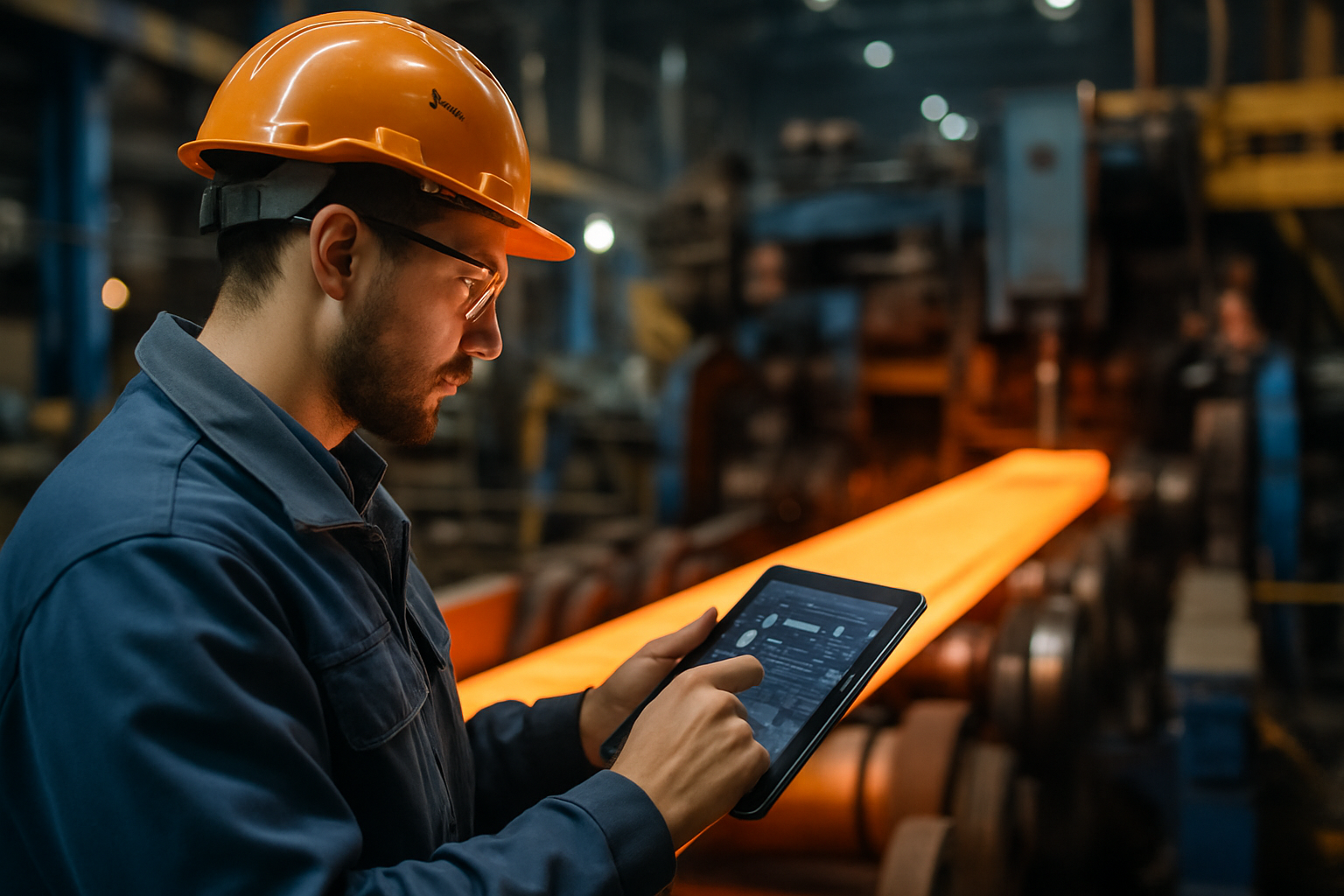
Steel manufacturing has always depended on skilled people.
Operators understand how a process behaves beyond what is written in an operating procedure. Maintenance technicians recognize patterns that precede equipment failure. Metallurgists connect process conditions with microstructure and product performance. Quality professionals identify recurring defect mechanisms. Production supervisors understand how hundreds of operational decisions interact during a shift.
What is changing is the environment in which these professionals work.
Modern steel plants increasingly combine automation, advanced process control, Manufacturing Execution Systems (MES), condition monitoring, machine vision, predictive analytics, artificial intelligence, digital twins and integrated data platforms.
As a result, industrial knowledge alone is no longer sufficient.
Workers increasingly need to understand how to interpret digital information, evaluate its reliability and convert it into better operational decisions.
This does not mean turning every operator into a programmer or every metallurgist into a data scientist.
It means developing the digital capabilities appropriate to each role.
For steelmakers, this distinction is critical.
Digital transformation is not primarily a software deployment problem.
It is a capability-development problem.
A company may invest millions in sensors, automation and analytics and still capture only a fraction of the potential value if the workforce cannot effectively use the information those technologies generate.
What Digital Skills Mean in Modern Steel Manufacturing
Digital skills in a steel plant extend far beyond basic computer literacy.
They represent the ability to interact effectively with the digital systems that support industrial operations.
Depending on the role, these capabilities may include:
- navigating Human-Machine Interfaces (HMIs);
- interpreting process trends and alarms;
- using MES and production-management systems;
- accessing digital Standard Operating Procedures;
- understanding condition-monitoring information;
- working with digital maintenance records;
- interpreting quality dashboards;
- using mobile inspection applications;
- understanding sensor reliability;
- analyzing production data;
- interacting safely with automated systems;
- using AI-assisted tools;
- understanding the limitations of algorithms and automated recommendations.
The required level varies considerably across functions.
An operator may need to understand process trends and recognize abnormal patterns.
A maintenance technician may need to interpret vibration, temperature and condition-monitoring data.
A process engineer may need to analyze large datasets to identify relationships between operating parameters and product performance.
A digital specialist may develop predictive models.
Management must understand enough about these systems to evaluate investments, risks and business outcomes.
This leads to an important distinction:
Digital literacy → Digital capability → Digital expertise
Digital literacy means understanding and using digital information.
Digital capability means applying that information effectively to industrial decisions.
Digital expertise involves designing, developing or optimizing the technologies themselves.
A steel plant needs all three—but not necessarily in every employee.
Why Digital Transformation Fails Without Workforce Capability
Technology creates potential.
People convert that potential into operational performance.
Consider a predictive-maintenance system monitoring bearings on a critical rolling-mill drive.
The system may continuously analyze vibration, temperature and other variables and generate an alert indicating abnormal behavior.
But the alert itself does not prevent failure.
Someone must determine:
Is the signal reliable?
Has the operating condition changed?
Is the vibration associated with load, alignment, lubrication or bearing degradation?
Should production continue?
Should maintenance inspect the equipment immediately?
Can the intervention wait for a planned shutdown?
The value emerges from the combination of:
sensor + data + algorithm + equipment knowledge + operational context + decision
Remove any of those elements and the quality of the decision may deteriorate.
The same principle applies to process optimization.
An AI model may identify a relationship between furnace parameters and energy consumption. But metallurgical and operational knowledge is still necessary to determine whether the recommendation is technically feasible, safe and repeatable.
Digital transformation therefore changes the role of industrial professionals rather than simply replacing their knowledge.
The Digital Skill Architecture of a Steel Plant
A useful workforce strategy should avoid the common mistake of giving everyone the same digital training.
Training should follow the decisions people are expected to make.
Operators
Operators are closest to the process.
Their digital capabilities should therefore emphasize:
- HMI navigation;
- process visualization;
- alarm interpretation;
- trend analysis;
- MES interaction;
- digital production records;
- abnormal-condition recognition;
- standardized digital workflows.
The objective is not programming.
It is better process awareness and faster, more consistent decision-making.
Maintenance technicians
Maintenance increasingly operates in a condition-based environment.
Relevant capabilities include:
- Computerized Maintenance Management Systems (CMMS);
- digital work orders;
- equipment history;
- vibration monitoring;
- thermal inspection;
- sensor diagnostics;
- predictive-maintenance alerts;
- mobile maintenance applications;
- digital troubleshooting procedures.
The transition is important because maintenance moves gradually from:
failure → repair
toward:
condition → prediction → planned intervention
Process and metallurgical engineers
Engineers increasingly need stronger data-literacy capabilities.
These may include:
- statistical analysis;
- process-data extraction;
- trend correlation;
- process capability;
- visualization tools;
- model interpretation;
- experimentation;
- understanding AI-generated recommendations.
The purpose is not necessarily to develop algorithms.
It is to combine metallurgical reasoning with evidence from data.
Quality professionals
Digital quality systems are increasingly connected to production genealogy, machine vision, laboratory information and process parameters.
Relevant capabilities include:
- digital defect classification;
- automated inspection systems;
- quality dashboards;
- traceability;
- statistical process control;
- defect genealogy;
- correlation between process variables and nonconformities.
This can shift quality management from detecting defects toward understanding and preventing them.
Automation, IT and OT specialists
These professionals require deeper technical expertise.
Their role may involve:
- PLCs and control systems;
- industrial networks;
- sensor architecture;
- data historians;
- cybersecurity;
- system integration;
- industrial databases;
- advanced analytics;
- AI infrastructure.
But technical expertise alone is insufficient.
They also need enough process understanding to know whether the information being collected actually represents the physical process correctly.
Supervisors and managers
Leadership needs a different type of digital capability.
Managers must be able to ask:
What problem are we solving?
Which KPI should improve?
Is the data reliable?
What decisions will change?
What is the economic value?
What are the operational and cybersecurity risks?
What happens if the system fails?
A digitally mature organization therefore requires more than technologically skilled specialists.
It requires digital decision-making capability across multiple organizational levels.
From Data Access to Industrial Decision-Making
One of the biggest misconceptions about Industry 4.0 is that more data automatically leads to better decisions.
It does not.
Steel plants already generate enormous amounts of information from:
- process-control systems;
- laboratory systems;
- inspection equipment;
- energy monitoring;
- maintenance databases;
- MES;
- ERP;
- machine vision;
- sensors;
- logistics systems.
The real challenge is converting this information into industrial knowledge.
A useful maturity sequence is:
Data → Information → Interpretation → Decision → Action → Result
For example, a temperature measurement is data.
A temperature trend is information.
Recognizing that the trend differs from normal operation requires interpretation.
Determining that corrective action is necessary requires a decision.
Changing the operating parameter is an action.
Improved process stability is the result.
Digital skill development should therefore focus not only on how to use software, but on how to move through this entire decision chain.
Digital Skills Across the Steel Value Chain
Different stages of steel production create different digital capability requirements.
Steelmaking and casting
Digital systems may support:
- charge optimization;
- furnace control;
- temperature prediction;
- chemistry control;
- energy optimization;
- casting stability;
- breakout prediction;
- process genealogy.
Operators and engineers must understand both the metallurgical mechanism and the information generated by the control system.
Rolling and finishing
Digital capability becomes important for:
- dimensional control;
- thickness optimization;
- flatness;
- temperature control;
- cooling strategies;
- surface inspection;
- line speed;
- yield improvement.
A model may recommend a parameter adjustment, but process specialists must understand how that change affects downstream properties and production stability.
Maintenance and reliability
Condition monitoring generates large amounts of information.
The workforce must learn to distinguish between:
signal, noise and meaningful degradation.
Without this capability, plants can create a new problem: too many alerts and too little action.
Quality and inspection
Machine vision and automated inspection systems can identify defects at speeds impossible for manual inspection.
But algorithms still need:
- appropriate defect definitions;
- representative training data;
- validation;
- process context;
- feedback from quality specialists.
Digital inspection works best when human expertise helps continuously improve the system.
Energy and decarbonization
Digitalization also supports:
- energy monitoring;
- fuel optimization;
- electricity management;
- process efficiency;
- emissions monitoring;
- energy recovery.
As steelmakers move toward increasingly complex decarbonization routes, the ability to connect production, energy and environmental data becomes increasingly valuable.
A Practical Digital Competency Matrix for Steel Plants
A simple competency matrix can help plants avoid generic training programs.
| Workforce level | Core digital capability | Typical industrial application |
|---|---|---|
| Operator | Digital literacy | HMI, alarms, process trends, MES |
| Technician | Digital diagnostics | Sensors, condition monitoring, maintenance systems |
| Engineer | Data-driven analysis | Process trends, optimization, statistical analysis |
| Specialist | Advanced digital expertise | AI, analytics, digital twins, predictive models |
| Supervisor | Digital performance management | Dashboards, deviations, KPI management |
| Leadership | Digital decision-making | Investment, governance, risk and value creation |
The matrix should then be adapted by process area.
A blast-furnace operator and a galvanizing-line operator may occupy the same workforce level while requiring very different technical competencies.
The objective is therefore not to create a universal digital curriculum.
It is to identify the minimum digital capability required to perform each industrial role effectively.
How to Identify Digital Skill Gaps
Before launching a training program, steelmakers should identify where capability gaps actually exist.
A practical assessment can compare:
Technology available → Capability required → Current capability → Gap → Training action
Questions may include:
Can operators correctly interpret process trends?
Can maintenance technicians use condition-monitoring information?
Can engineers independently analyze process datasets?
Can quality personnel correlate defects with production genealogy?
Can supervisors distinguish between activity metrics and performance KPIs?
Can managers evaluate the business case for an AI initiative?
The assessment should also consider technology planned for the future.
If a plant expects to implement predictive maintenance within two years, workforce development should begin before the technology is fully deployed.
Training after implementation is often too late.
How Steelmakers Can Build Digital Capabilities
Different competencies require different learning methods.
On-the-job training
On-the-job training remains one of the most effective approaches because learning occurs in the actual process environment.
An operator can learn trend interpretation while observing real production behavior.
A maintenance technician can learn condition monitoring while examining actual equipment.
Context makes the learning relevant.
Simulation-based learning
Simulation allows employees to experience abnormal conditions without exposing equipment, production or people to unnecessary risk.
Applications may include:
- furnace operation;
- rolling-mill control;
- emergency response;
- equipment start-up;
- shutdown procedures;
- process deviations.
Simulation is especially valuable when the real event is dangerous, rare or expensive to reproduce.
Virtual and augmented reality
VR and AR can support training for complex procedures, maintenance tasks and hazardous environments.
Their strongest applications are generally those in which visualization and procedural repetition create clear value.
Technology should not be adopted merely because it is impressive.
The learning objective must come first.
Microlearning
Short digital modules can support frequent reinforcement.
A five- or ten-minute module may address:
- one alarm condition;
- one maintenance procedure;
- one quality defect;
- one safety rule;
- one software function.
This approach can reduce the disruption caused by long classroom programs.
Mentoring and peer learning
Digital capability development can work in both directions.
Younger professionals may be more familiar with digital tools.
Experienced employees may possess decades of process knowledge.
Pairing them can create a powerful exchange:
digital fluency ↔ industrial experience
Cross-functional digital projects
One of the strongest learning methods is solving a real industrial problem.
A team involving production, maintenance, process engineering, automation and data specialists can work on a specific challenge such as reducing downtime or improving yield.
Employees learn digital tools while simultaneously learning how other functions interpret the same process.
This approach also complements the methodology discussed in How Cross-Functional Teams Drive Innovation in Steel Manufacturing.
Why Experienced Operators Are Critical to Digital Transformation
A major industrial risk is assuming that historical operating knowledge becomes less important as automation increases.
In many cases, the opposite is true.
Experienced operators and technicians possess tacit knowledge accumulated through thousands of operating situations.
They may recognize:
- unusual equipment sounds;
- abnormal process behavior;
- subtle relationships between variables;
- recurring failure patterns;
- conditions that precede quality problems.
Much of this knowledge may never have been formally documented.
Digital transformation creates an opportunity to capture it.
For example, if an experienced operator recognizes a particular combination of temperature, pressure and equipment behavior as an early warning condition, that knowledge can potentially be investigated using historical data.
If the relationship is confirmed, it may become:
experience → hypothesis → data analysis → rule/model → standardized knowledge
This is a much more productive approach than treating digitalization as a replacement for experienced workers.
Human Knowledge + Data + AI
Artificial intelligence is expanding rapidly across manufacturing.
But industrial AI should not be treated as an autonomous source of truth.
A model can identify patterns that humans may not detect easily.
Humans can understand physical mechanisms, operating constraints, safety implications and exceptional situations that may not be adequately represented in the training data.
The strongest model is therefore:
Human knowledge + Process data + AI → Better industrial decisions
This also changes the skills workers need.
Future digital capability will increasingly include the ability to:
- question AI recommendations;
- recognize unreliable outputs;
- understand data limitations;
- provide process context;
- validate results;
- know when human intervention is necessary.
In industrial environments, critical thinking becomes more important—not less—as automation increases.
Industrial Case: Tata Steel’s Digital and Workforce Capability Development
Tata Steel provides a useful example of the scale at which digital transformation and workforce capability are converging.
In its FY2025-26 reporting, the company describes Digital and AI as a strategic enabler and reports large-scale adoption of artificial intelligence throughout its operations. Tata Steel states that 860 AI models and agents were deployed across its value chain, covering employee and customer experiences, safety and autonomous business processes. It also reports AI-enabled remote operations and maintenance supporting predictive, real-time asset management.
This technology deployment exists alongside substantial investment in people.
For FY2025-26, Tata Steel reports 77,000+ employees, approximately 76 training hours per employee and more than 529 thousand person-days of employee training across its steelmaking entities.
The relationship between technology and capability is particularly important.
The same reporting describes more than 12,000 ASPIRE projects, 3,500+ Kaizens and 5,309 Quality Circles, while capability-building initiatives trained more than 3,700 employees in TQM competencies. Tata Steel Thailand also launched an AI & Analytics Mind platform intended to institutionalize data-driven capability development.
Tata Steel’s major manufacturing sites provide another indicator of this transformation. The company reports that its IJmuiden, Kalinganagar and Jamshedpur operations have received World Economic Forum Global Lighthouse recognition associated with advanced adoption of technologies such as AI, Big Data and Machine Learning.
The lesson is not that every steelmaker needs hundreds of AI models.
The more transferable lesson is that technology deployment, continuous improvement and workforce capability must evolve together.
Industrial Case: POSCO’s New Collar Model
POSCO offers another useful approach.
Its New Collar Level Certification System was created to develop employees capable of using emerging IT technologies to improve work and create value.
Rather than treating digital competency as a single skill, POSCO structured the system into four proficiency levels, with training ranging from basic data utilization to more advanced applications involving AI and Big Data. Employees who achieve certification can receive HR-related incentives, including preferential opportunities for overseas study.
The approach is particularly relevant because it connects:
learning → demonstrated capability → certification → career incentive
POSCO’s current digital learning environment also supports access through computers, tablets and smartphones and includes e-learning, e-books, audiobooks and immersive 3D/VR content. The company reports using an AI-powered recommendation engine to personalize learning according to employees’ roles and interests.
The New Collar concept has continued beyond its initial launch. In 2024, POSCO’s Gwangyang Steelworks reported AI and data-analysis training covering tools including Python and Dataiku as part of its workforce digital capability program.
This provides a practical model for steelmakers:
Digital capability can be treated as a structured professional competency, rather than an occasional training course.
Why Digital Upskilling Programs Fail
Digital training can fail even when the technology and course content are technically sound.
Training disconnected from real work
Generic software training often has limited impact.
Employees learn faster when the training is connected to an actual operational decision.
Too much technology, too little process
A technically impressive dashboard creates little value if employees do not understand the process variables behind it.
One curriculum for everyone
Operators, engineers, maintenance specialists and managers need different capabilities.
Role-specific training is more effective than universal training.
Lack of time for application
Training without subsequent practice deteriorates quickly.
Employees need opportunities to use the capability on real problems.
Measuring attendance instead of capability
Completing a course does not prove that someone can apply the skill.
Plants should evaluate demonstrated competence.
Ignoring experienced workers
Digital programs designed without frontline participation may fail to capture important process knowledge.
Technology changes faster than training
Digital capability cannot be treated as a one-time qualification.
It requires continuous learning.
KPIs for Digital Skill Development
Training programs should ultimately be connected to industrial outcomes.
Useful learning indicators may include:
- training hours;
- certification completion;
- competency assessment scores;
- percentage of roles meeting required digital capability;
- employee participation.
But these should not be the only measures.
The stronger question is whether capability development improves the process.
Depending on the initiative, operational KPIs might include:
- OEE;
- unplanned downtime;
- MTBF;
- yield;
- defect rate;
- energy consumption;
- process variability;
- maintenance response time;
- quality claims;
- lead time.
The measurement chain should ideally be:
Training → Capability → Behavior → Process improvement → Business result
For example:
condition-monitoring training → better diagnosis → earlier intervention → fewer failures → higher availability
That is much more meaningful than reporting training hours alone.
A Practical Implementation Framework
A steel plant does not need to begin with a large corporate academy.
It can start with one important business problem.
A practical sequence is:
Business Problem → Technology → Roles Affected → Skills Required → Gap Assessment → Training → Application → Validation → Standardization
Suppose a plant wants to reduce recurring downtime on a critical production line.
The company could identify:
Business problem: excessive unplanned downtime.
Technology: condition monitoring and predictive analytics.
Roles affected: operators, maintenance technicians, reliability engineers and supervisors.
Capabilities required: alarm interpretation, vibration analysis, equipment history, trend analysis and maintenance planning.
Training: targeted modules plus supervised application.
Validation: compare diagnosis quality, intervention timing and equipment reliability before and after implementation.
Standardization: incorporate the new capability into job requirements, maintenance procedures and recurring training.
This makes digital development part of operational improvement rather than a separate HR initiative.
Sources and Further Reading
For readers who want to explore the industrial cases and workforce-development approaches discussed in this article, the following primary corporate sources provide additional information:
Tata Steel — Integrated Report & Annual Accounts 2025-26
Corporate reporting covering digital transformation, artificial intelligence, advanced manufacturing and workforce capability development.
POSCO — Sustainability Report 2023
Corporate sustainability reporting covering POSCO’s Learning Platform, New Collar Certification System, digital capability levels and workforce development.
POSCO — Human Rights & Talent Development
Current corporate ESG information covering employee development, digital learning and the New Collar Certification System.
Frequently Asked Questions
Are digital skills only important for engineers and IT professionals?
No. Digital technologies increasingly influence operators, maintenance technicians, quality professionals, supervisors and managers. The required competency level differs by role, but digital capability is becoming relevant across the industrial workforce.
Do steel plant operators need to learn programming?
Usually not. Most operators need strong capabilities in process visualization, HMI use, alarm interpretation, digital procedures and production systems. Programming may be appropriate for specific technical roles but should not be treated as a universal requirement.
Can experienced workers adapt to digital technologies?
Yes. Industrial experience can actually make digital tools more valuable because experienced professionals understand the physical process behind the data. Effective programs combine digital learning with existing process expertise.
Will AI replace steel plant workers?
AI will automate certain tasks and change many roles, but industrial operations still require process knowledge, validation, safety judgment and decision-making. The more relevant question for steelmakers is how roles will evolve as people increasingly work with AI-enabled systems.
How should a steelmaker begin digital workforce development?
Start with a measurable industrial problem rather than a generic training program. Identify the technology involved, the roles affected, the capabilities required and the current skill gaps. Then connect training to practical application and measurable operational results.
How can digital training ROI be measured?
Avoid measuring only attendance or training hours. Connect training to demonstrated capability and then to operational KPIs such as downtime, yield, quality, energy consumption or productivity.
Conclusion
The future steel workforce will not be defined simply by who knows the most about technology.
It will be defined by who can combine industrial knowledge with digital capability.
Modern steel plants need operators who can interpret process information, maintenance professionals who can use predictive data, engineers who can extract insight from complex datasets and managers who can distinguish technological novelty from measurable industrial value.
At the same time, digitalization creates an opportunity to preserve and amplify something steelmakers have always depended on: human experience.
When tacit operational knowledge is combined with reliable data, analytical tools and artificial intelligence, organizations can convert individual experience into repeatable organizational capability.
That is why digital workforce development should not be treated as an isolated training initiative.
It is part of the operating system of the modern steel plant.
Steelmakers that align people + process + data + technology will be better positioned to improve reliability, quality, productivity, energy efficiency and innovation.
The competitive advantage will not come from technology alone.
It will come from a workforce capable of using technology to make better industrial decisions.