
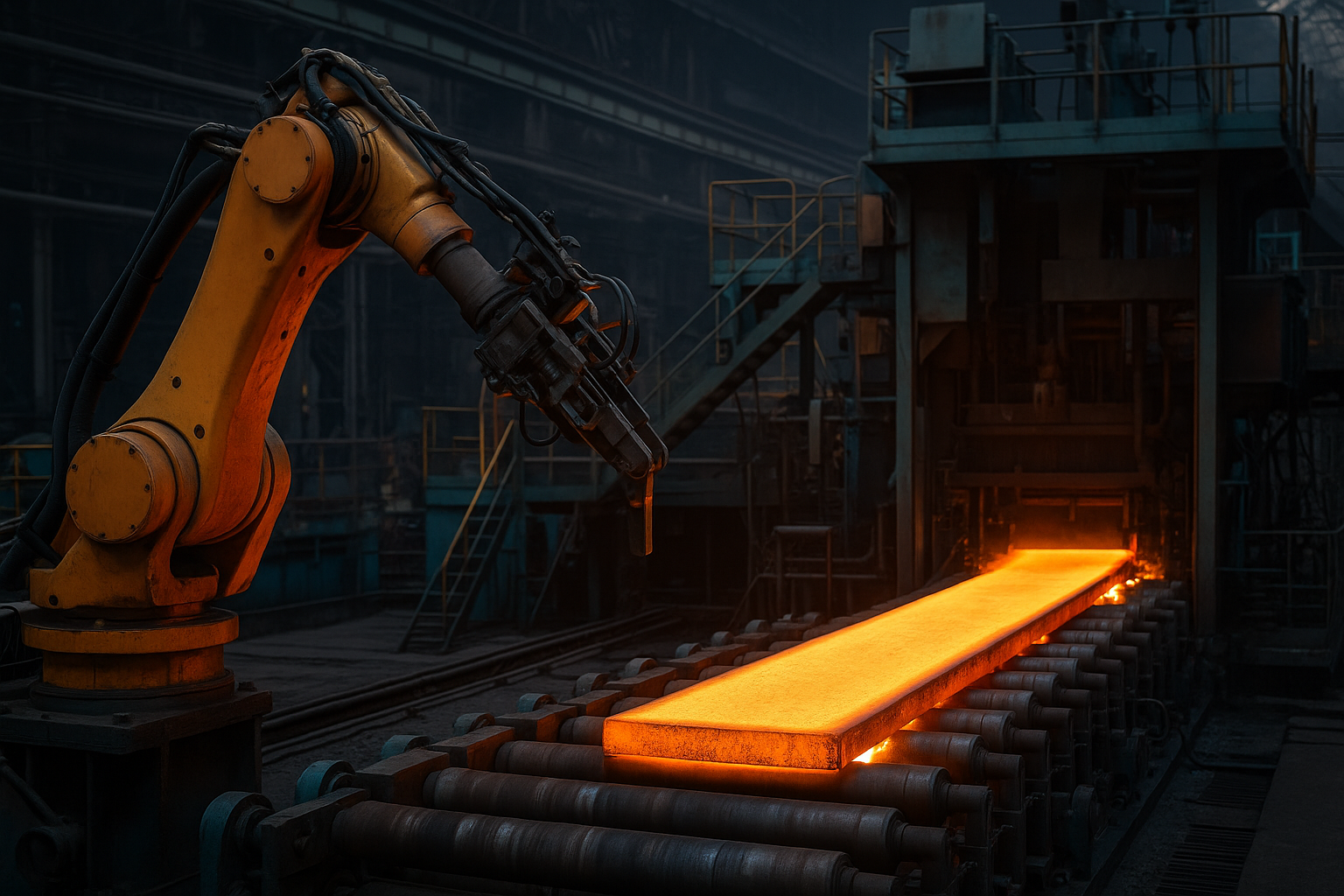
Steel manufacturing is one of the most demanding environments for industrial automation.
A modern steel plant must coordinate high temperatures, heavy equipment, high-speed production lines, large energy flows, complex metallurgical processes, stringent dimensional tolerances and continuous material movement. Some control decisions must occur within milliseconds, while others operate over seconds, minutes, production shifts or entire planning cycles.
This means that steel plant automation cannot be understood simply as robots, artificial intelligence or connected sensors.
It is better understood as a layered engineering architecture that connects the physical production process with instrumentation, control systems, supervisory functions, manufacturing operations and business systems.
A simplified automation chain can be represented as:
Physical Process → Sensors and Actuators → PLC/DCS/Drives → Supervisory Systems → Manufacturing Operations → Enterprise Systems
Across these layers, data moves upward to create visibility and context, while commands, production requirements and operating decisions move toward the process.
The engineering challenge is therefore not to maximize automation.
It is to determine:
What should be measured, what should be controlled, how fast the response must be, where each function should reside, how systems should exchange information, and what happens when something fails.
That distinction separates robust industrial automation from digitalization for its own sake.
1. Automation Is More Than Replacing Manual Work
Industrial automation is sometimes described as the replacement of human tasks by machines.
That definition is incomplete.
In steel manufacturing, automation can perform several different functions:
- measurement;
- sequence control;
- closed-loop control;
- equipment protection;
- material tracking;
- production coordination;
- quality control;
- optimization;
- decision support.
Consider a hot rolling mill.
Sensors measure temperature, thickness, position, speed, force and tension.
Controllers execute deterministic logic.
Drives regulate motor speed and torque.
Automatic gauge control adjusts process variables to maintain dimensional targets.
Supervisory systems provide operators with process status and alarms.
Higher-level systems connect production information with steel grade, slab identity, rolling schedule and quality requirements.
No single device performs all these functions.
Automation is the architecture that allows them to work together.
2. The Automation Hierarchy
A useful way to understand manufacturing automation is the functional hierarchy associated with ISA-95 / IEC 62264.
The exact implementation varies between plants, but the conceptual structure is highly useful.
| Level | Primary Function | Typical Steel-Plant Examples |
|---|---|---|
| Level 0 | Physical process | Furnace, caster, rolling mill, cooling system |
| Level 1 | Sensing and manipulation | Sensors, analyzers, valves, actuators, drives |
| Level 2 | Monitoring and control | PLC, DCS, control systems, process control |
| Level 3 | Manufacturing operations management | MES/MOM, production tracking, quality, genealogy |
| Level 4 | Business planning and logistics | ERP, orders, procurement, business planning |
These levels should not be interpreted as a rigid technology map.
Modern architectures may use edge computing, distributed applications, cloud services and direct information exchanges that do not visually resemble the traditional automation pyramid.
The important concept is the functional boundary.
A millisecond control loop and a monthly production-planning process have fundamentally different requirements.
They should not be designed as if they were the same system.
3. Level 0 — The Physical Steelmaking Process
Automation begins with the physical process.
In a steel plant, Level 0 may include:
- blast furnaces;
- basic oxygen furnaces;
- electric arc furnaces;
- ladle furnaces;
- continuous casters;
- reheating furnaces;
- rolling stands;
- cooling systems;
- pickling lines;
- galvanizing lines;
- cutting lines;
- coilers;
- cranes;
- conveyors.
This layer is often overlooked in digitalization discussions.
But automation cannot compensate for poor understanding of process physics.
Before designing a control strategy, engineers need to understand:
- process dynamics;
- operating limits;
- disturbances;
- material behavior;
- equipment constraints;
- failure consequences.
The best automation architecture begins with the process, not the software.
4. Level 1 — Sensors Turn Physical Processes Into Information
A control system cannot regulate what it cannot measure.
Steel plants therefore depend on extensive instrumentation.
Typical measurements include:
- temperature;
- pressure;
- flow;
- level;
- position;
- speed;
- force;
- torque;
- tension;
- vibration;
- current;
- voltage;
- thickness;
- width;
- flatness;
- chemical composition;
- surface condition.
The quality of automation is fundamentally constrained by the quality of these measurements.
A poorly located, drifting or incorrectly calibrated sensor can cause an advanced control system to make consistently wrong decisions.
This creates a basic automation principle:
Measurement Quality → Control Quality → Process Performance
More sensors do not automatically create better automation.
The measurements must be relevant, accurate, maintainable and sufficiently fast for the intended control function.
5. Actuators Close the Automation Loop
Measurement alone creates monitoring.
Automation requires the ability to affect the process.
Actuators may include:
- control valves;
- hydraulic cylinders;
- electric motors;
- variable-speed drives;
- dampers;
- positioning systems;
- burners;
- oxygen valves;
- cooling valves;
- robotic mechanisms.
A simplified closed-loop control architecture is:
Setpoint → Controller → Actuator → Physical Process → Sensor → Feedback → Controller
The controller continuously compares measured performance with the required condition and adjusts the process accordingly.
This distinction between monitoring and control is essential.
A dashboard showing furnace temperature is monitoring.
A control loop automatically modifying fuel flow to maintain furnace temperature is control.
6. PLCs and DCSs Perform Different Types of Control
Programmable Logic Controllers are widely used throughout steel plants.
Typical PLC functions include:
- sequences;
- interlocks;
- machine states;
- digital logic;
- equipment coordination;
- analog processing;
- alarms;
- communication with drives and field devices.
Distributed Control Systems are frequently used where many interacting continuous control loops and process variables must be coordinated.
Depending on plant architecture, both may coexist.
For example:
A rolling line may rely heavily on PLC-based machine control and high-performance drive systems.
A process involving large numbers of continuous variables may use DCS functions extensively.
The important point is that neither PLC nor DCS should simply be described as the “brain” of the entire plant.
Steel plants normally contain multiple distributed control systems, each responsible for defined functions.
7. Deterministic Control Matters
Industrial control differs from ordinary information processing.
Many process functions require a response within a defined time.
Examples include:
- position control;
- motor synchronization;
- roll-gap adjustment;
- strip-tension control;
- mold-level control;
- sequence interlocking.
For these applications, average computing speed is not enough.
The system must respond predictably within the required control interval.
This is one reason why critical control functions should not automatically be moved to enterprise servers or cloud platforms simply because those platforms offer more computing power.
Automation architecture must respect:
Latency + Determinism + Availability + Safety + Process Dynamics
The appropriate location for a function depends on all five.
8. Drives Are a Critical Part of Steel Automation
Steel production depends heavily on electric motors.
Rolling mills, conveyors, pumps, fans, coilers and auxiliary systems require precise control of:
- speed;
- torque;
- acceleration;
- deceleration;
- synchronization.
Variable-frequency and high-performance drive systems therefore play a major role in plant automation.
In rolling applications, several drives may need coordinated control.
Poor synchronization can affect:
- strip tension;
- dimensional accuracy;
- line stability;
- equipment loading;
- product quality.
Drive systems should therefore be considered part of the control architecture, not simply electrical utilities.
9. Safety Systems Require Their Own Engineering Logic
Not every automation function has the same consequence of failure.
A production optimization function may reduce throughput if it fails.
A safety function may need to prevent injury or catastrophic equipment damage.
Safety-related functions can involve:
- emergency stops;
- burner management;
- furnace protection;
- overspeed protection;
- safe positioning;
- access control;
- hazardous movement prevention.
These functions require appropriate risk assessment and safety engineering.
The important architectural principle is:
Production control and safety protection should not be assumed to have identical design requirements.
Automation projects should explicitly define what happens when:
- a sensor fails;
- a controller fails;
- communication is lost;
- power is interrupted;
- an actuator does not respond.
Failure behavior is part of automation design.
10. HMI Is the Operator’s Window Into the Process
Human-Machine Interfaces allow operators to interact with automated equipment.
An effective HMI should help answer:
- What is the current process state?
- What has changed?
- Is anything abnormal?
- Which action is required?
- What is the consequence of that action?
Poor HMI design can create:
- information overload;
- difficult navigation;
- hidden abnormal conditions;
- excessive colors;
- unclear priorities.
Automation should therefore support human performance rather than simply display every available variable.
The objective is not maximum information density.
It is situational awareness.
11. Alarm Management Is Part of Automation Engineering
Automated systems can generate thousands of potential alarms.
That does not mean operators should see all of them.
Poorly designed alarm systems can produce:
- nuisance alarms;
- repeated alarms;
- alarm floods;
- incorrect priorities;
- operator desensitization.
A useful alarm should represent a condition requiring awareness or action.
Alarm engineering should consider:
Condition → Consequence → Priority → Required Response → Available Response Time
If an alarm has no meaningful operator response, its purpose should be questioned.
More alarms do not mean greater control.
12. SCADA Provides Supervisory Visibility
Supervisory Control and Data Acquisition systems can provide:
- process visualization;
- status information;
- alarm handling;
- trends;
- supervisory commands;
- data acquisition.
However, SCADA should not be confused with every layer of plant automation.
Fast deterministic control normally resides closer to the process.
SCADA provides a supervisory layer.
This distinction matters because a plant may continue executing local control even if a higher-level visualization system becomes temporarily unavailable.
The required behavior depends on the architecture and criticality of the process.
13. Historians Preserve Process Memory
A process historian stores time-series industrial data.
This enables engineers to move from:
What is happening now?
to:
What happened before this condition occurred?
Historical data supports:
- troubleshooting;
- root-cause analysis;
- process optimization;
- quality investigations;
- energy analysis;
- maintenance analysis.
But historians require disciplined data management.
Important considerations include:
- tag naming;
- timestamps;
- engineering units;
- sampling;
- compression;
- retention;
- equipment identity;
- change management.
A plant can store billions of data points and still struggle to extract engineering value if the data lacks context.
For a detailed treatment of this subject, see Real-Time Data Monitoring in Steel Plants: From Sensors to Operational Decisions.
14. Level 2 Process Models Have Special Importance in Steelmaking
In steel-industry terminology, the expression Level 2 automation is often used for process computers, mathematical models and optimization functions operating above basic control.
The terminology should not be confused mechanically with every use of “Level 2” in generic reference architectures.
In practical steel applications, Level 2 functions may calculate:
- process setpoints;
- pass schedules;
- temperature targets;
- material tracking;
- setup parameters;
- rolling strategies;
- cooling strategies;
- production models.
A rolling mill provides a useful example.
Basic automation executes equipment commands and fast control.
Higher-level process models can calculate the initial setup needed to produce a particular steel grade and dimension.
The two work together.
15. Feedforward and Feedback Control Serve Different Purposes
Feedback reacts to measured deviations.
Feedforward anticipates process requirements based on known inputs or disturbances.
In steel manufacturing, both can be valuable.
For example, a rolling-control strategy may use information about:
- incoming thickness;
- temperature;
- material properties;
- target thickness.
to calculate an initial setup.
Feedback then corrects remaining deviations during production.
The combined concept is:
Model-Based Setup + Feedforward Compensation + Feedback Correction
This is more sophisticated than simply installing additional sensors.
It represents the integration of process knowledge with automation.
16. Continuous Casting Depends on Coordinated Automation
Continuous casting requires coordination between several interacting systems.
Automation may manage or support:
- mold level;
- casting speed;
- cooling;
- oscillation;
- withdrawal;
- cutting;
- material tracking.
The quality of the final slab or billet depends on interactions among these variables.
An isolated control loop may perform correctly while the overall process remains unstable.
This demonstrates an important principle:
Local control performance does not automatically guarantee process-wide optimization.
Integration matters.
17. Rolling Mills Are High-Performance Automation Environments
Rolling is one of the clearest examples of automation intensity in steel manufacturing.
Relevant variables can include:
- roll gap;
- rolling force;
- speed;
- torque;
- strip tension;
- thickness;
- width;
- temperature;
- flatness;
- cooling.
Control functions may need to coordinate multiple stands and drives while material travels through the line at high speed.
Automation therefore affects both productivity and dimensional quality.
For thickness control, for example, measurement, mechanical response, drive behavior, material properties and control strategy all interact.
This is why dimensional performance cannot be separated from process-control capability.
18. Finishing Lines Combine Continuous and Discrete Automation
Pickling, cold rolling, annealing, galvanizing, coating, slitting and cut-to-length operations can combine:
- continuous process control;
- discrete machine sequences;
- material tracking;
- quality inspection;
- drive synchronization.
This makes finishing lines useful examples of hybrid automation.
A galvanizing line, for example, may need coordinated control of:
- strip speed;
- tension;
- furnace conditions;
- bath conditions;
- coating control;
- cooling;
- inspection.
Automation therefore extends beyond simply starting and stopping machines.
It coordinates the process conditions that determine the final product.
19. Machine Vision Extends Automated Quality Control
Machine vision can support high-speed inspection of steel products.
Potential applications include:
- surface-defect detection;
- dimensional inspection;
- edge monitoring;
- position verification;
- identification;
- packaging inspection.
The engineering challenge is not merely installing cameras.
Performance depends on:
- illumination;
- optics;
- camera position;
- resolution;
- line speed;
- image processing;
- defect classification;
- reference standards.
False positives and false negatives both matter.
An inspection system that detects everything as defective is not useful.
Neither is one that misses critical defects.
20. Robotics Should Be Applied Where the Task Justifies It
Robotics can be valuable in steel plants where tasks involve:
- repetitive handling;
- hazardous exposure;
- high temperatures;
- difficult ergonomics;
- repeatable inspection;
- packaging;
- sampling.
But automation strategy should not begin with the question:
Where can we install a robot?
It should begin with:
What operational problem needs to be solved?
A fixed automation solution may be better than a robot for some repetitive tasks.
Manual operation may remain appropriate for low-frequency activities requiring high adaptability.
Technology selection should follow the application.
21. Automated Material Handling Requires Reliable Identification
Steel plants move:
- scrap;
- slabs;
- billets;
- blooms;
- coils;
- plates;
- finished products.
Automated cranes, conveyors and storage systems can improve material flow.
But automation depends on knowing:
What is the material, where is it, where should it go, and what operation comes next?
This requires reliable material identification and tracking.
If physical material and digital identity become separated, automated logistics can move the wrong product efficiently.
Traceability is therefore a control requirement.
22. Level 3 Connects Production With Manufacturing Operations
Manufacturing Operations Management sits between direct process control and enterprise planning.
Depending on implementation, Level 3 functions can include:
- production execution;
- scheduling;
- material genealogy;
- quality management;
- inventory status;
- maintenance coordination;
- performance analysis.
MES is commonly associated with this environment.
Its role is not to replace PLCs.
Its role is to provide manufacturing context and coordination.
A simplified information flow can be:
ERP Order → MES Production Requirement → Process Execution → Production Result → MES → ERP
This closes the information loop between business planning and actual manufacturing.
23. Material Genealogy Is Particularly Important in Steel
Steel production creates a chain of identities.
For example:
Heat → Slab → Coil → Finished Coil → Customer Order
The exact genealogy depends on the process route.
Automation and manufacturing systems should preserve the relationship between material identity and process history.
This allows engineers to answer:
- Which heat produced this coil?
- Which process conditions were used?
- Which quality results belong to this material?
- Which customer received products from the same production batch?
Traceability becomes especially important during:
- quality investigations;
- claims;
- rework;
- process analysis;
- certification.
24. Level 4 Connects Manufacturing With Business Planning
Enterprise systems manage functions such as:
- customer orders;
- procurement;
- inventory;
- financial planning;
- logistics;
- business planning.
These systems operate on different time horizons from process control.
An ERP system should not directly execute a high-speed rolling control loop.
Likewise, a PLC should not be responsible for enterprise financial planning.
ISA-95 helps clarify these functional boundaries and the information exchanged between manufacturing and enterprise systems.
This separation improves system ownership and integration design.
25. Interoperability Is More Important Than Connectivity Alone
A connected system is not necessarily an integrated system.
Suppose two applications can exchange a number:
850
Without context, the receiving system may not know:
- what the value represents;
- which asset generated it;
- its engineering unit;
- its timestamp;
- its quality status.
Useful interoperability requires both communication and meaning.
Modern industrial architectures therefore benefit from standardized information models and interfaces.
OPC UA, for example, is designed to support industrial information exchange across devices, control systems, MES and enterprise systems.
The broader principle is:
Connectivity moves data. Interoperability preserves meaning.
26. OT and IT Are Converging — but They Are Not Identical
Operational Technology directly interacts with physical processes.
Examples include:
- PLCs;
- DCSs;
- industrial networks;
- HMIs;
- SCADA;
- drives.
Information Technology commonly includes:
- enterprise applications;
- corporate networks;
- databases;
- business systems;
- analytics platforms.
The two environments increasingly exchange data.
But their priorities can differ.
IT environments often emphasize:
- confidentiality;
- information integrity;
- business availability.
OT environments must additionally consider:
- deterministic performance;
- physical process availability;
- equipment protection;
- personnel safety.
Successful integration requires both disciplines.
27. Cybersecurity Is Part of Automation Design
Connectivity expands functionality, but it also expands the attack surface.
Industrial cybersecurity should therefore be considered during automation architecture design.
Relevant controls may include:
- asset inventory;
- network segmentation;
- zones and conduits;
- authentication;
- authorization;
- secure remote access;
- logging;
- backup;
- recovery;
- change management;
- vulnerability management;
- vendor-access control.
NIST SP 800-82 emphasizes that OT security must account for the distinctive performance, reliability and safety requirements of operational systems.
The ISA/IEC 62443 family provides a lifecycle-oriented framework for industrial automation and control system cybersecurity.
The engineering principle is simple:
A plant should not increase connectivity without simultaneously evaluating exposure and control.
28. Remote Access Requires Special Control
Remote support can provide major operational benefits.
Specialists may diagnose equipment without travelling to the plant.
Vendors may assist with complex automation systems.
Engineers may monitor distributed operations.
But unmanaged remote access can create significant cybersecurity risk.
Access should therefore be:
- authorized;
- authenticated;
- limited;
- monitored;
- documented;
- revocable.
Remote connectivity should not create an uncontrolled path directly into critical control systems.
For a broader treatment of this subject, see Remote Monitoring in Steel Plants: Architecture, Safety and Secure Industrial Operations.
29. Legacy Equipment Is Often the Real Automation Challenge
Many steel plants contain equipment from multiple generations.
A single production line may combine:
- modern PLCs;
- older controllers;
- proprietary protocols;
- analog instruments;
- obsolete computers;
- unsupported software.
Replacing everything at once may be economically or operationally unrealistic.
Automation modernization therefore often requires:
- gateways;
- protocol conversion;
- selective instrumentation upgrades;
- phased controller migration;
- network segmentation;
- interface development.
The key question is not:
Is the equipment old?
It is:
Can it continue to perform its required function safely, reliably and maintainably within the target architecture?
30. Automation Reliability Must Be Engineered
Automation systems themselves can fail.
Potential failure modes include:
- sensor failure;
- controller failure;
- I/O failure;
- network interruption;
- power loss;
- server failure;
- software error;
- database failure.
The architecture should determine what happens after each relevant failure.
Possible design measures include:
- redundant controllers;
- redundant networks;
- backup power;
- redundant servers;
- local fallback;
- manual operation;
- safe-state logic;
- spare-parts strategy.
Redundancy should not be added indiscriminately.
It should be based on consequence and required availability.
31. Maintenance Is Part of the Automation Lifecycle
Automation does not eliminate maintenance.
It changes the maintenance requirement.
Modern automation assets may require management of:
- controller hardware;
- firmware;
- software versions;
- industrial networks;
- sensors;
- servers;
- licenses;
- backups;
- configuration files.
Obsolescence also becomes important.
A mechanically sound machine can become difficult to operate if its controller or software platform is unsupported.
Automation lifecycle management should therefore consider both physical and digital obsolescence.
32. Predictive Maintenance Uses Automation Data but Is a Separate Discipline
Automation systems generate valuable equipment-condition data.
Examples include:
- vibration;
- motor current;
- temperature;
- pressure;
- flow;
- operating cycles.
These data can support predictive maintenance.
But collecting them does not automatically create a predictive maintenance program.
Reliability engineering must connect:
Failure Mode → Detectable Condition → Measurement → Diagnosis → Maintenance Decision
For the complete reliability methodology, see Predictive Maintenance in Steel Plants: A Practical Engineering Guide to Equipment Reliability.
This distinction prevents unnecessary overlap between automation and maintenance systems.
33. Artificial Intelligence Should Sit on Top of Reliable Automation
AI can support steel operations through applications such as:
- anomaly detection;
- quality prediction;
- process optimization;
- equipment-condition assessment;
- energy optimization.
But AI does not eliminate the need for deterministic control.
A machine-learning model should not automatically replace a proven control function simply because it can identify complex patterns.
A more robust sequence is:
Reliable Instrumentation → Stable Control → Structured Data → Process Context → Analytics → AI Where Justified
AI is therefore an additional analytical and optimization capability.
It is not the foundation of industrial control.
34. Digital Twins Require a Clear Purpose
The term digital twin is frequently used broadly.
For engineering purposes, the important question is what the model actually does.
A digital representation may support:
- simulation;
- virtual commissioning;
- process optimization;
- operator training;
- equipment analysis;
- scenario evaluation.
The value depends on:
- model fidelity;
- data quality;
- synchronization;
- validation;
- intended decision.
A complex model with no operational decision attached to it can become an expensive visualization.
Digital-twin investment should begin with the engineering use case.
35. Automation and Energy Performance Are Closely Connected
Steel manufacturing is energy intensive.
Automation can support energy performance by improving:
- combustion control;
- furnace scheduling;
- motor efficiency;
- equipment sequencing;
- idle-state management;
- utility coordination;
- process stability.
However, installing automation does not automatically reduce energy consumption.
Energy savings require a mechanism.
For example:
Better Furnace Control → Reduced Temperature Variability → Less Overheating → Lower Fuel Consumption
The causal chain should be explicit.
This also makes project results easier to verify.
36. Automation Can Improve Quality Through Variability Reduction
Quality improvement is often one of the strongest automation benefits.
Automation can reduce variability through:
- repeatable sequences;
- precise positioning;
- closed-loop control;
- continuous measurement;
- automatic correction;
- standardized recipes.
But the correct quality metric should be identified.
Examples include:
- thickness variation;
- flatness;
- surface-defect rate;
- reject rate;
- rework;
- yield;
- capability indices where applicable.
A credible automation project connects the technical control improvement with a measurable quality outcome.
37. Automation Can Improve Safety — but the Claim Must Be Specific
Automation can reduce human exposure to:
- molten metal;
- hot surfaces;
- moving machinery;
- heavy loads;
- repetitive handling;
- hazardous inspection areas.
This can be a major benefit.
But “automation improves safety” should not be treated as an automatic conclusion.
New systems can also introduce hazards involving:
- unexpected movement;
- automatic restart;
- human-machine interaction;
- maintenance access;
- stored energy.
Safety improvement therefore requires formal risk assessment and appropriate safeguarding.
38. Human Operators Remain Part of the Control System
Highly automated plants still depend on people.
Operators handle:
- abnormal situations;
- startup and shutdown;
- process disturbances;
- maintenance coordination;
- unusual material conditions;
- emergency response.
Automation can change the operator’s role from direct manipulation toward supervision and exception management.
This creates a new risk:
Loss of situational awareness.
If the system normally operates automatically, operators may have limited opportunities to practice manual or degraded-mode operation.
Training should therefore cover not only normal operation but also:
- abnormal conditions;
- automation failure;
- fallback modes;
- recovery.
39. Automation Projects Should Start With the Process Problem
A weak project begins with:
We need AI.
or:
We need more robots.
A stronger project begins with:
What production problem are we trying to solve?
Examples include:
- excessive thickness variation;
- unstable furnace temperature;
- high manual exposure;
- poor material traceability;
- excessive downtime;
- slow quality inspection;
- high energy intensity.
Only then should the technology be selected.
The correct sequence is:
Problem → Requirement → Functional Design → Technology → Integration → Validation
not:
Technology → Search for Application
40. Define the Functional Requirement Before Selecting Equipment
Automation procurement should specify what the system must accomplish.
Functional requirements may include:
- required control accuracy;
- response time;
- availability;
- number of I/O points;
- communication interfaces;
- cybersecurity requirements;
- redundancy;
- environmental conditions;
- alarm philosophy;
- data retention;
- integration requirements.
This allows suppliers to propose technology against a defined engineering objective.
Without functional requirements, automation projects can become vendor-driven rather than process-driven.
41. FAT and SAT Reduce Commissioning Risk
Testing is essential before production acceptance.
A Factory Acceptance Test can verify functions before equipment reaches the plant.
A Site Acceptance Test verifies performance after installation and integration.
Depending on project scope, tests may cover:
- I/O;
- sequences;
- interlocks;
- alarms;
- communication;
- HMI;
- failure modes;
- permissives;
- interfaces;
- recovery.
Simulation and virtual commissioning can further reduce risk in suitable applications.
Testing should verify not merely that software executes.
It should verify that the system performs the required function.
42. Change Management Is Essential After Commissioning
Automation systems evolve.
Changes may involve:
- PLC logic;
- HMI configuration;
- setpoints;
- network settings;
- software;
- alarm parameters;
- interfaces.
Uncontrolled modifications can create hidden operational risk.
A mature change process should record:
What Changed → Why → Who Approved → Who Implemented → What Was Tested → How to Restore Previous State
Backups should also be maintained and periodically verified.
A backup that cannot be restored is not a reliable recovery strategy.
43. Measuring Automation Performance Requires the Right KPIs
Automation projects should be evaluated against the problem they were designed to solve.
Potential indicators include:
- throughput;
- yield;
- cycle time;
- process variability;
- reject rate;
- rework;
- downtime;
- energy intensity;
- alarm rate;
- manual interventions;
- safety exposure.
But attribution matters.
If throughput increases after automation, management should determine whether the improvement actually resulted from automation or from:
- product mix;
- maintenance;
- staffing;
- raw materials;
- operating practice.
Credible engineering avoids assigning every improvement to the latest technology project.
44. Automation Economics Go Beyond Labor Reduction
A common mistake is evaluating automation only through reduced labor.
A more complete business case may include:
Investment
- automation hardware;
- software;
- engineering;
- installation;
- integration;
- commissioning;
- training;
- production downtime.
Recurring Cost
- maintenance;
- licenses;
- cybersecurity;
- specialist support;
- spare parts;
- lifecycle upgrades.
Potential Benefits
- throughput improvement;
- yield improvement;
- reduced scrap;
- reduced rework;
- energy reduction;
- avoided downtime;
- reduced hazardous exposure;
- improved quality consistency.
There is no universal automation payback period.
Each project should be evaluated from its actual operating conditions.
45. A Practical Automation Modernization Roadmap
A steel plant can structure modernization in stages.
Step 1 — Define the Business and Process Problem
Identify the measurable operational need.
Step 2 — Map the Existing Architecture
Document:
- equipment;
- instrumentation;
- controllers;
- networks;
- software;
- interfaces;
- obsolete systems.
Step 3 — Define Functional Requirements
Specify performance, control, safety, data and integration requirements.
Step 4 — Assess Instrumentation
Verify that the process can actually be measured with sufficient reliability.
Step 5 — Define the Target Architecture
Clarify which functions belong at:
- field level;
- control level;
- supervisory level;
- manufacturing-operations level;
- enterprise level.
Step 6 — Define Cybersecurity Requirements
Address architecture and access before adding connectivity.
Step 7 — Build and Test
Use simulation, FAT and structured testing where appropriate.
Step 8 — Commission Carefully
Validate interfaces, control functions and failure behavior under actual plant conditions.
Step 9 — Train Operations and Maintenance
Training must include both normal and abnormal operation.
Step 10 — Measure Results
Compare actual performance with the original project baseline.
Step 11 — Standardize Successful Solutions
Scale what has demonstrated measurable value.
This approach reduces the risk of accumulating disconnected digital projects.
46. Common Steel Automation Mistakes
Automating an Unstable Process
Automation can reproduce instability faster if the underlying process is not understood.
Starting With Technology
The process problem should determine the solution.
Ignoring Instrumentation
Poor measurements undermine advanced control.
Connecting Systems Without Defining Ownership
Every system and interface needs responsible owners.
Treating PLC, SCADA, MES and ERP as Interchangeable
They serve different functions.
Moving Critical Functions Too Far From the Process
Latency and availability requirements must be respected.
Ignoring Legacy Systems
Modernization must account for installed assets.
Adding Connectivity Without Cybersecurity
Integration changes the risk profile.
Neglecting Operator Training
Automation changes work; it does not eliminate human responsibility.
Failing to Measure Results
A project cannot demonstrate value without a baseline and defined KPIs.
47. From Automation to Intelligent Operations
Automation maturity can be viewed as a progression.
Level 1 — Mechanized
Machines reduce manual physical work.
Level 2 — Controlled
Sensors and controllers automate defined functions.
Level 3 — Integrated
Control, supervisory and manufacturing systems exchange information.
Level 4 — Optimized
Process models and analytics improve setpoints and operating decisions.
Level 5 — Intelligent
Advanced analytics and AI support increasingly adaptive decision-making.
But higher maturity does not mean eliminating lower layers.
The opposite is true.
Advanced systems depend on reliable basic automation.
An AI model built on unstable sensors, inconsistent tags and poorly maintained control systems does not create intelligent manufacturing.
It creates sophisticated uncertainty.
48. Frequently Asked Questions
What is automation in steel manufacturing?
Steel manufacturing automation is the coordinated use of instrumentation, control systems, drives, supervisory systems and manufacturing software to measure, control, coordinate and optimize industrial production processes.
What is the difference between PLC and SCADA?
A PLC typically executes machine and process-control logic close to the physical process. SCADA primarily provides supervisory monitoring, visualization, alarms, data acquisition and authorized supervisory interaction.
What is the difference between SCADA and MES?
SCADA focuses primarily on process supervision. MES supports manufacturing-operations functions such as production execution, material genealogy, quality context and production tracking.
What does Level 2 automation mean in a steel plant?
In steel-industry practice, Level 2 often refers to process computers, models, setup calculations and optimization functions operating above basic control. The terminology should always be interpreted within the specific plant architecture.
Does automation require artificial intelligence?
No. Most essential industrial automation functions rely on instrumentation, deterministic control, sequences, drives and established process models. AI can add value in selected analytical and optimization applications.
Can an older steel plant be automated?
Yes. Modernization can be phased using instrumentation upgrades, controller migration, gateways and selective system integration. Full equipment replacement is not always necessary.
Does automation always reduce labor?
No. Automation often changes the type of work rather than simply eliminating it. Demand may shift toward automation engineering, instrumentation, maintenance, data analysis and system support.
Does automation improve safety?
It can reduce human exposure to hazardous tasks, but automated equipment also creates hazards that require risk assessment, safeguarding and appropriate safety systems.
Should steel plants connect their control systems directly to the cloud?
Not automatically. Architecture should be determined by latency, reliability, cybersecurity, safety and operational requirements. Critical deterministic control generally belongs close to the process.
What is the first step in an automation project?
Define the operational problem and measurable performance requirement before selecting technology.
49. Conclusion
Steel plant automation is not defined by the number of robots, sensors or AI models installed.
It is defined by how effectively the production process, instrumentation, control systems, manufacturing operations and business requirements work together.
The architecture can be summarized as:
Physical Process → Measurement → Control → Supervision → Manufacturing Operations → Enterprise Integration
At each layer, the engineering questions are different.
At the field level:
Can the process be measured and manipulated reliably?
At the control level:
Can the required response be executed accurately and predictably?
At the supervisory level:
Can operators understand process conditions and abnormal situations?
At the manufacturing-operations level:
Can production, material, quality and equipment information be coordinated?
At the enterprise level:
Can manufacturing information support planning and business decisions without compromising operational control?
Advanced analytics, AI, digital twins and cloud platforms can add significant capability.
But they do not replace the fundamentals.
Reliable instrumentation, stable control, clear system boundaries, cybersecurity, maintainability, competent operators and disciplined change management remain the foundation.
For steel manufacturers, the most effective automation strategy is therefore not:
Automate everything.
It is:
Automate the right functions, at the right architectural level, with the right performance, reliability and control.
That is how automation becomes an engineering system rather than a collection of technologies.
Technical References
- International Society of Automation — ISA-95 Series of Standards: Enterprise-Control System Integration
- International Society of Automation — 2025 Update to ISA-95 Part 1
- NIST — SP 800-82 Rev. 3: Guide to Operational Technology (OT) Security
- International Society of Automation — ISA/IEC 62443 Series of Standards
- OPC Foundation — OPC Unified Architecture: Overview and Concepts
- NIST — Cybersecurity for Smart Manufacturing Systems