
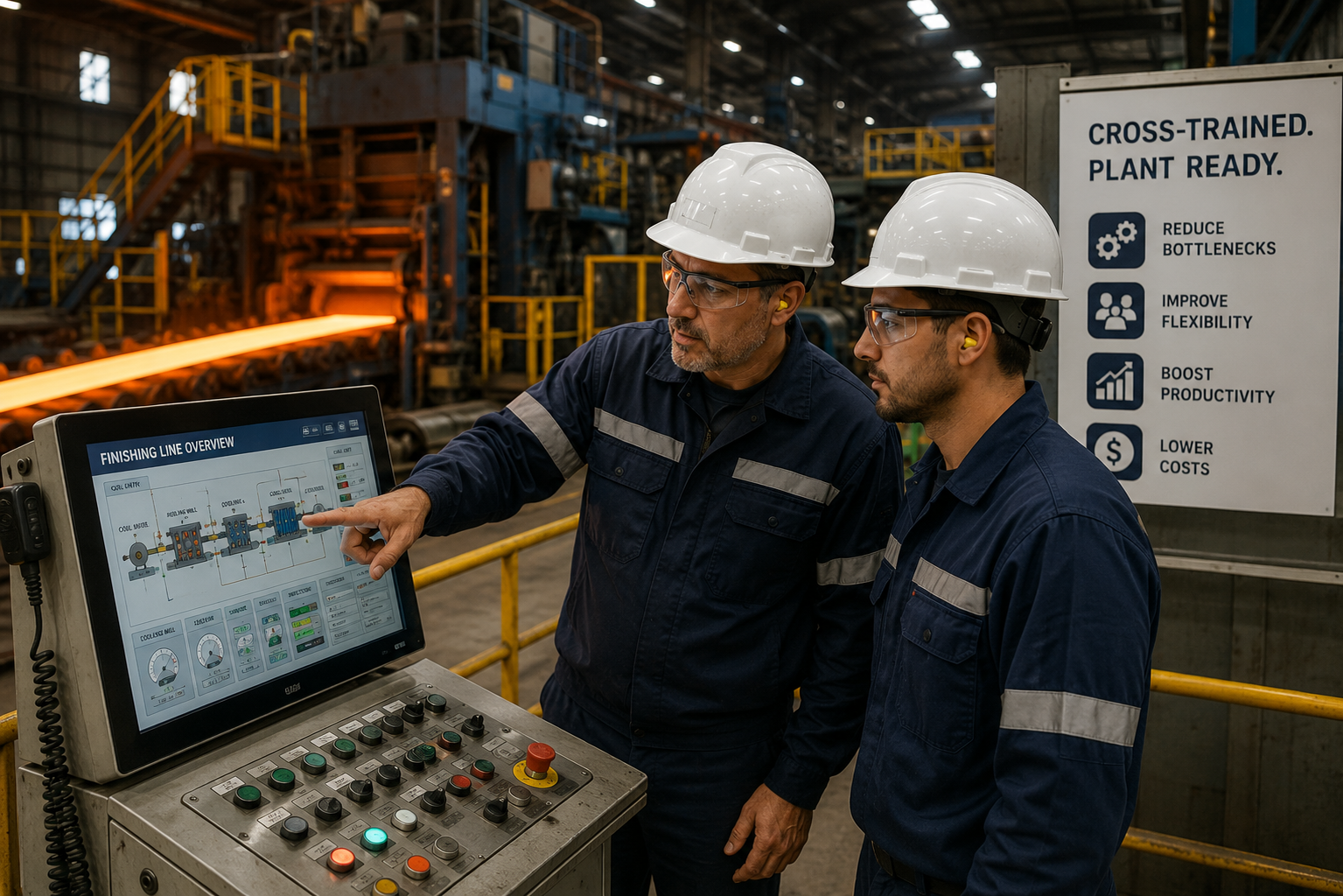
Steel plants are built around highly interconnected processes. Steelmaking, casting, rolling, finishing, inspection, maintenance, packaging and logistics depend on each other to maintain stable production flow.
Yet many plants still organize workforce capability around narrowly defined jobs.
An operator may be qualified for only one production position. A maintenance technician may specialize in one equipment family. A quality employee may be the only person on a shift authorized to perform a particular inspection. A logistics activity may depend on a small number of qualified employees.
Specialization is essential in steel manufacturing. Complex equipment, metallurgical processes and safety-critical operations require deep technical knowledge.
But excessive dependence on individual specialists can create another problem: operational bottlenecks caused by limited workforce flexibility.
When a critical employee is absent, workloads change, a line stops unexpectedly or production priorities shift, the plant may have equipment available but insufficient qualified people to respond.
Cross-training addresses this vulnerability.
Rather than attempting to make every employee capable of performing every job, cross-training systematically develops qualified backup capability for selected tasks and roles.
When designed correctly, it can improve workforce resilience, reduce overtime pressure, shorten response time, support maintenance, improve production flexibility and reduce the economic consequences of operational bottlenecks.
For steelmakers, cross-training should therefore be viewed not simply as a human-resources initiative but as part of operational excellence and cost management.
What Cross-Training Means in Steel Manufacturing
Cross-training is the structured development of employees so they can competently perform selected activities outside their primary role.
In a steel plant, this could include:
- preparing an operator to cover another workstation within the same production line;
- training maintenance personnel in first-response troubleshooting across mechanical and electrical boundaries;
- qualifying production employees to perform selected routine quality checks;
- developing logistics personnel to support multiple material-handling activities;
- training employees to operate different but related pieces of equipment;
- developing backup capability for critical control-room or inspection positions.
The objective is not unrestricted interchangeability.
A cross-trained employee should perform another activity only when the required competency, authorization, procedure, safety qualification and supervision requirements have been satisfied.
This distinction is fundamental.
Effective cross-training creates flexibility through competence. Poorly managed cross-training merely transfers risk from workforce availability to safety, quality or equipment reliability.
Why Workforce Specialization Creates Operational Bottlenecks
Steel production is a continuous chain of dependent activities.
A bottleneck does not necessarily occur because equipment lacks capacity. It can occur because the plant lacks the right qualified person at the right moment.
Consider a finishing line capable of producing 60 tons per hour. If a required inspection activity cannot keep pace because only one qualified employee is available, the effective capacity of the entire process may fall below the equipment’s nominal capability.
The same logic applies to maintenance.
A failed sensor, hydraulic component or drive may represent a relatively straightforward technical problem. But if diagnosis depends on a specialist who is unavailable, the waiting time can become longer than the actual repair time.
This creates what could be called a human-capability constraint.
Typical causes include:
- absenteeism;
- vacations;
- retirement of experienced employees;
- uneven shift capability;
- unexpected equipment failures;
- temporary production peaks;
- training gaps;
- narrow job definitions;
- concentration of knowledge in a few specialists;
- insufficient backup coverage.
The economic impact can appear in overtime, lost production, maintenance delays, lower throughput, shipment backlogs and inefficient labor allocation.
Cross-training reduces these dependencies by creating controlled redundancy of capability.
Where Cross-Training Creates the Most Value
Not every position requires the same degree of cross-training.
The greatest value normally appears where workforce dependency intersects with operational criticality.
Production
Production areas frequently contain closely related operating positions.
An employee qualified on one workstation may be a logical candidate for another position within the same process because the employee already understands the equipment, process flow, product requirements and operating risks.
Potential benefits include:
- improved shift coverage;
- easier rotation between workstations;
- faster response to absenteeism;
- better workload balancing;
- increased understanding of upstream and downstream consequences.
Cross-training can be particularly useful in rolling, finishing, packaging and material-handling operations where production demand varies across positions.
Maintenance
Maintenance bottlenecks are often caused by the boundaries between specialties.
Mechanical, electrical, instrumentation and automation expertise remains necessary, but many initial diagnostic activities overlap.
A mechanical technician who understands basic sensor diagnostics, for example, may identify whether a stoppage requires electrical or automation intervention before the specialist arrives.
Likewise, electrical technicians with basic knowledge of mechanical systems may recognize misalignment, lubrication or mechanical-load conditions affecting motors and drives.
The purpose is not to eliminate specialization.
It is to improve first-response capability and diagnostic speed.
Quality
Quality departments can become bottlenecks when routine inspections depend exclusively on a limited number of specialists.
Selected checks may be safely delegated to trained and qualified production personnel when procedures, measurement systems and acceptance criteria are clearly defined.
Examples may include:
- visual surface inspection;
- dimensional measurements;
- basic defect classification;
- sampling procedures;
- traceability verification.
More complex metallurgical testing, laboratory analysis or final disposition decisions should remain with appropriately qualified personnel.
Logistics
Internal logistics often experiences highly variable workloads.
Coil movement, warehouse activities, packaging, labeling, loading and inventory transactions may peak at different times.
Cross-training can increase flexibility by allowing qualified employees to support adjacent activities when demand changes.
This can reduce shipment delays and improve utilization without necessarily increasing permanent staffing.
Safety and Emergency Response
Cross-training also contributes to operational resilience when employees are prepared for emergency roles.
However, safety-related activities require particularly strict boundaries.
Cross-training must never be used to bypass legal requirements, internal authorizations, equipment certifications or competency requirements.
In industrial operations, flexibility never takes priority over safety.
Cross-Training vs. Multiskilling vs. Job Rotation
These concepts are related but not identical.
Cross-training prepares an employee to perform specific tasks or another role when necessary.
Multiskilling develops broader competence across multiple technical activities or job functions.
Job rotation deliberately moves employees through different positions for development, exposure or workforce flexibility.
A plant may use all three.
For example, an operator could initially receive cross-training for a second workstation. After demonstrating competence across several positions, that employee may become formally multiskilled. Planned job rotation can then maintain those competencies and broaden process knowledge.
The distinction matters because training alone does not guarantee operational capability.
A skill that is learned but rarely practiced can deteriorate.
Therefore, a mature workforce-flexibility program must combine:
training → demonstrated competence → authorization → practice → periodic reassessment
How Cross-Training Reduces Operating Costs
Cross-training does not automatically generate savings.
The economic benefit occurs when increased workforce flexibility removes or reduces a measurable operational constraint.
Overtime
Absences and workload peaks frequently create overtime.
If qualified backup employees are available within the existing shift structure, some overtime demand may be avoided.
The correct KPI is not simply training hours.
Plants should compare overtime associated with critical roles before and after implementing cross-training.
Temporary Labor
Some operations use temporary personnel to cover seasonal or short-term workforce gaps.
Developing internal flexibility may reduce dependence on temporary labor for activities that can appropriately be covered by qualified existing employees.
Downtime
The financial effect of downtime can be significant in high-throughput steel operations.
Cross-training can reduce waiting time when the bottleneck is human availability rather than the complexity of the technical intervention.
The relevant question is:
How much downtime is caused by waiting for a qualified person?
If this component is significant, cross-training may offer measurable value.
Bottleneck Losses
A process can lose throughput even when it is not technically stopped.
Inspection queues, delayed material movement, packaging constraints and insufficient operator coverage can reduce effective production.
Cross-trained employees can be temporarily reassigned to relieve these constraints.
Absenteeism Exposure
Absenteeism itself cannot always be prevented.
Its operational consequences can.
A plant where every critical activity depends on one employee per shift has much higher operational exposure than a plant with qualified backup coverage.
Onboarding and Succession
Cross-training can also support succession planning.
When experienced workers approach retirement, transferring knowledge to employees who already understand adjacent operations is generally more robust than waiting until the position becomes vacant.
This is especially relevant in industries facing demographic and technological workforce transitions. Broader international research also emphasizes the growing importance of reskilling, upskilling and lifelong learning as digital and green transitions reshape work.
Operational Bottlenecks and Cross-Training Actions
A useful way to design cross-training is to connect each workforce constraint directly to an operational and financial result.
| Operational Risk | Cross-Training Action | Primary KPI | Potential Economic Impact |
|---|---|---|---|
| Critical operator absence | Certify backup operator | Role coverage ratio | Lower overtime and production loss |
| Slow maintenance response | Develop first-response multiskilling | MTTR / waiting time | Reduced downtime |
| Inspection bottleneck | Qualify backup inspection personnel | Inspection lead time | Higher throughput |
| Packaging constraint | Cross-train adjacent logistics personnel | Tons/hour | Reduced shipment backlog |
| Uneven workload | Build multi-role coverage | Labor utilization | Reduced idle time |
| Retirement risk | Transfer critical skills before departure | Backup coverage | Lower knowledge-loss risk |
| Shift capability imbalance | Standardize qualification across shifts | Skills coverage by shift | More stable production |
The table highlights an important principle:
The business case for cross-training should begin with the bottleneck, not with the training course.
A Practical Skills Matrix for Steel Plants
A skills matrix is one of the most useful tools for managing workforce flexibility.
Instead of merely recording whether an employee attended training, the matrix should show the actual level of demonstrated capability.
A simple model could use four levels:
| Level | Capability | Operational Meaning |
|---|---|---|
| 0 | Not trained | Cannot perform the task |
| 1 | Awareness | Understands task but cannot perform independently |
| 2 | Trained / supervised | Can perform with supervision |
| 3 | Qualified | Can perform independently within defined authorization |
| 4 | Trainer / expert | Can perform, troubleshoot and train others |
This allows managers to see workforce capability as an operational resource.
Suppose a critical finishing-line position requires Level 3 capability.
If six employees appear on the roster but only one has Level 3 qualification, the plant does not really have six-person coverage.
It has one operationally qualified resource.
That distinction is exactly what a good skills matrix should reveal.
How to Identify Critical Roles and Single-Point Dependencies
Cross-training should not begin by selecting employees randomly.
It should begin with a risk assessment.
Plants can map every important activity according to two variables:
Operational criticality and backup capability.
A role deserves priority when:
- its absence can stop or constrain production;
- few employees are qualified;
- specialist response time is long;
- overtime is frequently required;
- knowledge is concentrated in one experienced employee;
- retirement or turnover risk is high;
- the activity affects safety, quality or customer delivery.
One useful indicator is the qualified coverage ratio:
Qualified Coverage Ratio = Number of qualified employees / Minimum employees required
If a task requires one qualified person per shift and only one employee on that shift can perform it, the coverage ratio is 1.0.
That may be operationally fragile.
A target greater than 1.0 creates backup capacity, although the appropriate level depends on risk, staffing model and process criticality.
How to Design a Cross-Training Program
1. Map Critical Activities
Start with the process, not the organization chart.
Identify activities that influence:
- production continuity;
- maintenance response;
- quality release;
- safety;
- material flow;
- customer delivery.
2. Identify Capability Gaps
Use the skills matrix to determine where critical activities depend on too few people.
This reveals single-point dependencies.
3. Select Logical Skill Adjacencies
The best cross-training opportunities usually involve related activities.
A rolling-mill operator may be a logical candidate for another operating position on the same line.
A maintenance technician may develop adjacent diagnostic skills.
A logistics employee may learn another material-handling activity.
Random cross-training increases training effort without necessarily improving plant performance.
4. Define Competency Requirements
For every cross-trained role, define:
- tasks;
- operating limits;
- safety requirements;
- required knowledge;
- practical exercises;
- assessment criteria;
- authorization level;
- retraining frequency.
5. Train Through Real Work
Classroom instruction can provide background knowledge, but industrial competence requires practice.
On-the-job training should expose employees to realistic operating situations under qualified supervision.
6. Assess Demonstrated Competence
Course completion should not equal qualification.
Employees should demonstrate the required capability through observation, practical testing, simulation, documented task execution or another suitable competency assessment.
7. Authorize the Employee
Qualification should be formally recorded.
The plant should know exactly:
- who can perform the task;
- at what level;
- under what conditions;
- until when the qualification remains valid.
8. Maintain the Skill
Competence can decline when unused.
Periodic rotation, refresher training and reassessment help maintain capability.
Competency Levels and Certification
A common failure in industrial training systems is confusing attendance with competence.
An employee who completed a course six months ago may still not be ready to independently operate equipment or make quality decisions.
Certification should therefore be linked to observable capability.
Depending on the activity, assessment may include:
- written knowledge checks;
- supervised task execution;
- practical troubleshooting;
- equipment startup or shutdown;
- abnormal-condition response;
- quality measurement;
- safety procedure demonstration.
For critical activities, certification should include defined expiration or reassessment criteria.
This converts cross-training from an informal practice into a controlled competency-management system.
Safety, Authorization and Regulatory Boundaries
This is one of the most important aspects of cross-training in heavy industry.
Cross-training must not be interpreted as permission to bypass specialist qualifications.
Some activities require specific training, certification, licensing, medical fitness, internal authorization or legal compliance.
Examples can include:
- electrical work;
- crane operation;
- mobile equipment;
- confined-space activities;
- lockout/tagout;
- hot work;
- laboratory activities;
- lifting operations;
- safety-critical process interventions.
The correct rule is:
No cross-trained employee should perform a task beyond demonstrated competence and formal authorization.
This protects employees, equipment, product quality and the company.
A poorly designed cross-training program can actually increase operational risk if employees are encouraged to act beyond their competency boundaries.
How Cross-Training Supports Maintenance and Reliability
Maintenance offers one of the strongest applications for multiskilling.
Equipment failures rarely respect organizational boundaries.
A production stoppage may involve mechanical load, lubrication, instrumentation, electrical power, automation logic or process conditions simultaneously.
Traditional functional silos can create sequential troubleshooting:
mechanical checks → electrical checks → instrumentation checks → automation checks.
Each handoff adds time.
Cross-trained technicians can improve the initial diagnosis and direct the problem toward the correct specialist sooner.
The goal is not to create a technician who is an expert in every discipline.
The goal is to reduce diagnostic latency.
Plants can measure this through:
- maintenance response time;
- time waiting for specialist support;
- MTTR;
- first-time fix rate;
- repeated failures;
- emergency maintenance hours.
How Cross-Training Improves Production Flexibility
Steel demand changes by product, dimension, grade and customer.
Production schedules therefore change.
A workforce organized around rigid job boundaries may struggle to adapt even when equipment capacity is available.
Cross-training creates a more flexible relationship between workforce capacity and production demand.
For example, if packaging becomes the temporary constraint after a production campaign, qualified employees from an adjacent area may support packaging rather than remaining underutilized.
Likewise, during maintenance shutdowns, employees with appropriate secondary competencies may support inspections, preparation or controlled maintenance activities.
This is not multitasking.
It is dynamic allocation of qualified capability.
Industrial Evidence: JSW Steel and Multiskilling
Large steelmakers increasingly treat workforce development as part of organizational capability rather than isolated training.
JSW Steel describes job rotation as part of its employee-development model and explicitly associates rotational assignments with multi-skilling and agility. The company also reports structured learning and technical capability-building programs, including digital and automation upskilling.
This is significant because it connects three elements:
mobility → skill development → organizational agility
For steel plants, the lesson is broader than the specific JSW program.
Workforce flexibility becomes more sustainable when it is embedded in career development rather than introduced only when an operational emergency occurs.
Employees then have a clearer reason to acquire additional competencies, while the organization develops greater internal capability.
Industrial Evidence: ArcelorMittal and Continuous Skill Development
ArcelorMittal provides another useful reference for structured industrial learning.
Its global learning platform, ArcelorMittal University, supports development in areas including technical expertise, safety, sustainability, digitalization and operational excellence through classroom, online and experiential learning.
ArcelorMittal North America also describes structured training, on-the-job learning, apprenticeships, certification programs, mentoring and continuous skills development as part of employee development.
These examples do not prove that every training initiative directly reduces bottlenecks.
They demonstrate something more defensible: major steelmakers are building structured, continuous capability-development systems rather than treating workforce knowledge as static.
For plants implementing cross-training, that distinction matters.
Cross-training works best as part of a broader competency-management system.
Why Cross-Training Programs Fail
Training Everyone on Everything
More skills are not automatically better.
Training resources should concentrate on capabilities that reduce meaningful operational risks or constraints.
No Connection to Plant KPIs
If the only measures are number of courses and training hours, management cannot determine whether cross-training creates value.
The program should connect to operational metrics.
No Formal Qualification
Informal statements such as “he knows how to operate that machine” are inadequate for critical industrial activities.
Competence should be documented.
Skills Are Not Practiced
Employees can lose proficiency when secondary skills are rarely used.
Planned rotation helps maintain capability.
Employees See Only More Work
Cross-training can generate resistance when employees believe they are being asked to assume more responsibility without recognition, development or career benefit.
Clear communication and appropriate recognition are important.
Specialists Feel Threatened
Experienced specialists may interpret multiskilling as an attempt to replace expertise.
Management should make clear that cross-training creates backup capability while specialists remain essential for advanced diagnostics, complex interventions and knowledge transfer.
Safety Boundaries Become Blurred
This is the most serious failure mode.
Operational flexibility must never override competency requirements.
KPIs for Cross-Training Programs
A strong program measures both capability development and operational impact.
Useful KPIs include:
| KPI | What It Measures |
|---|---|
| Qualified coverage ratio | Backup capability for critical roles |
| Skills per employee | Breadth of qualified capability |
| Critical roles with backup | Workforce resilience |
| Overtime hours | Labor flexibility impact |
| Downtime waiting for personnel | Human-capability constraint |
| MTTR | Maintenance response effectiveness |
| Training-to-certification rate | Training effectiveness |
| Skill retention rate | Sustainability of competence |
| Internal coverage of absences | Scheduling resilience |
| Throughput at constrained operations | Bottleneck improvement |
One caution is necessary.
A rising number of skills per employee is not necessarily positive if those skills are irrelevant, outdated or insufficiently practiced.
The objective is not maximum skill count.
It is the right capability at the right level where the operation needs it.
Measuring the Economic Value of Cross-Training
Cross-training can be evaluated financially.
A simple business case can compare implementation cost with avoided operational losses.
Consider:
Annual Cross-Training Benefit = Avoided Overtime + Avoided Downtime + Avoided Temporary Labor + Recovered Throughput + Other Measurable Savings
Then:
Net Benefit = Annual Cross-Training Benefit − Training and Qualification Cost
And:
ROI = Net Benefit / Training and Qualification Cost × 100
This framework should be used carefully.
Benefits should only be included when a reasonable causal relationship exists between the cross-training action and the improvement.
For example, if downtime falls after cross-training but equipment reliability also improved because of a major maintenance project, the entire reduction should not be attributed to training.
Credible cost reduction requires credible measurement.
A Practical Implementation Framework
Steel plants do not need to cross-train the entire workforce at once.
A focused pilot is usually more effective.
Step 1 — Select one operational bottleneck
Choose an area with measurable workforce dependency.
Step 2 — Establish the baseline
Measure overtime, downtime, waiting time, throughput or another relevant KPI.
Step 3 — Map current competencies
Build a skills matrix for the selected area.
Step 4 — Identify critical gaps
Determine which roles have inadequate backup coverage.
Step 5 — Select candidates
Choose employees whose current skills are adjacent to the target capability.
Step 6 — Develop training and assessment
Define theoretical knowledge, practical training and qualification criteria.
Step 7 — Train and certify
Use experienced employees, supervisors and technical specialists.
Step 8 — Deploy the new capability
Use qualified employees during planned rotations or genuine operational needs.
Step 9 — Measure results
Compare the selected KPIs with the baseline.
Step 10 — Standardize and expand
If the pilot produces measurable benefits without compromising safety or quality, apply the method to the next constraint.
This creates a disciplined cycle:
bottleneck → capability gap → training → certification → deployment → measurement → standardization
Cross-Training and the Future Steel Workforce
Cross-training is becoming more relevant as steel manufacturing changes.
Automation, digitalization, decarbonization and demographic turnover are altering traditional job boundaries.
The International Labour Organization emphasizes that green and digital transitions are changing skill requirements and increasing the importance of reskilling, upskilling and lifelong learning.
The World Economic Forum’s Future of Jobs Report 2025 similarly identifies skills gaps as a major barrier to business transformation and highlights continued demand for both technological competencies and human capabilities such as resilience, flexibility and agility.
For steelmakers, this means workforce flexibility should not be viewed only as a solution to today’s absenteeism or scheduling problem.
It is part of preparing the organization for changing industrial technologies and processes.
Sources and Further Reading
For readers interested in workforce capability, industrial learning and changing skill requirements, the following sources provide useful background:
- ArcelorMittal — Learning and Development
- ArcelorMittal North America — Development
- JSW Steel — Culture and Benefits
- International Labour Organization — Workforce 2030: Skills for Thriving in the Green and Digital Transition
- International Labour Organization — Navigating the Future: Skills and Jobs in the Green and Digital Transitions
- World Economic Forum — Future of Jobs Report 2025
Frequently Asked Questions
Is cross-training the same as multitasking?
No. Multitasking generally means performing multiple activities at the same time. Cross-training develops competence so an employee can perform another defined role when required.
Does cross-training eliminate the need for specialists?
No. Specialists remain essential for complex technical activities, advanced troubleshooting, critical decisions and knowledge development. Cross-training creates backup and first-response capability; it should not dilute specialist expertise.
Can cross-training reduce labor costs?
Potentially. Savings may come from lower overtime, reduced dependence on temporary labor, shorter downtime or improved workforce utilization. However, savings should be measured rather than assumed.
How many backup employees should a critical role have?
There is no universal number. It depends on shift structure, process criticality, absence risk, required competence and operational consequences. A skills matrix and qualified coverage ratio can help establish appropriate targets.
Should every employee be cross-trained?
No. Cross-training should be prioritized according to operational risk and economic value. Training everyone for every activity is expensive and can create shallow competencies.
How should cross-trained employees be certified?
Certification should reflect the risk and complexity of the activity. It may include theoretical assessment, supervised practical execution, troubleshooting exercises, safety verification and formal authorization.
Can cross-training improve maintenance performance?
Yes, particularly when delays result from waiting for specialized diagnostic capability. Adjacent technical skills can improve first response and reduce diagnostic latency, while complex work remains with qualified specialists.
How can the ROI of cross-training be measured?
Establish operational baselines before implementation and measure changes in overtime, downtime, MTTR, throughput, temporary labor or other relevant costs. Compare verified benefits with the cost of training, qualification and maintaining competence.
Conclusion
Operational bottlenecks in steel plants are not always caused by machines.
Sometimes the limiting resource is qualified human capability.
A production line may have available capacity but insufficient operator coverage. Maintenance may have the necessary tools but be waiting for a specialist. Inspection may constrain throughput because only one employee is qualified. Logistics may accumulate backlogs while another area has available labor.
Cross-training provides a structured way to reduce these vulnerabilities.
But the objective is not to make every worker interchangeable.
The objective is to create controlled workforce flexibility based on demonstrated competence.
The strongest programs begin with a real operational constraint, identify the capability gap behind it, train employees in logically adjacent skills, certify competence, maintain those skills through practice and measure the resulting operational and economic impact.
When implemented this way, cross-training becomes more than employee development.
It becomes part of the plant’s operational resilience, productivity and cost-reduction system.