
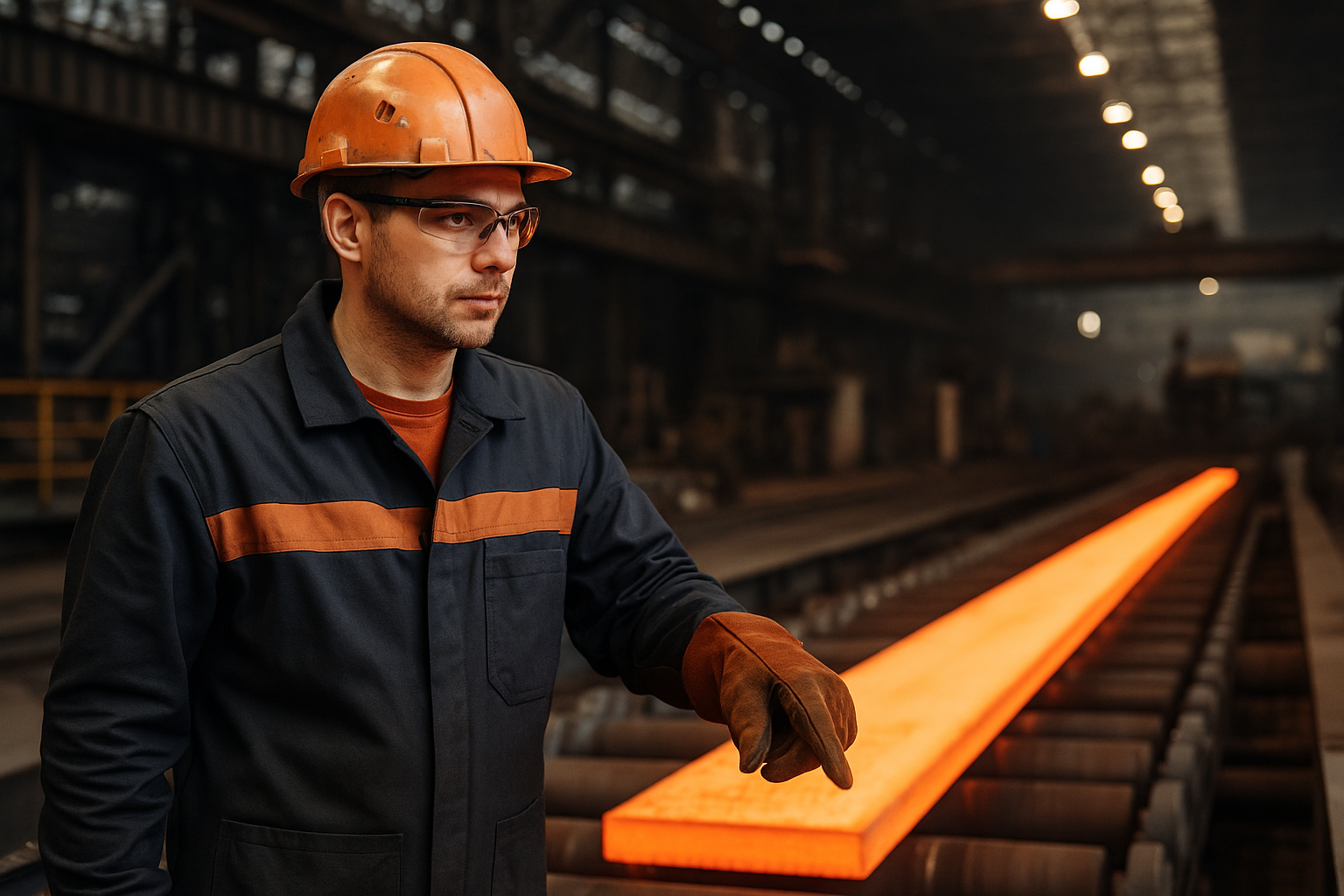
Steel manufacturing operates at a scale where small inefficiencies can become large operational losses.
A delay between process stages, excessive work-in-progress, unstable equipment, unnecessary material movement, poor production sequencing, repeated quality deviations or a small reduction in metallic yield can affect thousands of tonnes of production.
This makes steel manufacturing a natural environment for lean thinking.
But applying lean principles to a steel plant requires more than transferring methods developed for automotive assembly directly into steelmaking.
Steel production combines batch, continuous and discrete operations. It involves high-temperature processes, large capital-intensive equipment, metallurgical constraints, campaigns, long process routes, energy-intensive operations and complex production scheduling.
A blast furnace cannot simply be stopped because downstream demand falls for several hours. A continuous caster cannot operate according to the same pull logic as an assembly workstation. A rolling mill may require campaign sequencing because product dimensions, grades and roll changes influence productivity and quality.
Lean manufacturing in steel must therefore be adapted to the physics and economics of the process.
The objective is not to minimize every inventory, maximize every machine or eliminate every buffer.
The objective is to improve the total flow of value while reducing waste, instability and unnecessary consumption of resources.
That distinction is fundamental.
1. What Lean Manufacturing Actually Means
Lean is often associated with individual tools:
- 5S;
- kanban;
- kaizen;
- value stream mapping;
- standardized work;
- visual management;
- setup reduction.
But lean is broader than any individual method.
The Lean Enterprise Institute describes lean thinking around five fundamental principles:
Value → Value Stream → Flow → Pull → Perfection
The starting point is value from the customer’s perspective. The organization then examines the complete sequence of activities required to provide that value, improves flow, uses pull where appropriate and continues improving the system rather than treating improvement as a one-time project.
In a steel plant, this means asking questions such as:
What does the customer actually require?
Which operations are necessary to achieve those requirements?
Where does material wait?
Where is capacity lost?
Where is quality created or destroyed?
Where is energy consumed without producing proportional value?
Where does information arrive too late?
Which activities exist only because another part of the system is unstable?
Lean begins with these questions, not with the selection of a tool.
2. Why Steel Manufacturing Requires Its Own Lean Approach
Steel plants do not behave like conventional assembly operations.
A typical steel value stream can involve:
Raw Materials → Ironmaking → Steelmaking → Secondary Metallurgy → Continuous Casting → Reheating → Rolling → Finishing → Inspection → Storage → Shipping
Each stage has different operating characteristics.
Some processes operate continuously.
Others operate in batches.
Some require campaigns.
Others require frequent product changes.
Some equipment can accumulate intermediate inventory upstream or downstream.
Others must remain synchronized with adjacent processes.
Production decisions may also depend on:
- steel grade;
- heat sequence;
- slab dimensions;
- rolling width;
- thickness;
- furnace capacity;
- casting speed;
- roll campaign;
- surface requirements;
- downstream finishing route;
- customer delivery requirements.
Lean principles remain applicable, but the implementation must respect these constraints.
The correct question is not:
How do we force a steel plant to behave like an assembly line?
It is:
How do we apply lean thinking to improve flow within the real constraints of steel production?
3. Value Must Be Defined Before Waste Can Be Identified
An activity cannot be classified intelligently as waste until value is understood.
For a steel customer, value may include:
- correct grade;
- dimensional accuracy;
- mechanical properties;
- surface quality;
- flatness;
- coating requirements;
- certification;
- traceability;
- delivery reliability;
- appropriate packaging.
Producing characteristics beyond what is technically or commercially required does not necessarily create additional customer value.
For example, repeatedly processing material to compensate for unstable upstream quality is not value creation.
Neither is producing inventory simply to keep a machine operating.
Lean therefore distinguishes between:
Value-Adding Activities
Activities that transform the product toward what the customer requires.
Necessary but Non-Value-Adding Activities
Activities that may not create customer value directly but are currently necessary because of technical, regulatory, safety or process requirements.
Waste
Activities that consume resources without creating required value.
This classification is more useful than simply asking whether an activity is productive.
4. The Seven Traditional Wastes in Steel Manufacturing
Lean traditionally identifies seven major categories of waste.
Their physical manifestation in a steel plant can be very different from that in discrete manufacturing.
Overproduction
Overproduction occurs when production exceeds what the next process or customer actually requires.
In steel manufacturing, this may appear as:
- unnecessarily large production campaigns;
- coils produced before required delivery windows;
- intermediate material created without downstream capacity;
- production driven by local equipment utilization rather than system demand.
Overproduction is particularly important because it can create other forms of waste:
Overproduction → Inventory → Handling → Storage → Waiting → Working Capital
A machine being busy does not prove that value is being created.
Waiting
Waiting can include:
- equipment waiting for material;
- material waiting for equipment;
- waiting for laboratory results;
- waiting for quality release;
- waiting for maintenance;
- waiting for cranes;
- waiting for production instructions;
- waiting between metallurgical stages.
Some waiting is physically necessary.
Other waiting results from poor synchronization.
Lean requires distinguishing between the two.
Transportation
Steel products are heavy.
Every unnecessary movement of:
- scrap;
- hot metal;
- billets;
- slabs;
- coils;
- plates;
- finished products
requires equipment, energy, labor and time.
Transportation can also introduce risks of:
- damage;
- incorrect identification;
- safety incidents;
- scheduling conflicts.
The objective is not zero transportation.
It is eliminating transportation that does not contribute to the required process route.
Over-Processing
Examples can include:
- unnecessary inspection;
- repeated data entry;
- redundant handling;
- unnecessary surface treatment;
- reprocessing caused by upstream instability;
- duplicate administrative approvals.
An activity may appear technically legitimate while existing only because another process is unreliable.
Lean asks why the activity exists.
Inventory
Steel inventory can include:
- raw materials;
- scrap;
- work-in-progress;
- slabs;
- billets;
- coils;
- plates;
- finished products;
- spare parts.
Inventory can provide necessary protection against variability.
But excessive inventory can conceal problems.
It can hide:
- unreliable equipment;
- poor scheduling;
- long changeovers;
- supplier instability;
- quality problems;
- imbalanced capacity.
Therefore:
Inventory is not automatically waste, and zero inventory is not automatically lean.
The correct level depends on the function the inventory performs and the variability it must absorb.
Motion
Motion concerns unnecessary movement by people or equipment during work.
Examples include:
- operators repeatedly walking for tools;
- maintenance technicians searching for parts;
- unnecessary climbing or access;
- poorly positioned inspection equipment;
- excessive movement during changeovers.
These losses may appear small individually but occur repeatedly.
Defects
Defects in steel production can generate:
- scrap;
- rework;
- downgrade;
- reprocessing;
- additional inspection;
- yield loss;
- delayed delivery;
- customer claims.
A defect should therefore be evaluated beyond the direct value of rejected material.
Its full effect can propagate through the value stream.
5. Energy and Material Losses Cut Across the Traditional Wastes
Energy is not normally listed as one of the original seven wastes.
But in steel manufacturing it deserves explicit management because energy intensity is high.
The same applies to metallic and material losses.
World Steel Association’s 2026 indicators report an energy intensity of 20.95 GJ per tonne of crude steel and material efficiency of 92.79% for the reporting sample. These are industry-level indicators rather than targets for an individual plant, but they illustrate the scale at which energy and material performance matter.
Lean analysis should therefore ask:
- Is material being reheated unnecessarily?
- Is equipment idling without productive purpose?
- Are compressed air, gases or cooling systems being used inefficiently?
- Are defects causing repeated energy-intensive processing?
- Is poor yield forcing additional production to obtain the same saleable tonnage?
Energy and material performance should be treated as consequences of how effectively the production system operates.
6. Local Efficiency Is Not the Same as System Efficiency
One of the most important lean concepts in steel manufacturing is the difference between optimizing equipment and optimizing flow.
Suppose an upstream machine has more capacity than the downstream process.
Running the upstream equipment continuously at maximum output may improve its local utilization indicator.
But it may also produce:
More Output → More WIP → More Storage → More Handling → Longer Lead Time
The local KPI improves while the value stream becomes worse.
This creates an important distinction:
Equipment Efficiency ≠ Value-Stream Efficiency
A lean plant does not intentionally reduce productive capacity.
It asks whether using that capacity at a particular moment improves the performance of the whole system.
7. Bottlenecks Determine the Effective Flow of the System
Every production system contains constraints.
A bottleneck can occur at:
- furnace capacity;
- casting capacity;
- reheating;
- rolling;
- annealing;
- galvanizing;
- inspection;
- packaging;
- logistics.
The bottleneck may also change with product mix.
A finishing operation that has excess capacity for one product family may become the constraint for another.
Lean improvement should therefore consider the complete production route.
Increasing the capacity of a non-bottleneck process may produce little system benefit if the additional output simply waits before the actual constraint.
This is why plant-wide analysis is more important than isolated machine optimization.
8. Value Stream Mapping Makes the Entire Flow Visible
Value Stream Mapping, or VSM, examines both material and information flow.
NIST describes VSM as a method for visualizing manufacturing processes and information flows, developing a current-state map, identifying problems and opportunities, defining a future state and implementing improvements.
For a steel product family, the current-state map might follow:
Order → Production Planning → Steelmaking → Casting → Slab Yard → Reheating → Rolling → Finishing → Inspection → Warehouse → Shipping
The map should capture more than process sequence.
Useful data can include:
- processing time;
- waiting time;
- queue time;
- inventory;
- batch size;
- changeover time;
- equipment availability;
- yield;
- rework;
- information flow;
- production frequency.
The objective is to understand how the complete system behaves.
9. Processing Time and Lead Time Are Not the Same
This distinction is fundamental.
A product may spend relatively little time being physically transformed while spending much longer:
- waiting;
- stored;
- queued;
- transported;
- awaiting information.
Conceptually:
Total Lead Time = Processing Time + Waiting + Queue + Transport + Other Delays
A production line can therefore contain very fast machines while still having a long order-to-delivery lead time.
Lean focuses attention on the entire elapsed time, not only machine cycle time.
This often reveals improvement opportunities that equipment-speed studies miss.
10. WIP Is Both Inventory and Information
Work-in-progress is not simply material stored between operations.
It tells engineers something about the production system.
Increasing WIP can indicate:
- capacity imbalance;
- schedule instability;
- long changeovers;
- equipment unreliability;
- oversized batches;
- quality holds;
- downstream constraints.
But buffers may also perform a legitimate operational function.
The question should therefore be:
Why does this buffer exist?
Then:
What would have to improve before it could safely be reduced?
Removing inventory without removing the variability that required it can make the system less reliable.
Lean should expose problems, not create artificial shortages.
11. Flow Is the Objective — Not Zero Inventory
Ideal lean flow means that value moves through the process with minimal interruption.
But continuous physical flow is not possible across every steelmaking stage.
Steel production may require:
- batch formation;
- metallurgical residence time;
- buffer storage;
- campaign operation;
- inspection holds;
- cooling;
- sequencing.
The goal is therefore not literal one-piece flow from raw material to customer.
The goal is to identify and reduce avoidable interruption to value flow.
This is a much more useful interpretation of lean for process industries.
12. Pull Systems Must Be Adapted to Steelmaking
In classical lean thinking, pull means that upstream activity responds to downstream need when continuous flow is not possible.
This concept is powerful.
But steel plants should not apply it mechanically.
A production system may contain operations that cannot start and stop economically or technically in response to every downstream withdrawal.
Pull can instead be applied selectively to:
- finished-goods replenishment;
- consumables;
- packaging materials;
- spare parts;
- coil movement;
- certain finishing operations;
- production release at selected control points.
The architecture must reflect the production route.
Pull is a flow-control principle, not a requirement that every steelmaking asset wait for an individual downstream signal.
13. Just-in-Time Does Not Mean Eliminating Every Buffer
JIT is often misunderstood as “zero inventory.”
That interpretation can be dangerous.
The deeper objective is to provide what is required:
in the required quantity, at the required time, with minimum unnecessary inventory.
Steelmaking uncertainty can arise from:
- equipment reliability;
- supplier variability;
- quality;
- transportation;
- product mix;
- campaign constraints;
- process yield.
Buffers may therefore be economically justified.
A better lean question is:
What variability is this inventory protecting us from?
If the cause can be reduced, the buffer may also be reduced.
If the cause remains, eliminating the buffer may simply transfer the problem elsewhere.
14. Production Leveling Has Physical Limits
Leveling aims to reduce unnecessary production volatility.
But steel plants cannot always level production exactly according to daily customer mix.
Changing from one product to another may affect:
- furnace operation;
- casting sequence;
- slab dimensions;
- rolling setup;
- rolls;
- finishing route;
- cleaning requirements.
Production planning must balance:
Customer Demand + Process Constraints + Campaign Efficiency + Inventory + Delivery Performance
The optimum sequence is therefore rarely obtained by considering only one variable.
Lean planning seeks greater stability without ignoring metallurgical reality.
15. Standardized Work Creates a Baseline for Improvement
Standardized work defines the currently accepted method for performing repeatable work.
The Lean Enterprise Institute describes standardized work as a foundation for reducing variability, training operators and supporting improvement. It also emphasizes that standardized work itself becomes the subject of subsequent kaizen.
In steel plants, standards can support:
- inspections;
- equipment setup;
- sampling;
- changeovers;
- packaging;
- startup procedures;
- routine operating activities;
- maintenance tasks.
But standardization must not become rigidity.
The correct principle is:
Standard Work = Best Currently Known Safe and Repeatable Method
When a better method is demonstrated and validated, the standard should change.
16. Standardization and Kaizen Depend on Each Other
Without a baseline, it is difficult to determine whether a change actually improved performance.
This creates the relationship:
Standard → Improvement → Validation → New Standard → Further Improvement
Lean guidance explicitly connects standardized work and kaizen: stable operating conditions and a defined baseline make systematic improvement possible.
This is especially important in steel production because process variability can make anecdotal improvement claims misleading.
A change should be evaluated against defined performance measures.
17. 5S Is a Production-Control Discipline, Not a Cleaning Campaign
5S is commonly summarized as:
Sort → Set in Order → Shine → Standardize → Sustain
But reducing it to housekeeping misses much of its industrial value.
In a steel plant, effective 5S can make abnormalities visible.
Examples include:
- missing tools;
- oil leaks;
- damaged hoses;
- misplaced components;
- abnormal accumulation;
- incorrect material location;
- obstructed access;
- missing inspection devices.
The objective is to create a workplace where the expected condition is clear enough that deviation becomes visible.
That supports safety, maintenance and operational stability.
18. Visual Management Should Make Abnormal Conditions Obvious
A visual management system should help people understand the state of the operation without requiring extensive investigation.
Useful information may include:
- target versus actual production;
- equipment status;
- quality deviation;
- maintenance status;
- material queue;
- schedule adherence;
- safety conditions.
But more screens do not automatically improve visual management.
The essential question is:
Can the person responsible recognize an abnormal condition and understand what response is required?
A display containing hundreds of indicators may be less effective than a small number of clearly defined signals.
19. Kaizen Should Solve Problems, Not Generate Activity
Kaizen is continuous improvement through repeated problem solving and learning.
It should not be measured simply by:
- number of events;
- number of suggestions;
- number of workshops.
A successful kaizen activity should improve a defined condition.
Examples include:
- reducing crane waiting;
- reducing inspection delay;
- improving setup;
- eliminating repeated quality deviation;
- improving workplace organization;
- reducing unnecessary motion.
The improvement should then be standardized if successful.
Lean becomes sustainable when improvement becomes part of normal management rather than an occasional campaign.
20. Root-Cause Analysis Prevents Repeated Firefighting
Steel operations frequently face recurring problems.
A weak improvement system repeatedly restores production without eliminating the cause.
A stronger system distinguishes:
Symptom → Immediate Cause → Contributing Conditions → Root Cause → Corrective Action
Methods such as:
- 5 Whys;
- cause-and-effect analysis;
- A3 problem solving;
- Pareto analysis
can support this process.
The tool is less important than the discipline of verifying cause and effect.
A plant that solves the same problem every week is not continuously improving.
It is continuously recovering.
21. TPM Supports Lean by Creating Equipment Stability
Lean flow depends on reliable equipment.
Unexpected failures create:
- waiting;
- rescheduling;
- excess WIP;
- quality instability;
- overtime;
- emergency maintenance.
Total Productive Maintenance, or TPM, therefore supports lean by improving equipment stability and involving operations and maintenance in appropriate asset-care activities.
The lean perspective is straightforward:
Unreliable Equipment → Unstable Flow
TPM should not replace professional maintenance engineering.
It should strengthen the operating discipline that allows equipment to remain capable and available.
For a deeper discussion of planned maintenance strategy, see Preventive Maintenance in Steel Plants: How to Reduce Cost Without Over-Maintaining Equipment.
22. Predictive Maintenance Supports Flow When Applied to Relevant Failure Modes
Condition monitoring can further support operational stability.
But collecting vibration, temperature or current data is not automatically lean.
The value appears when information prevents a failure that would disrupt production or enables maintenance to be performed more effectively.
The logic should remain:
Failure Mode → Detectable Condition → Measurement → Diagnosis → Decision
For the complete methodology, see Predictive Maintenance in Steel Plants: A Practical Engineering Guide to Equipment Reliability.
Lean provides the operational context.
Reliability engineering provides the maintenance methodology.
23. Setup Reduction Can Change the Economics of Batch Size
Large batches are often justified by long setup times.
If changing a production condition requires several hours, management may prefer longer campaigns to distribute that setup loss over more tonnes.
But this can create:
- excess WIP;
- longer lead times;
- reduced flexibility;
- larger finished-goods inventory.
Setup reduction changes this relationship.
Lean setup-reduction methods typically distinguish between:
Internal Setup
Activities that require the equipment to be stopped.
External Setup
Activities that can be prepared while the equipment is operating.
Moving appropriate activities from internal to external setup and simplifying the remaining tasks can reduce downtime and enable smaller economic batches. Lean literature identifies setup reduction as an important enabler of flow and pull.
24. SMED Must Be Adapted to Steel Equipment
Single-Minute Exchange of Die, or SMED, originated in environments different from many steel operations.
Its underlying logic, however, remains useful.
A steel-plant changeover study may examine:
- roll changes;
- knife changes;
- tooling;
- guides;
- coil preparation;
- inspection setup;
- packaging change;
- cleaning;
- parameter preparation.
The objective is not necessarily achieving a literal single-digit-minute changeover.
The objective is systematically separating, simplifying, preparing and standardizing changeover activities.
The target should come from the economics and technical possibilities of the actual process.
25. Quality Should Be Controlled as Close to the Source as Possible
Traditional inspection detects problems after they have already been created.
Lean aims to detect and correct abnormal conditions closer to their origin.
In steel production, this can involve:
- process monitoring;
- dimensional measurement;
- surface inspection;
- automated alarms;
- laboratory feedback;
- standardized inspection;
- traceability.
The earlier a deviation is detected, the smaller the quantity of potentially affected material.
This changes quality from:
Produce → Inspect → Separate
toward:
Control → Detect → Correct → Prevent Recurrence
Inspection remains necessary, but it should not substitute for capable processes.
26. Poka-Yoke Should Prevent Predictable Errors
Error-proofing is useful where predictable human or process errors can be prevented by design.
Examples may include:
- connector designs preventing incorrect assembly;
- interlocks preventing invalid sequences;
- identification checks preventing material mix-up;
- software validation preventing impossible parameter combinations;
- physical guides ensuring correct positioning.
The strongest poka-yoke prevents the error.
The next best detects it immediately.
Both are preferable to discovering the problem after downstream processing.
27. Yield Is a Lean Performance Variable
In steel manufacturing, yield deserves special attention because material loss can propagate through the entire production route.
Losses may result from:
- trimming;
- crop ends;
- scale;
- defects;
- dimensional deviations;
- scrap;
- downgrade;
- process instability.
A small yield improvement can reduce the amount of upstream material and energy required to produce the same quantity of saleable steel.
Worldsteel’s Step Up efficiency methodology explicitly identifies improving yield as one of four major operational-efficiency areas and links better yield to lower raw-material and energy intensity.
For a detailed treatment of this subject, see Material Yield Optimization in Steel Manufacturing: How Small Improvements Drive Major Cost Savings.
28. Process Reliability Is Part of Operational Excellence
Worldsteel’s Step Up methodology is useful because it highlights four interconnected efficiency areas:
Raw Materials → Energy Efficiency and Waste → Yield → Process Reliability
It specifically connects process reliability and maintenance with reductions in quality losses, process-time losses and energy use per tonne.
This reinforces an important lean principle:
A plant cannot sustain flow when its basic operating conditions are unstable.
Operational excellence therefore requires both:
Waste Reduction + Process Stability
Trying to accelerate an unstable process usually creates instability faster.
29. Lean Logistics Begins With Material Identity and Destination
Steel logistics involve large masses and long internal movements.
A coil moved to the wrong storage location creates more than transportation waste.
It may cause:
- searching;
- crane movements;
- schedule disruption;
- shipping delay;
- safety exposure.
Lean internal logistics should therefore combine:
- material identification;
- defined storage logic;
- route discipline;
- movement planning;
- visual control;
- digital traceability where appropriate.
The objective is not simply moving material faster.
It is moving the correct material to the correct location with minimum unnecessary handling.
30. Layout Influences Waste
Steel plants are often constrained by legacy layouts.
Major equipment cannot be moved easily.
Nevertheless, layout analysis can still improve:
- tool location;
- maintenance support;
- inspection stations;
- spare-part storage;
- staging areas;
- internal routes;
- packaging operations.
A spaghetti diagram or movement study may reveal repeated travel that has become accepted simply because it has always existed.
Not every layout problem requires a major capital project.
31. Lean Production Planning Requires Cross-Functional Coordination
Production planning in steel is not merely a scheduling activity.
It connects:
- sales;
- order requirements;
- metallurgy;
- production;
- maintenance;
- quality;
- logistics.
Optimizing one department independently can degrade total performance.
For example:
A production schedule optimized solely for long campaigns may improve rolling efficiency while increasing finished inventory and customer lead time.
A schedule optimized solely for customer sequence may create excessive setups and capacity loss.
The objective is a system-level compromise based on transparent constraints.
32. Information Flow Can Be a Major Source of Waste
Material does not move efficiently when information is late, inconsistent or incorrect.
Information waste can include:
- outdated production instructions;
- duplicated data entry;
- conflicting specifications;
- manual transcription;
- delayed quality release;
- missing material status;
- unclear responsibility.
Value Stream Mapping should therefore examine both physical and information flow.
A steel plant can have advanced equipment and still experience poor flow because decisions arrive too late.
33. Automation Can Enable Lean — but It Cannot Create Lean Thinking
Automation can reduce waste through:
- automatic measurement;
- material tracking;
- process control;
- visual management;
- quality inspection;
- scheduling support.
But automating a poorly designed process may simply make waste faster and less visible.
The sequence should be:
Understand the Process → Identify Waste → Stabilize → Simplify → Automate Where Valuable
not:
Automate Everything → Assume Improvement
For the automation architecture behind modern steel production, see Steel Plant Automation: From Sensors and PLCs to MES and Intelligent Operations.
34. Digital Data Should Support Gemba Understanding
Industrial analytics can provide powerful insight.
But lean management also emphasizes understanding the actual work where it occurs.
Data may indicate:
Waiting time increased by 18%.
A direct process investigation may reveal why:
- crane unavailable;
- material identification problem;
- operator waiting for laboratory release;
- staging area blocked.
The strongest improvement process combines:
Data + Direct Observation + Operator Knowledge + Engineering Analysis
Dashboards should direct attention toward problems, not replace understanding of the process.
35. Lean Safety Means Removing Exposure, Not Only Recording Incidents
Safety and productivity should not be treated as opposing objectives.
Many forms of operational waste also create exposure:
- unnecessary walking;
- unnecessary lifting;
- repeated manual handling;
- excessive crane movement;
- clutter;
- unstable processes;
- emergency intervention.
Eliminating these activities can improve both flow and safety.
However, safety controls must never be removed merely because they appear non-value-adding from a narrow production perspective.
Necessary safeguards may not transform the product, but they are essential operating requirements.
36. Lean Should Not Be Used as a Headcount-Reduction Program
If employees associate lean only with job elimination, they have little incentive to identify waste.
This undermines continuous improvement.
Operators and maintenance personnel often possess detailed knowledge of:
- recurring failures;
- difficult setups;
- unnecessary movement;
- unreliable standards;
- quality problems;
- informal workarounds.
A mature lean system uses this knowledge to improve processes.
The objective is to remove waste from work, not remove thinking from the workforce.
37. KPIs Must Reinforce System Performance
Poorly designed KPIs can encourage waste.
For example, measuring only machine utilization can encourage overproduction.
Measuring only tonnes produced can conceal:
- yield loss;
- defects;
- inventory;
- energy intensity;
- delayed orders.
A balanced lean performance system may monitor:
- lead time;
- WIP;
- throughput;
- yield;
- schedule adherence;
- first-pass quality;
- rework;
- downtime;
- changeover time;
- energy per tonne;
- on-time delivery.
The KPI should reflect the operational problem being managed.
38. OEE Is Useful but Should Not Become the Objective
Overall Equipment Effectiveness combines:
Availability × Performance × Quality
It can help identify losses in equipment-intensive processes.
But maximizing OEE on every machine does not automatically optimize the value stream.
A non-bottleneck machine may not need to run continuously.
Producing unnecessary material merely to maintain a high utilization or OEE number creates waste elsewhere.
OEE should therefore support operational diagnosis.
It should not override system flow.
39. Cost per Tonne Can Hide the Cost of Poor Flow
Unit cost is essential in steel manufacturing.
But some accounting interpretations can encourage larger batches and higher inventory because fixed costs appear to be distributed over more tonnes.
The operational consequences may include:
- more WIP;
- longer lead time;
- additional storage;
- increased handling;
- slower response.
Lean analysis therefore complements traditional cost accounting with physical operating measures.
A lower calculated unit cost does not necessarily mean a better production system if cash and material remain trapped in the value stream longer.
40. Where Lean Tools Need Adaptation in Steel Manufacturing
Lean principles are broadly applicable.
Individual tools require context.
| Lean Concept | Typical Discrete Interpretation | Steel-Manufacturing Adaptation |
|---|---|---|
| Flow | One-piece continuous flow | Minimize avoidable interruption across batch, continuous and discrete stages |
| Pull | Downstream signal triggers upstream production | Selective pull at appropriate control points |
| JIT | Minimal inventory | Minimum justified inventory consistent with process stability |
| Takt | Production rhythm based on demand | Useful where demand and process structure allow meaningful application |
| SMED | Very short equipment changeover | Systematic reduction of technically necessary changeover |
| Standard Work | Repeatable operator sequence | Standards adapted to process, metallurgical and safety conditions |
| Kanban | Replenishment signal | Appropriate for selected materials, consumables, spares and process interfaces |
| 5S | Workplace organization | Abnormality visibility, access, safety and maintainability |
This distinction prevents lean from becoming a collection of copied tools.
41. Common Lean Implementation Mistakes in Steel Plants
Starting With 5S Everywhere
5S can be valuable, but isolated housekeeping campaigns rarely transform a value stream.
Declaring All Inventory Waste
Some inventory protects the process from real variability.
Understand its function first.
Maximizing Every Machine
Local utilization can create system-level overproduction.
Applying Pull Everywhere
Not every steelmaking process can respond directly to downstream consumption.
Ignoring Metallurgical Constraints
Process physics cannot be removed through management terminology.
Copying Automotive Methods Literally
Principles transfer more easily than specific operating mechanisms.
Running Kaizen Events Without Standards
Improvements cannot be sustained if the new method is not standardized.
Treating Lean as Cost Cutting
Lean should improve value creation and operating capability.
Ignoring Maintenance
Unreliable equipment destroys flow.
Measuring Activity Instead of Results
The number of lean events is not a performance outcome.
42. A Practical Lean Transformation Roadmap for Steel Plants
Step 1 — Select a Value Stream
Do not begin by attempting to transform the entire plant simultaneously.
Select a meaningful product family or production route.
Step 2 — Define Customer Value
Clarify:
- quality;
- quantity;
- delivery;
- technical requirements.
Step 3 — Map the Current State
Document material and information flow.
Measure:
- process time;
- waiting;
- WIP;
- yield;
- downtime;
- changeovers;
- quality losses.
Step 4 — Identify the Constraint
Determine what currently limits total flow.
Step 5 — Identify the Major Sources of Waste
Prioritize by operational impact rather than by ease of visibility.
Step 6 — Stabilize the Process
Address:
- reliability;
- standards;
- quality;
- basic operating conditions.
Step 7 — Improve Flow
Reduce unnecessary:
- queues;
- movement;
- batches;
- waiting;
- information delays.
Step 8 — Apply Pull Selectively
Use pull where it improves coordination without violating process constraints.
Step 9 — Reduce Changeover Where Economically Relevant
Smaller effective batches can improve flexibility and reduce WIP.
Step 10 — Standardize the Improved Condition
Document and train the new method.
Step 11 — Measure Results
Compare against the original baseline.
Step 12 — Repeat
Lean has no final state.
The future state becomes the next current state.
43. How to Measure a Lean Project
A credible project should define its baseline before implementation.
For example:
| Indicator | Before | After | Change |
|---|---|---|---|
| Lead time | Baseline | Result | Difference |
| WIP | Baseline | Result | Difference |
| Yield | Baseline | Result | Difference |
| Changeover | Baseline | Result | Difference |
| Downtime | Baseline | Result | Difference |
| Energy/t | Baseline | Result | Difference |
| Rework | Baseline | Result | Difference |
| On-time delivery | Baseline | Result | Difference |
The table should use actual plant data.
Avoid claiming savings simply because a lean tool was implemented.
The correct logic is:
Intervention → Measurable Process Change → Operational Result → Financial Effect
44. Lean and Operational Excellence Are Closely Related
Lean is one framework for operational improvement.
Operational excellence is broader.
A high-performing steel plant may integrate:
- lean;
- reliability engineering;
- process control;
- quality management;
- industrial automation;
- energy management;
- safety systems;
- production planning.
These disciplines should reinforce one another.
For example:
Lean identifies unnecessary waiting.
Reliability engineering reduces equipment failures causing that waiting.
Automation stabilizes process control.
Quality engineering reduces defects.
Production planning improves sequencing.
Operational excellence appears when these capabilities operate as a system.
45. Frequently Asked Questions
Can lean manufacturing be applied to steel plants?
Yes. Lean principles such as value, waste reduction, flow, standardization and continuous improvement are applicable to steel manufacturing. However, individual tools must be adapted to batch, continuous and metallurgically constrained processes.
Does lean mean reducing all inventory?
No. Lean seeks to eliminate unnecessary inventory. Buffers that protect production from justified variability may remain necessary until the underlying source of variability is reduced.
Can a blast furnace operate with a pull system?
Not in the same manner as a discrete assembly process. Pull principles can be applied at selected production interfaces, but continuous steelmaking assets must respect their technical and operating constraints.
What is the best lean tool for a steel plant?
There is no universal best tool. The correct method depends on the problem. Value Stream Mapping can be useful for understanding the overall flow before selecting specific interventions.
Is 5S just housekeeping?
No. Effective 5S establishes workplace organization and visual standards that help make abnormal conditions visible.
What is the relationship between lean and TPM?
TPM supports lean by improving equipment stability and availability. Reliable equipment is necessary for predictable production flow.
What is the relationship between lean and predictive maintenance?
Predictive maintenance uses equipment-condition information to support reliability decisions. Lean provides the flow and waste-reduction context in which improved reliability creates operational value.
Does lean require automation?
No. Lean and automation are different disciplines. Automation can enable lean processes, but automating waste does not eliminate it.
Does lean always require smaller batches?
Not automatically. Smaller batches can reduce WIP and improve flexibility, but batch size must consider setup, process physics, metallurgy, capacity and production economics.
What should a steel plant measure first?
Start with the performance problem. For a flow problem, useful measures may include lead time, WIP, waiting, throughput, schedule adherence, yield and downtime.
46. Conclusion
Lean manufacturing can create significant value in steel plants, but only when its principles are applied to the realities of steel production.
The objective is not:
Zero Inventory.
It is:
Only the inventory that the system genuinely requires.
The objective is not:
Maximum Utilization of Every Machine.
It is:
Maximum effectiveness of the total value stream.
The objective is not:
Install Lean Tools.
It is:
Solve operational problems systematically.
And the objective is not:
Copy an automotive production system.
It is:
Apply lean thinking intelligently to steelmaking.
A useful steel-industry interpretation can therefore be summarized as:
Customer Value → Understand the Value Stream → Identify Waste → Stabilize the Process → Improve Flow → Control WIP → Improve Reliability → Standardize → Measure → Improve Again
The strongest lean steel plants will not necessarily be those with the most kanban boards, kaizen events or visual displays.
They will be those that can reliably convert raw materials, energy, equipment time and human knowledge into customer value with progressively less waste.
That is the practical meaning of operational excellence.
Technical References
- Lean Enterprise Institute — Lean Thinking and Practice
- Lean Enterprise Institute — What Is Lean?
- NIST — Value Stream Mapping
- Lean Enterprise Institute — Standardized Work
- World Steel Association — Step Up and Efficiency Programme
- World Steel Association — World Steel in Figures 2026
- Lean Enterprise Institute — Kaizen
- Lean Enterprise Institute — Why Does Setup Time Reduction Matter So Much?