
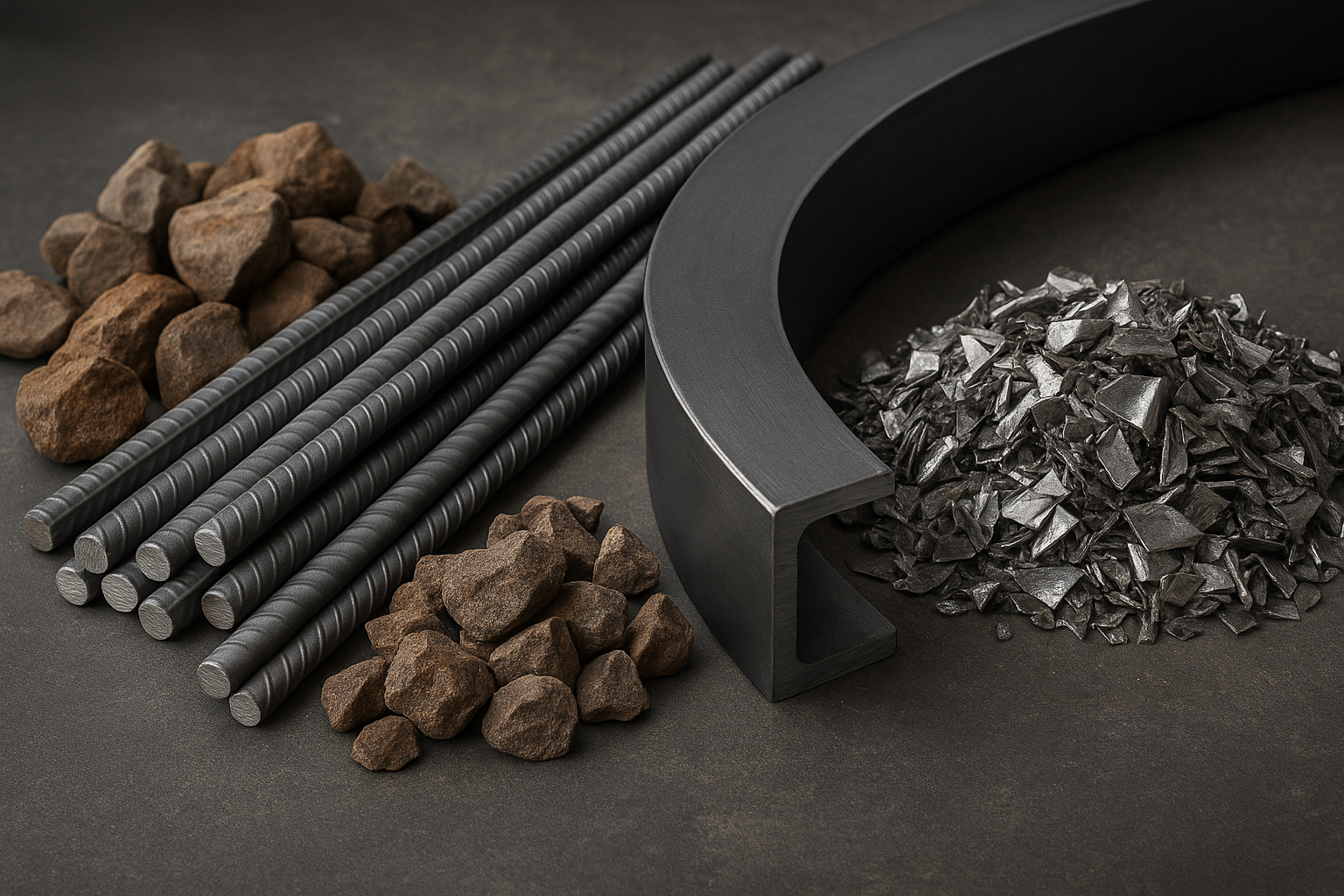
Steel is often described as one of the most sustainable industrial materials because of its durability, versatility, and ability to be recycled repeatedly.
That statement, however, requires an important qualification.
Steel is not sustainable simply because it is recyclable.
The environmental and economic performance of a steel product depends on an entire system:
Raw Materials → Ironmaking → Steelmaking → Casting & Rolling → Manufacturing → Use → Life Extension → Reuse/Remanufacturing → Scrap Collection & Sorting → Recycling → New Steel
Across every stage, five variables should be evaluated:
Energy → Carbon → Material Efficiency → Traceability → Economics
This life-cycle perspective changes the question companies should ask.
Instead of asking:
Is this steel sustainable?
A more useful engineering question is:
How efficiently are materials, energy, carbon, assets and economic resources managed throughout the complete life cycle of this steel product?
That distinction is fundamental.
A steel product manufactured with relatively low production emissions but replaced prematurely because of corrosion may not represent the best life-cycle solution.
Conversely, a steel grade with higher initial production impacts may provide decades of additional service life, reduce maintenance, allow thickness reduction, improve payload, or enable reuse.
Sustainable steel therefore requires life-cycle engineering rather than environmental marketing.
1. Sustainability Must Be Evaluated Across the Entire Steel Life Cycle
The environmental performance of steel cannot be understood by looking only at the steelmaking furnace.
Every stage matters.
| Life-Cycle Stage | Important Variables |
|---|---|
| Raw materials | Ore, coal, scrap, alloys, water, energy |
| Ironmaking | Reductant, energy, emissions, yield |
| Steelmaking | Production route, electricity, metallic charge |
| Casting & rolling | Yield, energy, scrap, dimensional control |
| Manufacturing | Material utilization, scrap, forming, welding |
| Distribution | Distance, transport mode, payload |
| Use | Durability, weight, efficiency, maintenance |
| Life extension | Repair, coating, replacement prevention |
| Reuse | Component recovery and qualification |
| Scrap processing | Collection, separation, contamination |
| Recycling | Energy, metallic yield, scrap quality |
| New steel | Metallurgical requirements and final application |
This means sustainability cannot be reduced to a single indicator such as recycled content or tonnes of CO₂ per tonne of steel.
A proper evaluation requires Life Cycle Assessment — LCA.
The World Steel Association supports LCA methodology based on relevant ISO standards and maintains life-cycle inventory data for steel products, including information that can support cradle-to-gate and cradle-to-grave analyses.
2. Steel Is a Permanent Material — But Sustainability Is Not Automatic
Steel has an exceptional characteristic: it can return to steelmaking after the end of a product’s useful life.
Buildings become scrap.
Vehicles become scrap.
Industrial machinery becomes scrap.
Packaging becomes scrap.
The recovered steel can become raw material for another generation of products.
This creates an important circular flow:
Steel → Product → Use → Recovery → Scrap → Steel
But circularity depends on several conditions.
The material must be collected.
It must be separated.
Contamination must be controlled.
The scrap must be classified.
Residual elements must remain compatible with the steel grade being produced.
Energy must be available for remelting and processing.
And the economics of recovery must remain viable.
Steel therefore provides an excellent technical foundation for circularity, but industry still needs to manage the cycle correctly.
3. Stage 1 — Raw Materials
The steel life cycle begins before the steel mill.
Primary steel production requires materials such as:
- iron ore;
- metallurgical coal in conventional integrated routes;
- limestone and fluxes;
- ferroalloys;
- recycled steel;
- energy;
- water.
Secondary production relies more heavily on steel scrap but may also require DRI, pig iron or other virgin metallic inputs to achieve the required chemistry.
The World Steel Association reports that the traditional integrated BF-BOF route uses iron ore, metallurgical coal, limestone and recycled steel, while EAF production relies primarily on recycled steel and other metallic inputs together with electricity.
This immediately demonstrates why the term “recycled steel versus virgin steel” can oversimplify industrial reality.
Modern steelmaking frequently uses combinations of primary and secondary metallic inputs.
4. Stage 2 — Ironmaking
When steel originates from iron ore, the iron oxides must first be reduced.
Historically, the dominant industrial route has been the blast furnace.
The blast furnace uses carbon-bearing materials not only as energy sources but also as reducing agents.
This is one reason why conventional primary steelmaking has significant CO₂ emissions.
Decarbonizing steel therefore requires more than simply improving furnace efficiency.
It may require changing the chemistry of iron reduction itself.
This explains the growing importance of technologies such as:
DRI — Direct Reduced Iron
and particularly:
H₂-DRI — hydrogen-based direct reduction.
Instead of relying primarily on carbon to remove oxygen from iron oxide, hydrogen can potentially perform the reduction while producing water as an important reaction product.
However, the industrial equation is more complex than:
Hydrogen = green steel.
The hydrogen must itself be produced.
Electricity is required.
Infrastructure is required.
High-quality iron ore may be required.
DRI must subsequently be converted into steel.
Capital investment can be substantial.
Therefore, H₂-DRI should be evaluated as part of an integrated energy, metallurgical and economic system.
5. Stage 3 — Steelmaking
Three production-route concepts are especially important in modern sustainability discussions:
BF-BOF
Blast Furnace + Basic Oxygen Furnace.
Predominantly ore-based primary steel production.
Scrap-EAF
Electric Arc Furnace using predominantly recycled steel.
DRI-EAF
Direct Reduced Iron followed by Electric Arc Furnace steelmaking.
These routes can have very different emissions profiles.
The World Steel Association’s latest route-level reporting for 2024 shows average CO₂ intensities of approximately:
| Route | CO₂ intensity |
|---|---|
| BF-BOF | 2.34 t CO₂/t crude steel |
| Scrap-EAF | 0.69 t CO₂/t crude steel |
| DRI-EAF | 1.47 t CO₂/t crude steel |
The expanded GHG indicator, which includes additional greenhouse gases and upstream mining effects, produces higher figures: approximately 2.66, 0.71 and 1.66 t CO₂e/t respectively.
These numbers illustrate an important principle:
The steelmaking route matters — but the route name alone does not define sustainability.
6. EAF Does Not Automatically Mean “Green Steel”
Electric arc furnaces offer important opportunities for reducing emissions, particularly when they process high levels of scrap and use low-carbon electricity.
But two EAF plants can have very different environmental performances.
Consider:
EAF Plant A
- high scrap content;
- renewable electricity;
- efficient furnace;
- optimized yield;
- short scrap transportation distance.
And:
EAF Plant B
- fossil-intensive electricity grid;
- significant virgin metallic input;
- lower energy efficiency;
- long-distance scrap transportation;
- poor metallic yield.
Both use an EAF.
Their environmental performance is not necessarily comparable.
Therefore:
Production technology should be evaluated together with the energy system, metallic charge, process efficiency and final product requirements.
7. Stage 4 — Casting, Rolling and Finishing
After steelmaking, liquid steel must become usable industrial products.
Typical processes include:
- continuous casting;
- reheating;
- hot rolling;
- cold rolling;
- annealing;
- pickling;
- coating;
- heat treatment;
- finishing.
Sustainability opportunities exist throughout this stage.
Examples include:
- increasing metallic yield;
- reducing edge trimming;
- optimizing slab dimensions;
- improving rolling schedules;
- reducing rejected material;
- recovering process heat;
- reducing water consumption;
- controlling thickness more precisely.
This last point is especially important.
A steel producer capable of maintaining tighter dimensional control may allow customers to purchase material closer to the technical minimum thickness.
Therefore, process capability can become a sustainability variable.
This connects directly with thickness tolerance management.
If an industrial customer can safely reduce average steel consumption from 2.05 mm to 1.95 mm while maintaining the minimum required performance, sustainability improves because less steel must be produced, transported and processed.
8. Material Efficiency Is a Sustainability Strategy
Sustainability discussions frequently concentrate on carbon intensity.
But material efficiency deserves equal management attention.
The 2025 worldsteel sustainability indicators report shows that 92.79% of solid materials were converted into products and co-products in the 2024 reporting dataset.
At the downstream manufacturing level, the same principle applies.
Consider a company purchasing 10,000 tonnes of steel annually.
If manufacturing yield increases from:
82% → 90%
the company may obtain substantially more finished product from the same purchased steel.
That reduces:
- purchased tonnage;
- scrap generation;
- handling;
- freight;
- working capital;
- energy consumption;
- cost per finished product.
This leads to one of the central principles of sustainable steel manufacturing:
The most sustainable tonne of steel may be the tonne that does not need to be purchased because engineering eliminated unnecessary material consumption.
9. Stage 5 — Manufacturing the Final Product
The environmental footprint of steel does not stop at the mill gate.
Steel must be converted into products.
Processes may include:
- blanking;
- laser cutting;
- stamping;
- roll forming;
- machining;
- welding;
- painting;
- galvanizing;
- assembly.
Manufacturing efficiency can significantly change the sustainability equation.
For example, suppose two companies manufacture the same component.
Company A:
100 kg steel input → 72 kg finished product
Company B:
85 kg steel input → 72 kg finished product
Even if both companies purchase identical steel, Company B uses the material more efficiently.
This is why sustainability programs should measure:
Material Utilization Rate
Finished Product Weight ÷ Steel Input Weight × 100
rather than only purchased tonnes.
10. Design Can Reduce Environmental Impact Before Production Begins
One of the most powerful sustainability tools is not located inside the steel mill.
It is located in the engineering department.
Design determines:
- thickness;
- geometry;
- grade;
- number of components;
- welding length;
- scrap generation;
- corrosion protection;
- durability;
- repairability;
- disassembly potential.
A component that historically uses 4.0 mm low-carbon steel should not automatically continue using that material indefinitely.
Engineering should ask:
Does the product really require 4.0 mm?
Perhaps:
- 3.5 mm HSLA steel;
- optimized geometry;
- localized reinforcement;
- better forming;
- tighter thickness tolerance
could provide equivalent or better performance.
That possibility must be validated technically, but it demonstrates how material optimization and sustainability can reinforce each other.
11. Stage 6 — Distribution and Logistics
Steel is heavy.
Consequently, logistics can materially influence both cost and environmental performance.
Relevant variables include:
- supplier distance;
- transport mode;
- truck utilization;
- vessel utilization;
- minimum order quantity;
- delivery frequency;
- inventory policy;
- backhaul opportunities;
- packaging.
However, one common assumption should be avoided:
Local steel is not automatically more sustainable steel.
Suppose Supplier A is 100 km away but uses a significantly more carbon-intensive production route.
Supplier B is 1,000 km away but produces steel with much lower embedded emissions.
Transportation alone cannot determine the answer.
The complete life cycle must be considered.
This is another reason LCA is superior to isolated sustainability indicators.
12. Stage 7 — The Use Phase
Once the product enters service, another sustainability dimension begins.
For some applications, the use phase can dominate the economic or environmental equation.
Consider:
Road trailers
Lower structural weight may increase payload or reduce fuel consumption.
Automotive components
Lightweighting may reduce energy consumption during operation.
Agricultural machinery
Improved wear resistance may reduce replacement frequency.
Buildings
Durability can extend structural life for decades.
Industrial machinery
Improved fatigue resistance may prevent premature component replacement.
Therefore, steel should not always be optimized for the lowest initial environmental footprint.
Sometimes the correct engineering objective is:
Minimum environmental and economic impact per unit of useful service delivered.
13. Durability Can Be More Important Than Initial Material Consumption
Consider two hypothetical steels.
| Variable | Steel A | Steel B |
|---|---|---|
| Component weight | 100 kg | 105 kg |
| Initial material requirement | Lower | Higher |
| Expected service life | 10 years | 25 years |
If Steel B genuinely delivers 2.5 times the service life, the extra five kilograms may be insignificant compared with avoiding one or more complete replacements.
The correct sustainability metric therefore may not be:
kg of steel/product
but:
kg of steel/useful service year
This concept is especially relevant for:
- mining equipment;
- agricultural machinery;
- infrastructure;
- structural components;
- abrasion applications;
- corrosive environments.
14. Corrosion Protection Is a Sustainability Strategy
Corrosion is often discussed as a maintenance or quality issue.
It is also a sustainability issue.
Every premature replacement consumes:
- new steel;
- energy;
- processing capacity;
- freight;
- labor;
- coatings;
- capital.
Therefore, options such as:
- galvanized steel;
- Zn-Al-Mg coatings;
- weathering steel;
- stainless steel;
- protective paint systems;
- appropriate corrosion allowance
should be evaluated over the complete service life.
The cheapest material at purchase may not provide the lowest life-cycle cost.
15. Stage 8 — Life Extension
Before replacing a steel product, companies should ask whether its useful life can safely be extended.
Potential strategies include:
- inspection;
- repair;
- reinforcement;
- recoating;
- replacement of localized wear parts;
- fatigue monitoring;
- predictive maintenance;
- corrosion monitoring.
Life extension can preserve much of the energy and economic value already embedded in the product.
This produces a hierarchy:
Reduce → Extend Life → Reuse → Remanufacture → Recycle
Recycling remains extremely important.
But it should not automatically be the first end-of-life option.
16. Stage 9 — Reuse Before Recycling
Suppose a structural steel beam reaches the end of a building’s useful life.
There are two possible routes.
Route A — Recycling
Demolish → Separate → Transport → Prepare Scrap → Melt → Refine → Cast → Roll
Route B — Reuse
Deconstruct → Inspect → Characterize → Approve → Reuse
When technically feasible, Route B preserves substantially more of the existing component.
The World Steel Association’s circular-economy framework specifically recognizes reducing material use, reuse, remanufacturing and recycling as complementary strategies.
But reuse cannot ignore engineering.
The component may require verification of:
- grade;
- dimensions;
- corrosion;
- deformation;
- fatigue history;
- weld condition;
- traceability;
- mechanical properties;
- intended new loading conditions.
Reuse should therefore mean:
Reuse + Engineering Validation
—not simply reuse.
17. Remanufacturing Can Preserve More Value Than Recycling
Industrial machinery provides another opportunity.
Instead of scrapping an entire assembly, manufacturers may recover:
- frames;
- housings;
- structural members;
- shafts;
- mechanical assemblies.
Selected components can be:
- inspected;
- repaired;
- machined;
- recoated;
- heat treated where appropriate;
- returned to service.
This retains not only the steel but also part of the manufacturing value already incorporated into the component.
That distinction is economically important.
A tonne of manufactured components represents much more accumulated value than one tonne of scrap.
18. Stage 10 — Scrap Collection
Eventually, many steel products reach the end of their useful lives.
At this point, efficient scrap collection becomes critical.
Steel benefits from magnetic separation, which facilitates recovery from mixed waste streams.
But scrap should not be considered a homogeneous raw material.
Different sources produce very different scrap qualities.
Examples include:
- automotive scrap;
- structural demolition scrap;
- industrial production scrap;
- machining scrap;
- appliance scrap;
- packaging scrap.
Each stream can contain different:
- coatings;
- oils;
- non-ferrous metals;
- residual elements;
- attached materials.
Therefore:
Scrap quantity matters, but scrap quality matters equally.
19. Stage 11 — Scrap Sorting and Preparation
Sorting is becoming increasingly important as the steel industry increases scrap utilization.
The objective is not merely to separate ferrous from non-ferrous material.
Advanced scrap management may involve:
- grade separation;
- coating identification;
- removal of copper;
- removal of tin-bearing materials;
- density separation;
- sensor-based sorting;
- chemical analysis.
This is particularly important for high-quality flat steels.
The World Steel Association specifically identifies copper and tin among important residual metallic elements in scrap and notes that demanding flat products may have lower tolerance for these residuals.
20. Scrap Quality and Tramp Elements
This connects directly with steel chemistry.
Suppose scrap contains excessive copper.
Copper is not easily removed through conventional steelmaking refining.
Repeated recycling without adequate scrap management can therefore cause residual-element accumulation.
Possible consequences include:
- hot-shortness;
- surface defects;
- rolling problems;
- forming problems;
- difficulty producing demanding grades.
Tin can create similar metallurgical challenges.
This explains why future steel circularity depends not only on:
more scrap
but increasingly on:
better-characterized scrap.
21. Primary Metallics Can Help Control Scrap Chemistry
This leads to an important industrial point.
Even an EAF plant using large quantities of scrap may require:
- DRI;
- HBI;
- pig iron;
- other virgin metallic units.
Why?
Among other reasons, these materials can help dilute residual elements.
For demanding steels, especially certain flat products, chemistry control may require carefully balancing scrap and primary metallic inputs.
Worldsteel specifically notes that ore-based metallics such as DRI can be required to dilute trace metallic elements when producing demanding grades through EAF routes.
Therefore:
Using virgin metallics inside an EAF is not necessarily a failure of circularity. It can be a metallurgical requirement for maintaining steel quality.
22. Stage 12 — Recycling Into New Steel
Once prepared, steel scrap returns to steelmaking.
Scrap may be used in:
- EAF production;
- BOF production;
- other metallurgical routes.
Worldsteel reports that scrap can represent up to 100% of EAF metallic input in some operations and can also be used in BF-BOF steelmaking.
This creates the circular loop:
Old Steel → Scrap → Metallic Charge → Liquid Steel → New Product
The new product may have no relationship to the previous application.
A vehicle may become reinforcement steel.
A building component may become machinery.
Industrial scrap may become automotive steel.
The material does not need to return to the same product to remain within the steel cycle.
23. Recycling Produces Major Resource Benefits
Scrap utilization reduces demand for virgin raw materials and can significantly reduce emissions.
According to worldsteel, every tonne of steel scrap used avoids approximately:
- 1.5 tonnes of CO₂ emissions;
- 1.4 tonnes of iron ore;
- 740 kg of coal;
- 120 kg of limestone.
These figures help explain why maximizing technically appropriate scrap use is a major decarbonization lever.
But they also lead to an obvious question:
Why doesn’t the world simply produce all steel from scrap?
24. Why 100% Recycled Steel Cannot Supply Global Demand
The answer is fundamentally related to material stocks and time.
Steel products can remain in service for decades.
A bridge constructed today may remain operational for many decades.
A building may last even longer.
Industrial machinery may operate for 20, 30 or 40 years.
That steel cannot become scrap while it is still performing its useful function.
Worldsteel estimates the average lifespan of steel products at approximately 40 years, although individual applications vary substantially. It also estimates that scrap availability could rise toward approximately 900 million tonnes by 2050, but this would still remain insufficient to satisfy total steel demand.
This creates a structural constraint:
Available Scrap < Total Steel Demand
Consequently, primary iron will remain necessary.
Worldsteel’s current climate policy material estimates that even around 2050, approximately half of steel production may still rely on iron ore.
25. Primary and Secondary Steelmaking Are Complementary
This changes the traditional debate.
The question should not be:
Primary steel OR recycled steel?
A more realistic question is:
How should primary and secondary metallic resources be combined to satisfy global steel demand with progressively lower environmental impact?
Primary production is needed to introduce new iron units into the global material stock.
Secondary production keeps existing iron circulating through the economy.
Over time:
Primary Iron → Steel → Product → Use → Scrap → Secondary Steel → Product
The two systems are interconnected.
26. What Does “Green Steel” Actually Mean?
The expression green steel has become common.
But buyers should use it carefully.
It is not sufficient to treat “green steel” as if it were a universally standardized metallurgical grade.
Different suppliers may use the expression to describe:
- lower-carbon steel;
- high-recycled-content steel;
- renewable-electricity EAF steel;
- hydrogen-based DRI steel;
- carbon-offset steel;
- steel from certified responsible production;
- products below a defined carbon-intensity threshold.
These concepts are not identical.
Therefore, industrial buyers should ask:
What exactly is being claimed?
And:
How is it measured?
27. Ask for Quantitative Evidence
Instead of accepting only:
“Low-carbon steel”
request measurable information such as:
- kg CO₂e/t steel;
- methodology;
- system boundary;
- production route;
- scrap content;
- electricity source;
- product-specific EPD;
- verification status;
- reporting year;
- manufacturing site.
This converts sustainability from marketing terminology into purchasing information.
28. Renewable Electricity and EAF
Electricity is one of the critical variables in EAF steelmaking.
Therefore, decarbonizing the electrical system can significantly improve EAF performance.
But procurement teams should distinguish between:
- grid electricity;
- renewable PPAs;
- on-site renewable generation;
- certificates;
- contractual renewable claims.
The objective is to understand the actual methodology behind the reported carbon intensity.
Again:
EAF is a technology. Carbon intensity is a performance result.
They should not be treated as synonyms.
29. Hydrogen-Based DRI
Hydrogen-based direct reduction has significant potential because it addresses one of the central challenges of primary steelmaking: reducing iron ore without relying predominantly on fossil carbon.
The conceptual route becomes:
Iron Ore → H₂-DRI → EAF → Steel
If hydrogen is produced with low-carbon electricity, major emissions reductions may become possible.
But successful implementation depends on:
- hydrogen availability;
- hydrogen cost;
- renewable electricity;
- suitable ore;
- DRI plant investment;
- EAF capacity;
- infrastructure;
- logistics.
Therefore, hydrogen-based steelmaking should be understood as an industrial system rather than simply a furnace substitution.
30. Existing Steel Plants Also Matter
The global steel industry cannot replace all existing production assets immediately.
BF-BOF facilities represent enormous installed capital.
Therefore, decarbonization pathways can also involve:
- energy efficiency;
- improved burden quality;
- process optimization;
- increased scrap use;
- alternative reductants;
- carbon capture;
- operational improvements.
Sustainability transition will consequently involve multiple technologies, depending on geography, infrastructure, energy availability and plant age.
31. Life Cycle Assessment — LCA
This is where LCA becomes essential.
A proper life-cycle assessment can evaluate environmental impacts from different system boundaries.
Cradle-to-Gate
Raw materials through production at the factory gate.
Cradle-to-Grave
Production through use and final disposal/recovery.
Cradle-to-Cradle
Includes recovery and return of materials into another production cycle.
The World Steel Association’s LCA methodology provides a common basis for assessing steel products and is designed around relevant ISO standards.
For industrial decision-making, this prevents a major mistake:
optimizing one stage while worsening the total system.
32. Environmental Product Declarations — EPDs
Environmental Product Declarations can provide standardized environmental information for specific products.
They can help purchasers compare variables such as:
- global warming potential;
- energy use;
- resource consumption;
- waste;
- life-cycle impacts.
But an EPD should still be interpreted correctly.
Companies should check:
- declared product;
- manufacturing site;
- system boundary;
- reference period;
- methodology;
- verification;
- functional unit.
Two EPD values are not automatically comparable unless their methodological basis is compatible.
33. ResponsibleSteel and Responsible Production
ResponsibleSteel provides another important framework.
As of 2026, its current International Production Standard is Version 2.1.1, launched in October 2024, with requirements addressing responsible steel production, GHG emissions and input-material sourcing.
For procurement teams, certification can become part of supplier evaluation.
But certification should complement — not replace — technical due diligence.
A certified supplier must still demonstrate:
- correct grade;
- process capability;
- traceability;
- mechanical properties;
- dimensional capability;
- surface quality;
- delivery reliability.
Sustainability qualification and technical qualification should operate together.
34. Carbon Intensity Is Becoming a Purchasing Variable
Historically, purchasing departments compared:
Price + Freight + Payment Terms
Modern international sourcing increasingly requires:
Price + Freight + Tariffs + Inventory + Risk + Carbon
This is particularly important for companies supplying regulated markets.
A supplier with a lower FOB price may not necessarily generate the lowest future total acquisition cost.
Carbon data is becoming part of supplier capability.
35. CBAM Changes the Commercial Importance of Carbon Data
The European Union’s Carbon Border Adjustment Mechanism provides a clear example.
The definitive CBAM regime entered into force on January 1, 2026, and iron and steel are among the covered sectors. Under the definitive regime, qualifying EU importers must account for embedded emissions and surrender corresponding CBAM certificates under the applicable rules.
This creates a new industrial connection:
Steelmaking Route → Embedded Emissions → Carbon Data → Trade Compliance → Cost → Sourcing Decision
For exporters, carbon information is therefore becoming part of commercial competitiveness.
For importers, supplier capability increasingly includes the ability to provide reliable emissions information.
36. Sustainable Steel Procurement
A purchasing department should not ask only:
What is the price per tonne?
A stronger supplier evaluation may include:
| Variable | Supplier A | Supplier B | Supplier C |
|---|---|---|---|
| Steel grade | ✓ | ✓ | ✓ |
| Technical approval | ✓ | ✓ | ✓ |
| Price/t | $ | $ | $ |
| Freight/t | $ | $ | $ |
| Carbon intensity | |||
| Production route | |||
| Recycled content | |||
| EPD | |||
| Traceability | |||
| Responsible sourcing | |||
| Lead time | |||
| Minimum order | |||
| Scrap/yield effect | |||
| Total cost |
This transforms sustainability into a sourcing variable rather than a separate ESG exercise.
37. Sustainability Must Never Override Technical Performance
This point is critical.
Suppose Steel A has a lower reported carbon footprint than Steel B.
But Steel A produces:
- higher scrap rates;
- poorer formability;
- shorter fatigue life;
- more warranty failures;
- higher corrosion;
- premature replacement.
Steel A may not represent the more sustainable solution.
Therefore:
The first requirement of sustainable steel is that the steel must perform its intended function reliably.
Environmental performance cannot compensate for technical failure.
38. Sustainability and Total Cost of Ownership
A complete evaluation should combine:
Material Cost
- Processing
- Freight
- Inventory
- Scrap
- Maintenance
- Energy During Use
- Replacement
- End-of-Life
- Carbon-Related Cost
This creates:
Total Life-Cycle Cost
The methodology is particularly valuable when comparing:
- carbon steel vs. coated steel;
- mild steel vs. HSLA;
- conventional plate vs. abrasion-resistant steel;
- domestic vs. imported material;
- conventional vs. low-emission steel.
The lowest purchase price may not generate the lowest total cost.
39. Design for Material Efficiency
Engineering should ask:
Can we deliver the same function with less material?
Possible approaches include:
- higher-strength steels;
- optimized geometry;
- thinner sections;
- tighter tolerances;
- reduced overlap;
- optimized blanks;
- better nesting;
- fewer components;
- localized reinforcement.
Every kilogram safely eliminated can produce multiple downstream benefits.
Less:
Steel → Freight → Handling → Processing → Product Weight → End-of-Life Material
Material efficiency therefore creates a sustainability multiplier.
40. Design for Durability
The next question should be:
Can we make the product last longer?
Possible strategies include:
- better corrosion protection;
- abrasion-resistant steel;
- fatigue-resistant design;
- improved weld design;
- replaceable wear components;
- controlled surface hardening;
- appropriate steel chemistry.
Increasing product life from 10 to 20 years can sometimes create more value than reducing initial material consumption by a few percent.
41. Design for Disassembly
Engineers should also consider what happens decades later.
Can the product be dismantled?
Can steel be separated from:
- aluminum;
- copper;
- polymers;
- composites;
- concrete?
Can bolted connections replace some permanent joints?
Can components be identified?
Can the original steel grade be traced?
Designing for disassembly can improve both reuse and recycling.
42. Digital Traceability and Material Passports
Future circular steel systems will increasingly depend on information.
A recovered steel component is more valuable when users know:
- manufacturer;
- steel grade;
- heat number;
- chemistry;
- mechanical properties;
- coating;
- manufacturing history;
- service history.
Digital material passports can potentially preserve this information through the product life cycle.
That could make future:
Reuse → Qualification → Recycling
more technically reliable.
Traceability therefore has both quality and sustainability value.
43. Common Mistake: Assuming Recycled Content Equals Sustainability
High recycled content can be beneficial.
But it is not the complete answer.
A product may contain high recycled content and still have:
- inefficient production;
- fossil-intensive electricity;
- high scrap generation;
- excessive transportation;
- short service life.
Therefore:
Recycled Content ≠ Complete Sustainability Assessment
44. Common Mistake: Assuming EAF Automatically Means Green Steel
As discussed earlier:
EAF ≠ automatically low-carbon
The result depends on:
- electricity;
- charge mix;
- process efficiency;
- metallic yield;
- upstream inputs.
Always request quantitative information.
45. Common Mistake: Looking Only at Production Emissions
A lower-carbon steel that causes premature product failure may create worse life-cycle performance.
Evaluate:
Production + Manufacturing + Use + Maintenance + End-of-Life
not simply production.
46. Common Mistake: Ignoring Product Lifetime
Consider:
Product A: 500 kg steel, 10-year life.
Product B: 550 kg steel, 30-year life.
The second product contains 10% more steel initially.
But over 30 years:
Product A could theoretically require three generations.
Product B may require one.
That radically changes the life-cycle analysis.
47. Common Mistake: Treating Sustainability as a Marketing Claim
Terms such as:
- green;
- eco-friendly;
- sustainable;
- low-carbon;
- environmentally responsible
should not substitute for engineering data.
Ask:
How much?
Measured how?
According to which methodology?
Verified by whom?
For which plant?
For which product?
Sustainability claims become useful when they become measurable.
48. Build a Steel Life-Cycle Dashboard
Industrial companies can monitor sustainability using practical KPIs.
| KPI | Purpose |
|---|---|
| kg steel / finished product | Material efficiency |
| Scrap rate (%) | Manufacturing yield |
| CO₂e / tonne purchased | Carbon exposure |
| Freight / useful tonne | Logistics efficiency |
| Product service life | Durability |
| Warranty replacement rate | Life-cycle performance |
| Recycled content | Circular input |
| Reuse rate | Value preservation |
| Scrap recovery rate | Circular recovery |
| Supplier traceability score | Data reliability |
| Total life-cycle cost | Economic performance |
The dashboard converts sustainability from a report into a management system.
49. A Practical Sustainable-Steel Decision Flow
A company evaluating steel should follow a logical sequence:
1. Define Product Function
↓
2. Define Mechanical and Metallurgical Requirements
↓
3. Minimize Technically Necessary Material
↓
4. Evaluate Manufacturing Efficiency
↓
5. Qualify Suppliers
↓
6. Compare Production Routes and Carbon Data
↓
7. Evaluate Logistics
↓
8. Evaluate Product Service Life
↓
9. Evaluate Maintenance and Repair
↓
10. Evaluate Reuse Potential
↓
11. Evaluate End-of-Life Recovery
↓
12. Calculate Total Life-Cycle Cost
↓
13. Select the Best Technically Validated Solution
This prevents sustainability from becoming disconnected from engineering.
50. Frequently Asked Questions
Is steel infinitely recyclable?
Steel can be recycled repeatedly, but practical recycling depends on collection, separation, scrap quality and control of residual elements. Recycling should therefore be understood as a metallurgical process, not merely a waste-management process.
Is recycled steel always more sustainable than primary steel?
Not automatically. Scrap-based steel generally offers significant emissions and resource advantages, but the complete life cycle, electricity source, steel quality, transportation, manufacturing performance and final application should be considered.
Why can’t all steel be produced from scrap?
Because scrap availability is limited by the amount of steel reaching end of life. Many steel products remain in service for decades, while global steel demand continues to require additional metallic units.
Is EAF steel always low-carbon steel?
No. EAF carbon intensity depends strongly on electricity source, metallic charge, process efficiency and upstream inputs.
What is the difference between reuse and recycling?
Reuse preserves the existing component with relatively limited reprocessing. Recycling melts the steel and converts it into new steel. Where technically safe and economically practical, reuse can preserve more embedded value.
Why are copper and tin important in scrap recycling?
They are among the residual metallic elements that can accumulate in scrap streams and create metallurgical difficulties for certain demanding steel products. Proper scrap sorting and metallic-charge management are therefore important.
Is “green steel” a steel grade?
No. The term is generally used to describe steel associated with lower emissions or particular sustainability attributes. Buyers should request the methodology, carbon intensity, production route and verification behind the claim.
Can a more expensive steel be more sustainable?
Yes. A more expensive steel may allow lower thickness, longer service life, lower maintenance, reduced weight or fewer replacements. The correct comparison is often total life-cycle cost rather than price per tonne.
Does CBAM affect steel?
Yes. Iron and steel are covered sectors under the EU CBAM definitive regime, which has applied since January 1, 2026.
What is the most important sustainability KPI for steel?
There is no universal single KPI. Carbon intensity is important, but material efficiency, manufacturing yield, durability, useful service life, logistics, reuse, recycling and total life-cycle cost may all influence the final decision.
Conclusion: Sustainable Steel Is a Life-Cycle Engineering Decision
Steel possesses extraordinary characteristics for a circular economy.
It can remain in service for decades.
It can be repaired.
Components can sometimes be reused.
Products can be remanufactured.
And when the useful life finally ends, steel can return to steelmaking as a valuable metallic raw material.
But recyclability alone does not make a steel product sustainable.
The complete system must be managed:
Raw Materials → Ironmaking → Steelmaking → Casting & Rolling → Manufacturing → Use → Life Extension → Reuse/Remanufacturing → Scrap Collection & Sorting → Recycling → New Steel
And every stage should be evaluated through:
Energy + Carbon + Material Efficiency + Traceability + Economics
This leads to a much stronger industrial principle:
The objective is not simply to buy steel with the lowest carbon footprint. The objective is to select, manufacture, use and recover steel in a way that delivers the required technical function with the lowest practical life-cycle consumption of materials, energy, carbon and economic resources.
That is the difference between treating sustainability as a claim and managing it as an engineering discipline.