
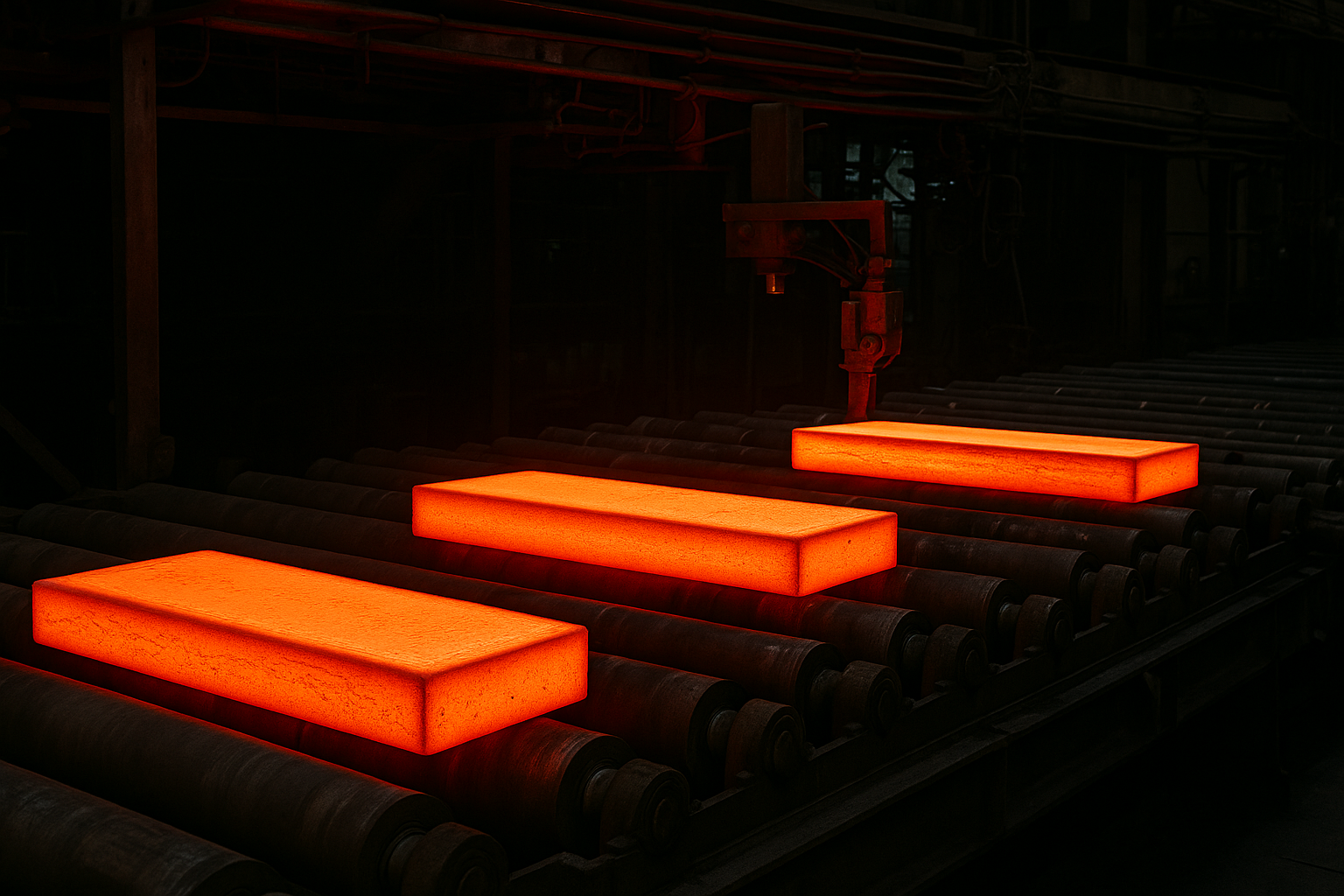
Steel production is a sequence of highly interconnected processes.
A variation introduced during steelmaking may affect continuous casting. A casting deviation may influence rolling behavior. Temperature instability during rolling or heat treatment may change microstructure and mechanical properties. A coating-line disturbance may create a product that meets dimensional requirements but fails corrosion-performance expectations.
For this reason, steel quality cannot be created only by final inspection.
It must be built into the process.
Modern process automation provides steel producers with the ability to measure critical variables continuously, compare actual conditions with defined targets, detect deviations, adjust equipment, record process history, and increasingly connect process behavior with final product performance.
However, there is an important engineering principle behind successful automation:
Automation does not create process knowledge. It executes process knowledge consistently.
If the wrong variable is measured, the wrong target is established, the sensor is unreliable, or the control strategy does not reflect the real metallurgical mechanism, automation may simply reproduce the wrong decision more consistently.
The objective, therefore, is not automation for its own sake.
The objective is to create a controlled production system capable of delivering:
Process Requirement → Critical Variables → Measurement → Automation → Process Control → Variability Reduction → Product Quality → Yield → Cost → Continuous Improvement
This article presents a practical methodology for understanding how automation can improve quality and consistency throughout steel production.
1. Steel Quality Begins With Process Stability
Steel specifications normally establish requirements such as:
- chemical composition;
- yield strength;
- tensile strength;
- elongation;
- hardness;
- toughness;
- thickness;
- width;
- flatness;
- surface quality;
- coating mass;
- dimensional tolerances;
- microstructural characteristics;
- and other application-specific properties.
But these are outputs.
Behind every output is a set of process variables.
For example, the final mechanical properties of a steel product may depend on:
- chemical composition;
- reheating temperature;
- rolling temperature;
- reduction schedule;
- cooling rate;
- coiling temperature;
- heat-treatment cycle;
- and previous thermomechanical history.
Consequently, consistent product quality requires consistent control of the variables that create those properties.
This is where automation becomes a quality-management tool rather than simply an equipment-control technology.
2. Automation Should Begin With Process Knowledge
A common mistake in industrial digitalization projects is to begin with technology:
Which PLC should be installed?
Which sensors should be purchased?
Which software should be implemented?
Which AI platform should be used?
These questions are important, but they should come later.
The first questions should be:
What does the product require?
Which process variables determine those requirements?
Where should they be measured?
How accurately must they be measured?
How quickly must the process respond to deviations?
Which variables can be automatically corrected?
Which deviations require human intervention?
Only after these questions are answered should the automation architecture be defined.
3. The Fundamental Automation Loop
A simplified industrial control loop can be represented as:
Target → Measurement → Comparison → Correction → New Measurement
Suppose a rolling process has a defined thickness target.
The system measures actual strip thickness.
The measured value is compared with the target.
If a deviation is detected, the control system may adjust:
- roll gap;
- rolling force;
- strip tension;
- mill speed;
- or another relevant parameter.
The product is measured again, and the cycle continues.
This is the basic principle of closed-loop control.
The faster and more accurately this loop operates, the greater the potential for reducing process variability.
4. Measurement Is the Foundation of Automation
Automation cannot control what it cannot measure reliably.
This makes instrumentation one of the most important elements of process automation.
Typical measurements in steel production may include:
- temperature;
- pressure;
- flow;
- chemical composition;
- oxygen content;
- steel level;
- speed;
- tension;
- rolling force;
- torque;
- thickness;
- width;
- profile;
- flatness;
- coating mass;
- surface defects;
- vibration;
- electrical current;
- energy consumption.
But having a sensor does not automatically mean having reliable information.
Measurement systems must be evaluated for:
- accuracy;
- repeatability;
- resolution;
- response time;
- calibration;
- environmental resistance;
- measurement location;
- maintenance condition.
A sophisticated control algorithm operating with unreliable measurements can generate poor decisions.
Good automation begins with good measurement.
5. Sensors Must Be Treated as Part of the Quality System
Steel plants are difficult environments for instrumentation.
Sensors may operate near:
- extreme temperatures;
- scale;
- steam;
- dust;
- vibration;
- electromagnetic interference;
- water;
- chemicals;
- mechanical impact.
Sensor degradation can create measurement drift without immediately stopping production.
This creates an important risk: the control system may believe that the process is correct when the measurement itself is wrong.
For critical variables, plants should therefore establish appropriate:
- calibration routines;
- verification frequencies;
- preventive maintenance;
- redundancy;
- plausibility checks;
- alarm strategies;
- measurement-system validation.
The automation system is only as trustworthy as the information entering it.
6. From Manual Control to Automated Process Control
Manual operation depends strongly on human observation, interpretation, experience and reaction time.
Experienced operators can develop remarkable process knowledge.
However, manual control has natural limitations.
People cannot continuously monitor hundreds or thousands of signals simultaneously.
Reaction time varies.
Shift-to-shift behavior may differ.
Fatigue can influence decisions.
Small process drifts may remain unnoticed until they become significant.
Automation reduces these limitations by providing continuous monitoring and standardized responses.
The objective should not be to remove human expertise.
It should be to use automation to make that expertise repeatable, measurable and scalable.
7. PLCs — Reliable Execution of Control Logic
Programmable Logic Controllers, or PLCs, are fundamental components of industrial automation.
They can control:
- motors;
- valves;
- pumps;
- actuators;
- conveyors;
- interlocks;
- sequences;
- safety-related operations;
- machine cycles.
PLCs are especially valuable where fast and deterministic responses are required.
In steel processing lines, they may coordinate equipment movement, line speed, material positioning and numerous operating sequences.
But PLC logic must reflect the actual process requirement.
A perfectly functioning PLC executing an incorrect control strategy still produces an incorrect result.
8. DCS and Supervisory Control
Distributed Control Systems are commonly applied where many interconnected process variables must be controlled continuously.
Supervisory systems such as SCADA provide operators with visibility of:
- current process values;
- historical trends;
- alarms;
- equipment status;
- setpoints;
- deviations;
- production conditions.
This converts thousands of individual measurements into a manageable operational picture.
Good visualization is important.
Operators should be able to distinguish between:
normal variation, developing instability and true abnormal conditions.
Too many alarms can be almost as dangerous as too few.
9. Advanced Process Control — APC
Traditional control systems frequently respond after a deviation has occurred.
Advanced Process Control can incorporate mathematical and process models to anticipate behavior and coordinate multiple variables.
This is especially useful when:
- variables interact strongly;
- process response is delayed;
- operating conditions change continuously;
- multiple objectives must be balanced.
In steel production, APC can support control of complex operations involving temperature, rolling conditions, cooling patterns, furnace behavior and other interacting variables.
The objective is not simply tighter control of one parameter.
It is improved control of the process as a system.
10. Feedback and Feedforward Control
Two concepts are particularly important.
Feedback Control
The system measures the output and corrects deviations after they are detected.
Example:
Measured thickness differs from target thickness → roll gap is adjusted.
Feedforward Control
The system detects an incoming disturbance and adjusts the process before the disturbance affects the output.
Example:
An incoming change in strip thickness or temperature is detected → rolling parameters are adjusted before the material reaches the critical control point.
In many industrial processes, combining feedback and feedforward strategies provides stronger control than either approach alone.
11. Automation in Raw Material Preparation
Quality begins before molten steel exists.
Automated raw-material systems can control:
- weighing;
- batching;
- blending;
- material identification;
- scrap classification;
- alloy additions;
- charging sequences.
Incorrect raw-material input can affect:
- chemistry;
- slag behavior;
- energy consumption;
- melting time;
- yield;
- residual elements.
Automation improves repeatability, but raw-material quality still needs to be understood.
A precisely weighed wrong material remains the wrong material.
12. Automation in BOF and EAF Steelmaking
Steelmaking involves complex interactions between:
- temperature;
- chemistry;
- oxygen;
- carbon;
- slag;
- metallic charge;
- alloy additions;
- energy input;
- process time.
Automated systems can integrate process measurements and models to support decisions concerning:
- oxygen blowing;
- electrical energy;
- carbon injection;
- burner operation;
- alloy additions;
- endpoint control;
- tapping conditions.
The objective is to reach the required steel chemistry and temperature consistently while controlling yield, energy and processing time.
13. Chemical Composition Requires More Than Automated Dosing
Chemical composition is one of the foundations of steel performance.
Automation can improve the precision of:
- alloy additions;
- weighing;
- sampling sequences;
- laboratory data transfer;
- recipe management.
But chemical composition cannot be managed as a simple ingredient list.
Interactions among carbon, manganese, silicon, chromium, nickel, molybdenum, boron, niobium, titanium, vanadium and residual elements may significantly influence steel behavior.
Therefore:
Automation executes the metallurgical strategy. Metallurgical knowledge defines the strategy.
14. Automation in Continuous Casting
Continuous casting is highly sensitive to process stability.
Important variables may include:
- casting speed;
- steel temperature;
- mold level;
- mold oscillation;
- secondary cooling;
- strand support;
- withdrawal conditions.
Poor control can contribute to:
- surface cracks;
- internal cracks;
- segregation;
- shape problems;
- breakout risk;
- internal-quality variation.
Automation allows these variables to be continuously monitored and coordinated.
Dynamic cooling strategies can also adapt operating conditions to steel grade, section dimensions and casting speed.
15. Mold-Level Control Is a Good Example of Automation Value
The mold is one of the most critical areas in continuous casting.
Unstable mold level can affect surface quality and process stability.
An automated control system can continuously measure steel level and adjust flow to maintain the desired operating range.
This illustrates a broader principle:
The greatest automation value often occurs where small process variations create large downstream consequences.
16. Automation in Hot Rolling
Hot rolling combines mechanical deformation with temperature-dependent metallurgical transformations.
Important variables include:
- slab temperature;
- rolling temperature;
- rolling force;
- reduction;
- roll gap;
- mill speed;
- strip tension;
- cooling conditions;
- coiling temperature.
These variables interact.
Changing one variable may influence several product characteristics.
For this reason, hot-mill automation requires both mechanical and metallurgical understanding.
17. Thickness Control Is a Multivariable Problem
Thickness is often treated as though it depends only on roll gap.
In reality, dimensional control may be influenced by:
Rolling Force + Roll Gap + Strip Tension + Temperature + Speed + Material Behavior
which ultimately affects:
Thickness + Profile + Flatness
Automatic Gauge Control systems can continuously use process information to maintain thickness closer to target.
This can improve more than dimensional compliance.
Reducing thickness variation may also create opportunities for better material utilization.
18. Process Capability Can Become an Economic Advantage
Suppose a steel specification permits a certain thickness tolerance.
Supplier A operates with a wide distribution but remains within specification.
Supplier B operates with a much narrower distribution centered close to the desired target.
Both suppliers may technically comply.
But they do not necessarily deliver the same economic value.
A more capable process may reduce:
- excess steel consumption;
- weight variation;
- downstream adjustment;
- scrap;
- customer variability.
This creates an important connection between automation and cost reduction.
Process capability can become a commercial advantage.
19. Average Values Are Not Enough
A process average can look excellent while variability remains excessive.
For this reason, automated process management should consider statistical behavior.
Useful concepts include:
- mean;
- range;
- standard deviation;
- process stability;
- control limits;
- specification limits;
- Cp;
- Cpk.
The objective is not simply:
“Stay within specification.”
A more advanced objective is:
“Maintain a stable, capable and appropriately centered process.”
20. Control Limits and Specification Limits Are Different
This distinction is fundamental.
Specification limits define what the product or customer requires.
Control limits describe the statistical behavior of the process.
They are not interchangeable.
A process can be statistically stable and still produce unacceptable material if it is centered incorrectly.
Conversely, a process may temporarily produce acceptable material while being statistically unstable.
Automation combined with statistical process control helps identify these situations earlier.
21. Automation in Cold Rolling
Cold rolling requires precise control because relatively small deviations can affect:
- final thickness;
- surface quality;
- flatness;
- mechanical behavior;
- downstream forming.
Control systems may integrate:
- rolling force;
- strip tension;
- roll gap;
- speed;
- lubrication;
- shape measurements;
- thickness measurements.
The objective is to produce repeatable strip geometry and stable operating conditions.
22. Flatness and Profile Require Their Own Control Strategy
A strip can meet thickness requirements and still create customer problems because of shape.
Examples include:
- edge wave;
- center buckle;
- crown variation;
- other flatness deviations.
Modern rolling control therefore evaluates more than average thickness.
Roll bending, shifting, cooling and other control mechanisms may be coordinated to manage profile and flatness.
This is important because the customer does not purchase only a chemical composition and nominal thickness.
The customer purchases a material that must work in a manufacturing process.
23. Automation in Heat Treatment
Heat treatment is another area where repeatability is essential.
Relevant variables can include:
- heating rate;
- furnace temperature;
- soaking temperature;
- soaking time;
- atmosphere;
- cooling rate;
- line speed.
These variables can influence:
- microstructure;
- hardness;
- strength;
- ductility;
- toughness;
- dimensional stability;
- surface condition.
A simplified relationship is:
Temperature + Time + Cooling Rate + Atmosphere → Microstructure → Mechanical Properties
This is why temperature control alone is insufficient.
The complete thermal history matters.
24. Furnace Uniformity Matters
An average furnace temperature may appear correct while temperature distribution across the furnace is poor.
Products located in different positions may therefore experience different thermal histories.
Automation should help evaluate:
- zone temperatures;
- spatial uniformity;
- residence time;
- heating curves;
- cooling behavior.
Again, averages can hide variability.
25. Automation in Pickling
Pickling quality depends on several interacting variables, potentially including:
- acid concentration;
- temperature;
- line speed;
- bath condition;
- exposure time;
- rinse performance.
Insufficient pickling may leave scale.
Excessive exposure may negatively affect surface condition and chemical consumption.
Automated control helps maintain the operating window required for the product and process.
26. Automation in Galvanizing and Metallic Coating Lines
Coating performance depends on far more than simply passing steel through a metallic bath.
Relevant variables can include:
- strip preparation;
- strip temperature;
- bath temperature;
- bath chemistry;
- line speed;
- wiping conditions;
- coating measurement;
- cooling.
For coated products, the control system may link:
Process Conditions → Coating Mass/Thickness → Surface Quality → Corrosion Performance
Online coating measurement can provide rapid feedback for process adjustment.
This can reduce both undercoating and unnecessary overcoating.
27. Overprocessing Is Also a Quality and Cost Problem
Manufacturing companies often focus on avoiding insufficient processing.
But excessive processing can also destroy value.
Examples may include:
- excessive alloy additions;
- unnecessary coating mass;
- excessive heat-treatment time;
- excessive grinding;
- excessive material thickness.
Automation can help maintain processes closer to their technically justified target rather than operating with large safety margins.
This is one way quality control and cost reduction can reinforce each other.
28. Surface Inspection Is Becoming Increasingly Automated
High-speed production lines make complete manual surface inspection difficult.
Automated vision systems can identify and classify potential defects using cameras, illumination, image processing and increasingly machine-learning techniques.
Potential defects may include:
- scratches;
- pits;
- scale-related defects;
- coating irregularities;
- marks;
- surface discontinuities.
The objective should not simply be defect detection.
The greater opportunity is to connect detected defects with process history.
29. From Defect Detection to Root-Cause Analysis
Suppose a surface-inspection system repeatedly detects a particular defect.
The most valuable question is not:
How many defects were detected?
It is:
Which process conditions are associated with the defect?
By connecting quality information with historical process data, engineers can investigate relationships involving:
- temperature;
- speed;
- tension;
- rolling force;
- equipment condition;
- cooling;
- raw material;
- shift;
- product grade;
- production sequence.
This converts inspection data into process knowledge.
30. Closed-Loop Quality Control
Traditional quality systems often operate like this:
Produce → Inspect → Detect Defect → Segregate → Investigate
A more advanced approach is:
Measure → Detect Trend → Correct Process → Prevent Defect
This is the essence of closed-loop quality control.
When technically appropriate, inspection results can feed information back into process-control systems.
However, automatic correction should be used carefully.
The relationship between measured defect and corrective action must be technically validated.
31. MES Connects Process Data With Product Identity
Manufacturing Execution Systems can create an important bridge between production automation and quality management.
MES may support:
- production scheduling;
- material identification;
- order tracking;
- process recipes;
- product genealogy;
- quality status;
- deviations;
- rework;
- traceability.
For steel products, traceability may connect the final coil, plate, bar or other product with its production history.
This can become extremely valuable during:
- customer complaints;
- internal investigations;
- audits;
- qualification processes;
- process improvement.
32. Traceability Should Go Beyond the Mill Test Certificate
A Mill Test Certificate is an important quality document.
But modern traceability can go much further.
Depending on the process and product, internal records may link a final product to:
- heat;
- slab;
- billet;
- coil;
- processing route;
- furnace cycle;
- rolling conditions;
- coating line;
- inspection results;
- test results.
This allows engineers to investigate not only what the final result was, but also how the material was produced.
33. Process Historians Create a Technical Memory
Process historians store large volumes of time-series operating data.
When properly structured, this information creates a technical memory of the plant.
Engineers can compare:
- good production versus defective production;
- one campaign versus another;
- one product family versus another;
- pre-maintenance versus post-maintenance behavior;
- one supplier’s raw material versus another.
Historical data can therefore become a powerful continuous-improvement resource.
But data quantity is not the same as knowledge.
Data must be contextualized.
34. Data Without Context Can Mislead
Modern plants can generate enormous amounts of information.
This creates a temptation to assume that more data automatically means better decisions.
It does not.
Data must be connected to:
- product identity;
- process stage;
- time;
- equipment;
- material;
- specification;
- measurement reliability;
- operating conditions.
Without context, correlations may be misinterpreted.
This becomes especially important when machine learning and AI are introduced.
35. Artificial Intelligence Should Not Replace Engineering Fundamentals
AI and machine learning can identify complex patterns in industrial data.
Potential applications include:
- defect prediction;
- quality classification;
- predictive maintenance;
- process optimization;
- anomaly detection;
- energy optimization.
But an algorithm can identify correlation without proving physical causation.
Therefore, AI results should be evaluated together with:
- metallurgy;
- mechanics;
- thermodynamics;
- process engineering;
- equipment knowledge;
- statistical analysis.
The best digital system combines computational capability with engineering understanding.
36. Automation Does Not Eliminate the Need for Experienced Operators
Experienced operators frequently possess knowledge that is difficult to capture completely in procedures.
They may recognize:
- unusual sound;
- vibration;
- visual behavior;
- process interactions;
- abnormal sequences;
- subtle operational patterns.
Automation should capture and amplify this knowledge where possible.
The operator’s role evolves from repetitive manual adjustment toward:
- process supervision;
- exception management;
- interpretation;
- diagnosis;
- improvement.
This can make human expertise more valuable, not less.
37. The Human-Machine Interface Matters
Poorly designed automation can create new problems.
If operators cannot understand:
- what the system is doing;
- why a setpoint changed;
- what an alarm means;
- which action is required;
the system may reduce rather than improve operational reliability.
Human-machine interfaces should therefore prioritize:
- clarity;
- hierarchy;
- meaningful alarms;
- trend visualization;
- process context.
Automation must be understandable to the people responsible for the process.
38. Alarm Management Is Part of Process Control
An excessive number of alarms can create alarm fatigue.
When everything becomes urgent, nothing is clearly urgent.
Alarm strategies should distinguish among:
- informational events;
- process warnings;
- quality risks;
- equipment risks;
- safety-critical conditions.
Operators need actionable information, not simply more information.
39. Automation Can Reduce Shift-to-Shift Variability
One important industrial benefit of automation is the reduction of dependence on individual operating styles.
Without standardized control, one shift may operate differently from another.
This can create:
- product variation;
- energy variation;
- different scrap levels;
- inconsistent equipment behavior.
Automation helps establish common operating logic.
However, deviations among shifts should still be studied because they may reveal valuable operational knowledge.
40. Automation and First-Pass Yield
A useful performance indicator is first-pass yield.
It measures how much production meets requirements without requiring:
- rework;
- reprocessing;
- downgrade;
- repair;
- additional inspection.
Improved process stability can increase first-pass yield by reducing defect generation rather than merely detecting defects more efficiently.
This is economically important because poor quality consumes:
- steel;
- energy;
- labor;
- equipment capacity;
- inspection resources;
- working capital.
41. Scrap Reduction Is Only Part of the Economic Benefit
Automation projects are often justified using scrap reduction.
But the economic effect may be much broader.
Potential benefits include:
- reduced rework;
- lower downgrade;
- improved yield;
- reduced alloy consumption;
- lower energy consumption;
- reduced coating overuse;
- improved productivity;
- fewer customer complaints;
- more consistent delivery;
- reduced process interruptions;
- better material utilization.
The business case should therefore evaluate total process economics, not a single KPI.
42. Quality Variability Has a Hidden Cost
A product can remain technically within specification and still create economic loss.
Consider thickness.
If the process consistently operates above the necessary target while remaining within specification, the company may be delivering unnecessary steel in every product.
The same concept can apply to:
- coating mass;
- alloy additions;
- dimensional allowances;
- processing time.
Therefore, one of automation’s greatest economic opportunities is:
reducing unnecessary variability and overprocessing while maintaining full technical compliance.
43. Automation Should Be Connected to Customer Performance
The final objective is not a perfect control chart.
It is a product that performs correctly for the customer.
For example, a steel sheet may need to perform successfully in:
- stamping;
- roll forming;
- welding;
- painting;
- bending;
- machining;
- structural loading;
- corrosion exposure.
Automation projects should therefore connect internal process variables with external product performance whenever possible.
44. Stage 1 — Define the Product Requirement
Before automating a process, define:
- what the product must do;
- which specifications apply;
- which characteristics are critical;
- which customer requirements exceed standard requirements.
This creates the technical objective.
45. Stage 2 — Identify Critical-to-Quality Variables
Determine which process variables have the strongest influence on the required product characteristics.
These are often called Critical-to-Quality, or CTQ, variables.
Not every available signal deserves the same attention.
Prioritize variables with real technical impact.
46. Stage 3 — Validate the Measurement System
Before using data for automatic control, confirm that the measurement system is suitable.
Evaluate:
- accuracy;
- repeatability;
- calibration;
- resolution;
- response time;
- environmental effects.
Never build advanced control on questionable measurements.
47. Stage 4 — Establish the Current Baseline
Measure current performance before changing the process.
Possible baseline indicators include:
- defect rate;
- scrap;
- rework;
- first-pass yield;
- standard deviation;
- Cp/Cpk where applicable;
- downtime;
- energy consumption;
- customer complaints;
- material overconsumption.
Without a baseline, improvement cannot be demonstrated objectively.
48. Stage 5 — Stabilize Before Optimizing
A highly unstable process should not immediately be subjected to aggressive optimization.
First identify:
- special causes;
- equipment problems;
- measurement problems;
- inconsistent operating practices;
- raw-material variation.
A useful principle is:
First stabilize. Then optimize. Then automate further.
49. Stage 6 — Define the Control Strategy
Determine:
- which variables are controlled;
- which are monitored only;
- appropriate setpoints;
- control limits;
- response logic;
- alarm conditions;
- operator authority;
- fail-safe conditions.
The control strategy should be documented and technically justified.
50. Stage 7 — Pilot the Automation
Whenever practical, implement new control strategies in a controlled environment.
Compare:
Before Automation vs. After Automation
using the same KPIs.
This prevents decisions based only on perception.
51. Stage 8 — Validate Product Quality
A process improvement is not approved merely because the control system performed as designed.
The finished product must still be validated.
Depending on the application, validation may include:
- dimensional testing;
- mechanical testing;
- metallography;
- surface inspection;
- corrosion testing;
- forming trials;
- welding trials;
- customer-specific testing.
The product validates the process.
52. Stage 9 — Measure the Financial Result
Translate technical improvement into economic impact.
For example:
Annual Benefit = Scrap Reduction + Rework Reduction + Material Savings + Productivity Gain + Energy Savings + Quality-Cost Reduction − Automation Operating Cost
Capital investment and implementation cost should also be considered in ROI analysis.
This transforms automation from a technology project into a business project.
53. Stage 10 — Standardize and Expand
Once validated:
- document the new process;
- update operating procedures;
- train personnel;
- establish calibration routines;
- define maintenance requirements;
- monitor KPIs;
- evaluate expansion to similar processes.
Successful automation should become part of the production system, not remain an isolated project.
54. Build an Automation Opportunity Matrix
Not every process should be automated first.
A practical prioritization matrix can evaluate:
| Criterion | Low Priority | High Priority |
|---|---|---|
| Quality variability | Low | High |
| Scrap/rework | Low | High |
| Manual intervention | Limited | Frequent |
| Economic impact | Small | Large |
| Measurement availability | Poor | Good |
| Process knowledge | Limited | Strong |
| Technical feasibility | Difficult | Favorable |
| Customer impact | Low | High |
Processes with high economic impact, measurable variables and established process knowledge are often strong candidates.
55. Do Not Automate an Unstable Process Blindly
Automation cannot compensate for every fundamental process problem.
Examples include:
- worn equipment;
- excessive mechanical clearance;
- unreliable raw material;
- poor maintenance;
- inadequate measurement;
- incorrect specifications.
Automating around these problems may hide the root cause temporarily.
Sometimes the correct first investment is maintenance, engineering or process redesign — not additional software.
56. Legacy Equipment Can Still Be Improved
Automation is not limited to new steel plants.
Existing equipment may often be modernized through:
- new sensors;
- data acquisition;
- updated PLCs;
- drives;
- process historians;
- supervisory systems;
- online measurement;
- targeted closed-loop control.
A phased retrofit strategy may provide significant benefits without replacing the complete production line.
57. Cybersecurity Becomes an Industrial Requirement
As production systems become increasingly connected, cybersecurity becomes part of operational reliability.
Automation architecture should consider appropriate protection of:
- control systems;
- industrial networks;
- remote access;
- production data;
- recipes;
- traceability information.
A quality system dependent on digital infrastructure must also protect that infrastructure.
58. Engineering, Operations, Quality and Maintenance Must Work Together
Automation should not be owned by one department alone.
Process Engineering
Defines process relationships and operating windows.
Metallurgy
Connects process conditions with microstructure and material properties.
Automation Engineering
Implements measurement and control logic.
Operations
Provides practical knowledge of real process behavior.
Quality
Defines product requirements and validates results.
Maintenance
Ensures equipment and instrumentation remain reliable.
IT/OT
Supports system integration, infrastructure and cybersecurity.
Management
Connects technical improvement with strategic and financial objectives.
The strongest automation projects are multidisciplinary.
59. Build a Process Automation Dashboard
A useful dashboard may include:
- process mean;
- standard deviation;
- Cp/Cpk where applicable;
- first-pass yield;
- scrap rate;
- rework rate;
- downgrade rate;
- alarm frequency;
- sensor availability;
- downtime;
- energy per tonne;
- material yield;
- customer complaints.
The purpose is not to create more charts.
The purpose is to connect process stability with product quality and economic performance.
60. From Automation to Continuous Improvement
Automation should not freeze a process permanently.
As production data accumulates, the organization can learn.
New questions become possible:
Why does one steel grade produce greater variability than another?
Why does defect frequency increase at certain speeds?
Which operating conditions produce the best combination of quality and productivity?
Can the target be moved closer to the technical optimum?
Can variability be reduced enough to decrease unnecessary material consumption?
This is where automation becomes more than control.
It becomes a platform for continuous industrial learning.
61. Frequently Asked Questions
Can automation eliminate steel defects?
No.
Automation can substantially improve process control, repeatability, detection and response, but defects may also result from raw-material variation, equipment condition, metallurgical phenomena, measurement limitations and other factors.
The realistic objective is defect prevention and variability reduction, not the assumption of zero defects simply because a process is automated.
Is automation useful only in new steel plants?
No.
Many existing plants can be modernized progressively using sensors, control-system upgrades, online measurement, process historians and targeted automation.
Does more automation automatically mean better quality?
No.
Automation creates value only when the measurements, process models, control strategies and technical targets are correct.
What is more important: automation or process knowledge?
They complement each other.
Process knowledge determines what should be controlled. Automation provides the speed, repeatability and consistency to execute that control.
Why are Cp and Cpk relevant to automation?
Because automation should reduce process variation and improve centering where appropriate.
Cp and Cpk can help evaluate process capability, although they should only be interpreted when the underlying statistical assumptions and process conditions are appropriate.
Can automation reduce steel consumption?
Indirectly, yes.
Better control of thickness, coating mass, alloy additions, scrap, yield and other variables can reduce unnecessary material consumption while maintaining technical requirements.
Can AI replace traditional process control?
Not generally.
AI can complement conventional automation by identifying patterns, predicting events and supporting optimization. Fundamental control, process knowledge and engineering validation remain essential.
Does automation reduce the importance of operators?
No.
It changes their role.
Operators increasingly supervise systems, interpret abnormal conditions, diagnose problems and contribute process knowledge instead of performing repetitive adjustments manually.
What should a steel plant automate first?
Processes with high variability, significant economic or quality impact, reliable measurement possibilities and sufficiently understood process relationships are usually strong candidates.
What is the best KPI for an automation project?
There is no universal single KPI.
A strong evaluation normally combines process capability, first-pass yield, quality losses, productivity and total economic benefit.
Conclusion: Automation Should Convert Process Knowledge Into Repeatable Performance
The greatest value of automation in steel production is not simply faster equipment or fewer manual adjustments.
It is the ability to convert engineering and metallurgical knowledge into repeatable industrial performance.
A mature automation strategy connects:
Product Requirement → Process Knowledge → Measurement → Control → Stability → Capability → Quality → Yield → Cost → Learning
This changes the role of quality itself.
Instead of relying primarily on inspection to identify defective steel after production, the organization progressively builds quality into the production process.
And as process variability decreases, additional opportunities appear: tighter control, higher yield, lower scrap, lower rework, better material utilization, more reliable customer performance and potentially lower total cost.
The fundamental principle is therefore simple:
Do not automate because the technology exists. Automate when you understand the process well enough to know what must be controlled — and why.
In steel production, the strongest automation system is not necessarily the one with the most sensors, software or algorithms.
It is the one that consistently transforms process knowledge into product quality.