
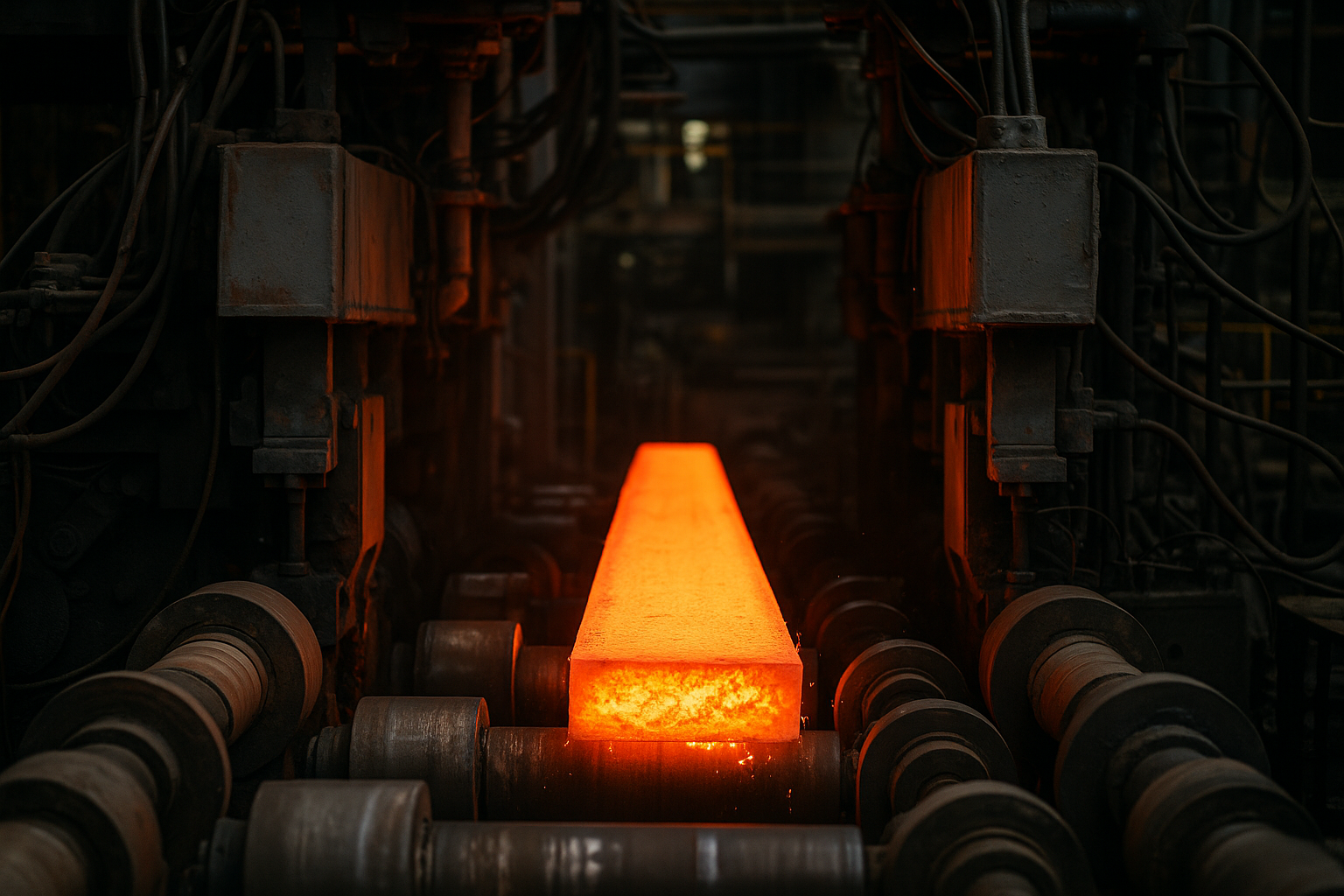
How Artificial Intelligence Is Optimizing Steel Plant Operations
Artificial Intelligence is moving from experimental projects to practical industrial applications across the steel value chain.
Modern steel plants generate enormous volumes of data from sensors, automation systems, laboratory equipment, quality-control systems, maintenance records, production planning platforms, and enterprise systems. Artificial Intelligence can transform this data into predictions, recommendations, and operational decisions.
The objective is not simply to automate existing tasks.
The greater opportunity is to use AI to improve process stability, equipment reliability, product quality, energy efficiency, yield, safety, and production planning.
For steel producers, this is particularly important because relatively small improvements in yield, energy consumption, equipment availability, or quality can have significant financial effects when multiplied across large production volumes.
However, AI does not automatically improve a steel plant. Successful implementation requires reliable data, metallurgical and process knowledge, appropriate sensors, integration with existing automation systems, cybersecurity, governance, and experienced personnel capable of validating AI recommendations.
This article examines where AI can create value in steel manufacturing, the technologies involved, the risks that must be controlled, and a practical approach for implementing AI in an industrial environment.
1. Why Steel Manufacturing Is Particularly Suitable for AI
Steel production combines several characteristics that create opportunities for advanced analytics and Artificial Intelligence:
- Continuous and high-volume production
- Large numbers of process variables
- Extensive sensor networks
- High energy consumption
- Expensive production equipment
- Strict dimensional and metallurgical requirements
- Complex interactions between process stages
- High cost of unplanned downtime
- Significant consequences from quality deviations
- Large historical production databases
Traditional automation systems remain essential for controlling steelmaking processes.
AI should therefore not be viewed as a replacement for PLCs, SCADA systems, Level 2 automation, MES platforms, process models, or experienced operators.
Instead, AI can operate as an additional intelligence layer.
Traditional control systems generally execute predefined logic and control strategies. AI and advanced analytics can identify complex relationships in historical and real-time data, estimate future conditions, detect abnormal behavior, and support predictive or prescriptive decisions.
The combination of industrial automation + process knowledge + data analytics + AI is what creates the greatest potential value.
2. Machine Learning in Steel Manufacturing
Machine Learning uses historical and real-time data to identify relationships between process variables and desired outcomes.
Potential applications include:
- Equipment failure prediction
- Product-quality prediction
- Energy-consumption forecasting
- Yield optimization
- Process anomaly detection
- Production scheduling
- Demand forecasting
- Maintenance planning
- Raw-material optimization
Consider a rolling mill, for example.
Thousands of historical coils may contain information about:
- Steel grade
- Entry temperature
- Rolling force
- Rolling speed
- Strip tension
- Roll condition
- Cooling parameters
- Final thickness
- Flatness
- Surface quality
Machine-learning models can analyze these relationships and help identify combinations of process parameters associated with quality deviations.
The model can then support operators by identifying abnormal conditions before the final product is completed.
3. Computer Vision and Automated Quality Inspection
Computer vision is one of the most practical AI applications in steel manufacturing.
High-resolution cameras combined with AI models can inspect steel surfaces continuously at production-line speeds.
Potential defects include:
- Scratches
- Scale defects
- Pitting
- Surface cracks
- Laminations
- Inclusion-related indications
- Coating defects
- Edge defects
- Marks and surface irregularities
Traditional automated inspection systems already provide important capabilities, but AI-based image classification can improve the ability to distinguish different defect patterns and support more consistent classification.
The objective is not simply to identify whether a defect exists.
A more advanced system can determine:
What type of defect is it?
Where is it located?
How severe is it?
What production conditions may have contributed to it?
Can the product still meet a different customer specification?
This creates an important connection between quality inspection and production optimization.
Instead of discovering a quality problem only after laboratory inspection or customer complaint, manufacturers can increasingly identify deviations during production.
4. Predictive and Prescriptive Maintenance
Steel plants contain critical equipment operating under severe conditions involving heat, vibration, dust, high loads, and continuous operation.
Unexpected equipment failures can create substantial production losses.
Traditional maintenance strategies generally include:
- Corrective maintenance
- Preventive maintenance
- Condition-based maintenance
AI adds another possibility:
predictive maintenance.
Models can analyze variables such as:
- Vibration
- Bearing temperature
- Motor current
- Lubrication conditions
- Pressure
- Acoustic signals
- Electrical load
- Historical failures
The objective is to identify patterns that precede equipment degradation.
Instead of simply asking:
Has the equipment exceeded an alarm limit?
predictive systems attempt to answer:
Is the behavior of this equipment changing in a way that suggests a future failure?
More advanced prescriptive systems can go further by helping determine:
- When maintenance should be performed
- Which component should be inspected
- Whether production can safely continue
- Which operating conditions may accelerate deterioration
This can improve equipment availability while avoiding unnecessary maintenance interventions.
5. Artificial Intelligence in Blast Furnace Operations
Blast furnaces are highly complex processes involving interactions between raw materials, gases, temperature, pressure, chemical reactions, and furnace conditions.
AI and advanced analytics can support operators by analyzing variables such as:
- Burden composition
- Coke rate
- Pulverized coal injection
- Hot blast conditions
- Furnace pressure
- Gas composition
- Temperature distribution
- Hot-metal chemistry
Potential objectives include:
- Stabilizing furnace operation
- Improving fuel efficiency
- Predicting abnormal conditions
- Supporting burden optimization
- Improving process consistency
However, blast furnace optimization illustrates an important principle:
AI recommendations must remain constrained by metallurgical and operational knowledge.
A statistically attractive recommendation is not necessarily physically or operationally acceptable.
Therefore, AI systems should incorporate engineering constraints and appropriate human validation.
6. AI in Electric Arc Furnace Operations
Electric Arc Furnaces operate with different economic and process drivers from integrated blast-furnace steelmaking.
AI applications can support:
- Scrap mix optimization
- Electrical energy management
- Oxygen injection
- Carbon injection
- Tap-temperature prediction
- Process-time estimation
- Electrode consumption analysis
- Slag-condition monitoring
One particularly interesting application is scrap optimization.
Different scrap categories have different:
- Prices
- Chemical compositions
- Densities
- Residual-element levels
- Melting characteristics
An optimization model can help determine a lower-cost charge mix while respecting metallurgical and operational constraints.
This combines AI with mathematical optimization and process engineering.
7. Continuous Casting
Continuous casting is another process where early prediction can generate substantial value.
Variables affecting slab, bloom, or billet quality may include:
- Casting speed
- Mold level
- Superheat
- Cooling conditions
- Mold behavior
- Steel chemistry
- Oscillation parameters
AI models can support:
- Breakout prediction
- Defect prediction
- Casting-speed optimization
- Quality classification
- Process anomaly detection
An important benefit is the ability to identify quality risk before downstream processing.
If a slab has a high predicted probability of a particular defect, the plant may be able to:
- Inspect it more carefully
- Change its downstream route
- Assign it to a less demanding application
- Prevent unnecessary additional processing
This converts quality prediction into an economic decision.
8. Hot and Cold Rolling Mills
Rolling operations contain many interacting variables.
AI can support optimization of:
- Rolling force
- Strip tension
- Speed
- Temperature
- Cooling
- Pass schedules
- Thickness control
- Flatness
- Roll wear
The objective is generally not to replace existing automatic gauge-control or process-control systems.
Instead, AI can complement them by identifying patterns that traditional models may not capture.
For example, historical production data may reveal combinations of:
steel grade + dimensions + roll condition + temperature + speed
that increase the probability of dimensional or surface-quality problems.
This information can be used to adjust production strategy before defects occur.
9. Energy Optimization
Steelmaking is energy intensive.
Energy is consumed by:
- Furnaces
- Electric Arc Furnaces
- Rolling mills
- Compressors
- Pumps
- Fans
- Motors
- Reheating systems
- Auxiliary equipment
AI can help identify opportunities to reduce energy consumption without compromising production requirements.
Applications include:
- Energy-demand forecasting
- Furnace optimization
- Peak-demand management
- Equipment scheduling
- Identification of abnormal energy consumption
- Energy-performance benchmarking
An important metric is not simply total energy consumption.
Plants should evaluate energy consumption relative to production conditions, product mix, steel grade, equipment condition, and throughput.
AI can help normalize these variables and identify whether energy performance is actually deteriorating.
10. Yield, Scrap and Rework Reduction
Yield improvement can generate substantial financial value in steel manufacturing.
Material can be lost through:
- Trimming
- Crop losses
- Downgrading
- Surface defects
- Dimensional deviations
- Process instability
- Internal rejection
- Customer rejection
AI can analyze production history to identify which combinations of process variables increase the probability of these losses.
The objective is to move from:
detecting defects
to:
predicting defects
and eventually to:
preventing defects.
This distinction is fundamental.
Quality inspection tells the plant what went wrong.
Predictive quality systems attempt to identify when the process is moving toward a condition likely to produce a defect.
11. Production Planning and Scheduling
Steel production scheduling is highly complex.
A production planner may need to consider:
- Steel grades
- Product dimensions
- Furnace sequences
- Casting constraints
- Rolling campaigns
- Customer priorities
- Equipment availability
- Delivery dates
- Energy constraints
- Inventory levels
AI combined with optimization algorithms can help evaluate many possible production sequences.
The objective can include:
- Reducing changeovers
- Increasing throughput
- Reducing waiting time
- Improving delivery performance
- Minimizing intermediate inventory
- Reducing energy consumption
Human planners remain essential because unusual operational situations and commercial priorities may not be fully represented in historical data.
12. Internal Logistics and Material Tracking
Steel plants move enormous quantities of raw materials, slabs, billets, coils, plates, and finished products.
AI and digital systems can improve:
- Crane scheduling
- Coil-yard management
- Warehouse allocation
- Material routing
- Truck scheduling
- Loading operations
When combined with identification and tracking technologies, these systems can help determine:
what material is available, where it is located, where it needs to go, and when it needs to arrive.
Better material visibility can reduce unnecessary movement and production delays.
13. AI for Safety
Artificial Intelligence can also support industrial safety.
Computer-vision systems can potentially identify:
- Personnel entering restricted areas
- Unsafe proximity between people and equipment
- Missing personal protective equipment
- Abnormal thermal conditions
- Operational deviations
AI should be considered an additional safety layer rather than a replacement for engineered safeguards, procedures, training, interlocks, and human supervision.
False positives and false negatives must be carefully evaluated before safety-related AI systems are relied upon operationally.
14. Generative and Agentic AI in Steel Operations
A newer development is the use of generative and agentic AI.
Unlike traditional predictive models focused on a particular variable, these systems can interact with multiple information sources and assist personnel with knowledge-intensive tasks.
Potential applications include:
- Searching maintenance documentation
- Analyzing historical maintenance records
- Summarizing shift reports
- Supporting troubleshooting
- Retrieving operating procedures
- Analyzing quality complaints
- Supporting engineering investigations
- Generating preliminary maintenance recommendations
This can reduce the time required to locate and interpret information distributed across different systems.
However, industrial use requires strict governance.
AI-generated recommendations should not automatically modify safety-critical process parameters without appropriate validation and control.
15. A Current Industrial Example: Tata Steel
Large steel producers are already deploying AI at significant scale.
Tata Steel has publicly reported hundreds of AI models deployed across its value chain, including applications involving process control, predictive and prescriptive maintenance, procurement analytics, integrated operational management, quality, yield, energy, productivity, and safety.
More recently, the company has also expanded the use of specialized AI agents across its operations.
This evolution illustrates an important change in industrial AI.
Steel companies are moving from isolated pilot projects toward integrated AI ecosystems connected to manufacturing, maintenance, safety, commercial, and enterprise processes.
The competitive question is therefore changing from:
“Should a steel company use AI?”
to:
“Where can AI create measurable operational value, and how can it be scaled safely?”
16. The Importance of Data Quality
AI performance depends heavily on data quality.
Common industrial data problems include:
- Missing sensor readings
- Incorrect timestamps
- Inconsistent equipment identification
- Different units of measurement
- Changes in sensor calibration
- Unrecorded process changes
- Incomplete maintenance history
- Poor defect classification
A sophisticated AI model trained on unreliable data can produce unreliable conclusions.
Before implementing AI, plants should therefore evaluate:
data availability + data accuracy + data consistency + process context + traceability.
In many projects, improving the data infrastructure creates as much value as the AI model itself.
17. Integration with Existing Industrial Systems
AI does not operate in isolation.
Industrial implementations may require integration with:
- PLC
- SCADA
- Distributed Control Systems
- Level 2 automation
- MES
- ERP
- Laboratory systems
- Quality-management systems
- Computerized Maintenance Management Systems
- Historian databases
The architecture must define clearly whether AI recommendations are:
- Informational
- Advisory
- Operator-approved
- Automatically executed
The higher the operational or safety consequence of a decision, the stronger the validation and governance requirements should be.
18. Cybersecurity and AI Governance
Connecting additional data systems and AI platforms can increase the digital attack surface of an industrial operation.
Steel companies should therefore consider:
- Network segmentation
- Access control
- Authentication
- Model governance
- Data protection
- Change management
- Audit trails
- Backup and recovery
- Validation procedures
Another concern is model drift.
A model trained using historical production data may become less accurate after changes involving:
- Equipment
- Raw materials
- Product mix
- Operating practices
- Sensors
- Process parameters
AI systems therefore require continuous performance monitoring and periodic validation.
19. Human Expertise Remains Essential
AI does not eliminate the need for metallurgists, engineers, maintenance specialists, operators, quality professionals, and production planners.
In fact, successful industrial AI depends heavily on their knowledge.
Data scientists may identify a statistical relationship, but experienced process specialists must determine whether that relationship makes physical and metallurgical sense.
The most effective model is therefore:
AI + engineering knowledge + operator experience.
Not:
AI versus people.
This also makes workforce development essential.
Personnel need to understand:
- What the model predicts
- What data it uses
- Its limitations
- When recommendations can be trusted
- When human intervention is required
20. How to Implement AI in a Steel Plant
A practical implementation roadmap can follow seven stages.
Step 1 — Identify a measurable problem
Start with a real operational problem rather than with the technology.
Examples:
- Excessive downtime
- High energy consumption
- Surface defects
- Low yield
- Excessive maintenance cost
Step 2 — Establish the baseline
Measure current performance.
Without a baseline, it is impossible to demonstrate improvement.
Step 3 — Evaluate data readiness
Determine whether sufficient reliable historical and real-time data exist.
Step 4 — Develop a pilot
Choose a limited application where results can be measured objectively.
Step 5 — Validate technically
Process engineers and operational personnel should validate whether model recommendations are technically reasonable.
Step 6 — Measure financial results
Evaluate indicators such as:
- Downtime reduction
- Yield improvement
- Energy reduction
- Scrap reduction
- Maintenance savings
- Throughput improvement
Step 7 — Scale only after validation
Successful pilots can then be expanded to additional equipment, lines, or plants.
21. How to Calculate the Business Case
An AI project should ultimately demonstrate measurable operational or financial value.
A simplified evaluation can consider:
Annual Benefit = Downtime Savings + Yield Gains + Energy Savings + Quality Savings + Maintenance Savings + Productivity Gains
This should then be compared with:
Total AI Cost = Sensors + Infrastructure + Software + Integration + Development + Training + Maintenance
The business case should also consider implementation risk and the probability that expected improvements will actually be achieved.
This prevents AI initiatives from becoming technology projects without clear industrial value.
Frequently Asked Questions
Is AI replacing steel plant operators and engineers?
Generally, the greatest value comes from augmenting human decision-making rather than simply replacing personnel. Operators and engineers provide process knowledge, validation, and judgment that AI systems do not inherently possess.
Can AI control a steel plant autonomously?
Certain process decisions can be highly automated, but complete autonomous operation is considerably more complex. Safety-critical and metallurgically sensitive processes require appropriate engineering safeguards, validation, and human oversight.
Which AI application should a steel plant implement first?
There is no universal answer. Plants should prioritize applications with a clearly measurable problem, adequate data, manageable implementation complexity, and meaningful financial impact.
Predictive maintenance, quality prediction, energy optimization, and process anomaly detection are common candidates.
Does a plant need large amounts of data?
Many AI applications benefit from substantial historical data, but quantity alone is insufficient. Data quality, consistency, labeling, and process context are equally important.
What is the greatest risk in industrial AI?
One of the greatest risks is trusting a statistically accurate model without adequately understanding its operational limitations.
AI recommendations must be validated against engineering knowledge, process constraints, safety requirements, and changing production conditions.
Conclusion: From Steel Production Data to Operational Intelligence
Artificial Intelligence is becoming an important component of modern steel manufacturing.
Its value extends far beyond automation.
AI can help steelmakers transform enormous volumes of production data into operational intelligence that supports:
- Predictive maintenance
- Process optimization
- Quality improvement
- Yield improvement
- Energy efficiency
- Production planning
- Logistics
- Safety
- Cost reduction
However, technology alone does not create these benefits.
Successful industrial AI requires the integration of reliable data, process knowledge, engineering validation, industrial automation, cybersecurity, workforce capability, and measurable business objectives.
The steel plants that create the greatest value from AI are unlikely to be those that simply deploy the largest number of algorithms.
They will be those that identify the right industrial problems, apply AI where it creates measurable value, and integrate digital intelligence with metallurgical knowledge and operational experience.
That is the transition from data collection to intelligent steel manufacturing.